Yantras


Yantras are diagrams that are composed of geometrical patterns that are used to visualize mantras and are claimed to be encapsulations of a deity or power in tantric ritual (Sastri 628, Khanna 11, 21). Practitioners of yantra believe the diagrams create a religious energy field in which the sacred powers can be invoked  (Khanna 30). They are typically drawn on paper, metal, or rock surfaces. Three-dimensional yantras also exist; they can be as small as an object that fits in your hand or may be as large as a building. Because of the complexity of composition, any rearrangement of the shapes or mantras used in the yantra creates a completely new yantra (Khanna 22-23, Buhnemann 30).

The word yantra stems from the word ‘yam,’ meaning to hold or control the energy of an object or element, which is often used in the building of something. The term has been extended into religious tradition as tools of ritual and meditation (Khanna 11, Buhnemann 28). Mantras and yantras are used together as tools in tantric ritual to achieve liberation (Khanna 37).

Today, yantra use is found in tantric practices but according to Khanna in Yantra: The Tantric Symbol of Cosmic Unity, yantra origin can be traced back to the Harappan culture about c. 3000 BCE. Seals have been found at Harappan sites that have yantra-like symbols engraved onto them. A thousand years later (c. 2000 BCE), Vedic altars have been found with yantra-like diagrams constructed on them. The yantra ritual wasn’t brought back into practice until tantric practices became popular around 700-1200 CE. The use of yantras is widespread throughout Hinduism but the tantric ritual power of a yantra is a guarded secret that is only orally passed down from guru to student (Khanna 10-11).

Tantra followers believe the symbols composing a yantra diagram hold little meaning by themselves, as the yantra must be understood in its entirety. Through ritual and meditation the cosmos, deity, and mantra are all inseparably joined to one in yantra (Khanna 21-22). Fusion of three principles: form, function, and power, is thought to compose a yantra. The shapes that often compose a yantra (triangle, square, circle, etc.) are the most basic forms that the universe deduced to. To understand the composition of the universe it is believed one must use a yantra to map together the basic shapes of the universe. The function principle is the process of interpreting the symbols as cosmic truths that metaphysically guide one to a spiritual realm of existence. Each symbol or shape in the yantra is used to achieve a psychological state needed to reach liberation. Our psychological states are a function of the symbols in yantras. The power principle is the true meaning of the yantra and can only be achieved by transcending form and function. It is the power principle, that tantric Hindus believe to be contained in a yantra, only emerges when it is no longer perceived as shapes and symbols (Khanna 11-12). Only transmitting the true meaning orally from guru to student it is protected from misuse.

A mantra must be said to understand the inner nature of a yantra. Mantras are believed to be the metaphysical forms of deities or cosmic power in the tantra tradition. It is thought that the vibrations of sound paired with the physical yantra that unites space, and the written and spoken word embodies this meaning. Script on paper has only limited meaning as does the vibration of sound but when you pair the two they contain a conceptual meaning that separately they don’t have  (Khanna 34-37, Buhnemann 40). The Om mantra is regarded as a yantra of its own. When Om is said it begins with silence then manifests sound vibrations and ends with silence. Yantra practice starts with empty physical space then a physical form manifests and ends in transcendence past the physical to a true meaning. Om is thought to embody the perfect vibration and is associated with the center (bindu) of a yantra (Khanna 37).

When multiple deities are believed to be encapsulated in a yantra the deity associated with the bindu is thought to be the most important (Buhnemann 40). The bindu is often depicted as an infinite point (a dot) symbolizing the pure energy of creation and existence. The bindu is where atman (true self) and Brahman (reality) is found. A triangle is the primary sign that encloses space because no fewer lines can create a bounded area. An Inverted triangle represents the yoni or the sakti female principle. A triangle with an apex pointing upward represents the linga. A circle often represents the cyclic nature of life: creation, preservation, and destruction. The bindu is the innermost regression of the cycle and also the source of expansion. The square is the depiction of the manifest world that must be transcended to reach to true meaning of the yantra and life. (Khanna 32-33, Buhnemann 41, Sastri 628)

The bindu is sometimes called the seed of fertility when it is inside an inverted triangle and an inverted triangle represents the womb (yoni) in yantras that depict the union of male and female as it is in the Sri Yantra (Khanna 67,72). In tantra, Siva the ultimate male principle (purusa) is the principle of consciousness and Sakti the ultimate female principle (prakrti) is the opposite and is the principle of energy and action. Siva oversees action while Sakti is the matter and nature. They are inseparable as the union allows each to fully manifest (Sastri 630-631, Khanna 67).

Hindus revere the Sri Yantra as the greatest of all yantras (Khanna 70, Bunce 44). The most common interpretation of the Sri Yantra is of nine interconnected triangles, four represent Siva with the apex facing upward, five inverted triangles represent Sakti and there is a dot in the center (Sastri 632). From the center bindu to the outer square there are nine containments representing the three phases of the cosmos and time: creation, preservation, and dissolution. The outermost phase (square field, 16 pedal lotus, and 8 pedal lotus) represents creation. The middle phase (14 outer triangles, 10 triangles inside the 14, and another ten triangles inside the previous ten) represents preservation. The innermost phase (the bindu, the inner-most triangle, and the 8 triangles that surround it) represents destruction of the world. Within each phase includes a dynamic cycle of creation, preservation, and destruction/dissolution but the cosmic cycle is only complete with the assimilation of all three phases. (Sastri 632, Khanna 78, Bunce 44-50)

The Sri Yantra is also represented as a mythical mountain or pyramid. At the apex of the pyramid is the union of Siva and Sakti. As the pyramid unfolds purity decreases as differentiation occurs and more cosmic categories are created. When the base reaches its maximum size the process must reverse and the pyramid must regress back to the pure unity at the apex. (Sastri 628, Khanna 79)

This cycle is symbolically the same as the cycle of life. In tantric philosophy it is believed that before coming into existence we are pure consciousness, Atman. Unfortunately one mistakes the physical existence for reality and thinks it is Atman. This illusion of maya causes one to not see the inner wholeness.  Through ritual and meditation maya can be overcome and Atman can be re-attained (Khanna 79-80). Like the journey from the base of the pyramid to the apex, Sri Yantra acts as a 9 – step map for the return to enlightenment. Each of the nine stages corresponds with one of the nine containments in the Sri Yantra. Starting from the outer square, one must work inwards conquering obstacles, each one harder than the next. The last stage arriving at the bindu is liberation and attainment of Atman (Khanna 109-118).

In the Tantra tradition, ritual is an outer form of spiritual discipline that gives away to inner form of contemplation needed to meditate. Yantra meditation is often combined with classical techniques of classical Yoga meditation by gaining perfect control of one’s mind to control all thought processes. A yantra provides a powerful tool to focus one’s consciousness. It is only after complete control over conscious thought that the yantra meditations lead on to symbolic revelation (Khanna 107).
References And Further Recommended Readings

Buhnemann, G. (2003) “Mandala, Yantra and Cakra: Some Observations”. Mandalas and Yantras in the Hindu traditions. Leiden: Brill, pp. 13-56.

Bunce, Fredrick W. (2001) The Yantras of deities and their numerological foundations: an iconographic consideration. New Delhi: D.K. Printworld.

Chari, V.K. (2002) “Representation in India’s Sacred Images: Objective vs. Metaphysical Reference”. Bulletin of the School of Oriental and African Studies, vol 65 London: Cambridge University Press, pp. 52-73. http://www.jstor.org/stable/4145901

Khanna, Madhu (1979) Yantra: The Tantric Symbol of Cosmic Unity. London: Thames and Hudson.

Sastri, Gaurinath (2002) “The Yantra of Sri-Chakra”. Rituals and Practices of

Tantra, vol. 3. New Delhi: Cosmo Publication, pp. 625-662.

Related Topics for Further Investigation

Mantra

Tantra

Purusa

Prakrti

Sakti

Yoni

Linga

Mandala

Atman

Brahman

Yoga

Maya

Moksa

Noteworthy Websites Related to the Topic

http://www.awmmp.org/sri_yantra.jpg

http://en.wikipedia.org/wiki/Yantra

http://www.sanatansociety.org/yoga_and_meditation/yantra_meditation.htm

http://www.tantra-kundalini.com/yantras.htm

http://en.wikipedia.org/wiki/Tantra

http://en.wikipedia.org/wiki/Mantra

http://www.mahavidya.ca/tantra/

Article written by: Jarett Rude (April 2010) who is solely responsible for its content.

Blood Sacrifice in Hinduism


The concept of sacrifice (yajna) in the form of offerings to the gods (Klostermaier 316) is one of the main tenets of Hinduism. The nature of offerings made to the gods tends to vary based on the function associated with the deity and the caste hierarchy of individuals. For the sake of ease, the various offerings given to the gods can be categorized by nature or type. The Baudhayana Srauta Sutras provides five types of “oblatory matter:  plants (ausadha), milk (payas), animal victims (pasu), soma, and clarified butter (ajya or ghrta).” The Yajna Paribhasa Sutras, on the other hand, distinguish between two groups, namely, “vegetal oblations [… and] animal oblations,” which includes blood or lohita (Malamoud 37). The Vedic term yajna often “conjures up the image of the offering of animals [but] contemporary homa rites [offerings into the fire] rarely involve offerings of flesh and blood” (Rodrigues 28). This review aims to discuss some deities that receive blood sacrifices, the reasons for these sacrifices, and the intricacies of the deity-devotee relationship.

The term bali refers to blood offerings and/or animal sacrifice (Fuller 84). These offerings are often designated for inferior or non-Sanskritic gods (Harper 227). Generally, within a village’s pantheon of gods, rural lower gods are given the names of Sanskritic gods but their functions do not become merged with the higher Sanskritic gods. This does not mean that there are no (superior) Sanskritic gods who receive blood and flesh sacrifices. Usually when blood sacrifice is mentioned it refers to the blood of an animal, as suggested by the term bali (that is, offerings of flesh and blood).  In urban Bengal, atmabali meaning ‘self-offering’ is amongst the rarest forms of bali that requires that an individual offer the god blood from his/her chest. Atmabali is performed during times of intense personal crisis and its purpose is to carry the individual through a difficult time (Samanta 783-784).

In order to comprehend the division of gods within the various levels and classification of Hinduism it is important to note that there is an “order and classification of supernaturals” (Harper 227). In the case of the village Totagadde in South India, the members of different castes venerate different deities in the Hindu pantheon. For example, in Totagadde there are thirty different local deities and spirits, which can be classified according to categories. The members of this village use a three-tier system that also correlates to the various castes. These classes of gods are: devaru (receive vegetarian offerings), devate (local deities who are known as meat-eating), and devva (those who are referred to as ‘blood demanding’). The first and second class of gods are those that are usually not represented iconographically. Harper, in his discussion of village deities, explains that these non-Sanskritic supernatural beings are often named after Sanskrit gods (2).

Blood Sacrifice in Hinduism (Beheaded goats lie beside the yoke where they are tethered when offered to the goddess Kamakhya at Nilachal in Assam)

Among these village deities, the class that concerns the inhabitants of Totagadde are the local deities known as devates, as they believe it is crucial to abide by the desires of these deities in order to avoid ill-fated events. The gods demanding blood sacrifice are most commonly described as “fierce, violent and ‘hot’” (Fuller 85). The gods who fall under this category are dark forms such as Durga, Kali, and village goddesses, such as Sitala Mata, Mariyamman, Bhairava and Narasimha. Some lower level gods are named after major deities such as Siva, Visnu, Kali and Durga (85). Mariamman, a goddess of disease in South India [also known as or equated with Shitala Devi in some areas], is the goddess of “smallpox, cholera, and plague” (Harper 230). She is the only goddess who is worshipped by all the residents of Totagadde and to whom they ascribe a lot of power especially because she is the only deity who is believed to have the power to keep epidemics diseases at bay (230-1). The goddess of disease can choose to either protect people from illness or cause illness. For this reason, she is given blood offerings “periodically at an elaborate festival (habba)” (230).

The devotees regard the village goddesses, like Durga and Kali, as human mothers and as such, in some areas they are called Amman meaning “mother, mistress, or lady” (Kinsley 198). The village is considered to have been created by the goddess.  Thus, it also belongs to the goddess. The relationship between the two is unique because it is comprehended as a “marriage-like arrangement is the village itself rather than a male deity. The two, the goddess and the village, are tied to each other, dependent on each other; in short, they are married to each other and nourish each other” (199). The devotees worship her and in return, she “ensures good crops, timely rain, fertility, and protection from demons, diseases, and untimely death” (200). There is a correlation between the “relationship of an epidemic or a disaster to the invasion of the village by hostile demons from outside” (205). Disasters or epidemics symbolize demons attempting to invade the village. Thus, during festivals, the goddess “confronts and overcomes the demons, and in this struggle she is helped by the villagers. While the villagers are struck down and overcome by the demons and suffer fever and sometimes death, the goddess too is said to become possessed, afflicted, or somehow invaded by the demons.” This points to a duality in the festival and the offering of blood sacrifice, which is “perhaps, the central dramatic event of village-goddess festivals” and so the “sacrifice may also be understood from two points of view.” That is, either the sacrifice is a gift that can represent the defeat of the demons or as something, which diffuses the goddess’ anger. Either way, what is clear is that the blood presented to the goddess either works to “appease her wrath or to invigorate her in contest with demons” (205).

Durga, a Sakti goddess [a superior Sanskritic goddess], is believed to be replenished with blood (Harper 785). In addition, although it is rare but the greater gods such as Ganesha, Skanda are also offered bali (Fuller 85). A bali sacrifice is claimed to hold the ability to calm an angry deity or calm those who simply crave blood. The blood, for a blood-craving god, serves the purpose of alleviating their anger and provides relief from the threat of the onset of an illness or worse (Fuller 85 and Harper 230). In North India, during the harvest season, Durga Puja is conducted as part of the festival called Navratra. The Durga Puja not only emphasizes the dual role of the goddess as a battle queen but also reinforces and celebrates her position as a divinity that restores the cosmic order. Additional themes embedded in Durga Puja are highlighted in the puja are her role as a harvest goddess. She is propitiated as the “power of plant fertility” (Kinsley 111). For these reasons, she is “invoked both as the power promoting the growth of agriculture grains and as the source of the power of life with which the gods achieved immortality.” She is addressed as “she who appeases the hunger of the world” (112). For these reasons, it becomes clear why the blood offerings are favoured by the goddess [“the animal sacrifices and the ribald behaviour that is specifically mentioned in certain religious texts as pleasing to the goddess” (112)]. Moreover, other forms of Durga, like Kali, also receive blood offerings in their temples.

The power and emotion attached to these goddesses is easy to understand when their true understanding is grasped. The Mahavidyas, for example, are a group of ten goddesses. The most significant aspect of this group of goddesses is “Devi’s tendency to display or manifest herself in a great variety of forms” and these appear “from time to time to maintain the order of dharma” as well as the “creator and maintainer of cosmic order” (Kinsley 161). The ten Mahavidyas are Kali, Tara, Cinnamasta, Bhuvanesvari, Bagala, Dhumavati, Kamala, Matangi, Sodasi, and Bhairava (162). Their descriptions relate that “they are meant to be fearsome deities” (Kinsley 163). It is true that this mythological definition deals primarily with the fearsome and destructive nature but at the same time it is crucial to note that this is “related to the context in which they are propitiated “especially in Tantrism” (164). Consider Cinnamasta, a goddess whose representation symbolizes and highlights the relationship between “life, sex, and death” (173) and so “sacrificing oneself to her is a way of acknowledging that one is obliged to give life back to her because one has received life from her. These images convey the truth that the goddess is ever hungry and demands blood in order to remain satisfied.” Although the goddess is never depicted feeding on the blood of another but her own, her mythology conveys the same realities as Kali and Durga (175).

Sacrificial Yoke and Goat Sacrifice (Kamakhya Devi Temple, Kamarupa, Assam)

The Tantric cult of Candi, which is very prominent in Bengal, involves blood sacrifice to the goddess (Fuller 86; see also Samanta 1994). Candi, who is a form of Durga and/or Kali [See Fuller (86) and Kinsley (117)] is a bloodthirsty goddess who represents fierceness but also embodies motherly characteristics. She is venerated and offered blood by Sabras, among others, who are a tribe of primitive hunters (Kinsley 117). If her thirst is quenched and she is provided the offerings that she craves, then the rewards of her puja can be great. In Calcutta, in addition to the dark side of Kali, she is also understood to be the “ideal and protective mother” (Samanta 780). Worshipping Kali, for the residents of Calcutta, means pleasing a goddess that can offer protection against all sorts of evil and ill-luck.  A successful sacrifice is “critical to the wellbeing (mangal) of the sacrifice” whereas a failed ritual can have catastrophic effects because the failure to conduct a proper and successful ritual could mean death, disease, poverty or any other forms of great ill-fortune (783-4). Kalighat temple is another place of worship where Kali is regarded as a mother figure. The devotees come to her with a variety of problems and desires ranging from domestic issues to prosperity (McDermott and Kripal 60-62). At this temple in Kalighat, other goddesses are also integrated into the temple worship of Kali. These include, Sasthi, the protector of children, Shitala and Manasi the snake goddess (64-65). In Nigama-Kalaputra, Picchila-, Yogni-, Kamakhya-, and Nirattra-tantra she is regarded as the greatest of the manifestations (vidyas) of the Mahadevi (Kinsley 122). The holistic understanding of Kali in Tantrism is that of a goddess who presides over death and destruction (124). For example, in the Karpuradi-Strotra she “makes gestures with her two right hands that dispel fear and offer boons…she grants the boons of salvation…she is here not only the symbol of death but the symbol of triumph over death” (125-126).

In Hindu belief, simply performing the act of giving blood to a divinity will not always appease the god and guarantee protection. The ritual or sacrifice requires the incorporation of honour and devotion toward the particular deity. Another significant fact is that the sacrificer symbolically identifies with the god as well as the sacrifice that is offered (Fuller 85). Samanta’s (1994) discussion of balidan offered to Kali (789-9) is helpful in explaining this point. The sacrificer is offering to the goddess his/her own demonic or animal-like characteristic. Just as Kali as the powerful goddess mythically kills demons and offers them to Durga, the sacrifice offers to the divinity the malevolent characteristics within the sacrificer’s own self. Thereby, the sacrifice purifies or rid themselves of those characteristics. This places an increased emphasis on the values of “inner purity and selflessness” (Samanta 799).

Many sociological functions are embedded in the act of offering sacrifice to gods. Bali is one form of the many types of gifts given to the gods. Blood sacrifice can appease major deities such as Kali, but is also offered to minor deities whose purpose sometimes appears only to be as disturbers of peace. This highlights the fact that deities are often upholders of extreme polarities. Consider Sitala and Mariyamman, as the two are “remind people that their tightly ordered worlds may be reduced to chaos at any moment. To pay attention to such goddesses, however, is to make one’s view of reality less fragile, less prone to being shattered by sudden death” (Kinsley 211). Both major and minor deities point to the cyclical, unpredictable, and short-lived nature of the material world. The worships, festivals and the reliance of devotees on the gods indicate this aspect of human life. In addition, the types of sacrifices such as the vegetal and animal offerings to gods who are, for some, associated distinctly with vegetarian and/or non-vegetarian devotees (and their respective gods) show the need for a society to engage in rituals that permit entering into non-normative practices. According to Victor Turner, a festival held for a goddess and the ritual, such as offering of blood, delves the “dimension of reality, the dimension that remains outside social norms and expectations but that is capable of enlivening and nourishing the realm of social order and normality” (Kinsley 207). It is clear that blood sacrifice, in Hinduism, is an offering of utmost significance as it symbolizes life and all of its dynamic aspects such as the taking of life or death. It also shows that the divine have the power to do as they choose, rightfully so, for they are the creators and upholders of order, hence, the necessity on the part of devotee to be humble and grateful in his/her worship of the god(s).


References and Further Recommended Reading

Babb, Lawrence A. “Marriage and Malevolence: The uses of Sexual Opposition in a Hindu Pantheon.” Ethnology 9 no 2. 1970. University of Pittsburgh- Of the Commonwealth System of Higher Education. p. 137-148. Accessed on March 12, 2010. http://www.jstor.org/stable3772779

Fuller, C. J. (2004) The Camphor Flame: Popular Hinduism and Society in India. Revised and Expanded Edition. Princeton: Princeton University Press.

_____ (1988) “The Hindu pantheon and the Legitimation of Hierarchy.” Man, New Series, 23 no 1. Royal Anthropological Institute of Great Britain and Ireland. p. 19-39. Accessed on March 12, 2010. http://www.jstor.org/stable/2803031

Harper, Edward B. “A Hindu Village Pantheon.” Southwestern Journal of Anthropology 15 no 3. 1959. University of New Mexico. p. 227-234. Accessed on February 22, 2010. http://www.jstor.org/stable/3628973

Hillary, Rodrigues (2006) Introducing Hinduism. New York: Routledge.

Kinsley, D. (1986) Hindu Goddesses: Visions of the Divine Feminine in the Hindu Religious Tradition. Los Angeles, CA: University of California Press.

Klostermaier, Klaus K. (2007) A Survey of Hinduism. 3rd ed. Albany: State University of New York.

Malamoud, Charles. (trans. by White, David). (1998) Cooking the World: Ritual and Thought in Ancient India. Oxford: Oxford University Press.

McDermott, Rachel Fell & Kripal, Jeffrey J. Eds. (2003) Encountering Kali: In the Margins, at the Center, in the West. Los Angeles, CA: University of California Press.

Mittal, Sushil & Thursby, Gene, Eds. (2008) Studying Hinduism: Key Concepts and Methods. New York: Routledge.

Samanta, Suchitra “The ‘Self-Animal’ and Divine Digestion: Goat Sacrifice to the Goddess Kali in Bengal.” The Journal of Asian Studies 53 no 3. 1994. Association for Asian Studies. p. 779-803. Accessed on February 22, 2010. http://www.jstor.org/stable/2059730

Srinivas, M. N. “A Note on Sanskritization and Westernization.” The Far Eastern Quarterly 15 no 4. 1956. Association for Asian Studies. p. 481-496. Accessed on March 12, 2010. http://www.jstor.org/stable/2941919

Tailhet, Jehanne H. “The Tradition of the Nava Durga in Bhaktapur, Nepal.” A Journal of Himalayan Studies Khatmandu. 1978. Accessed on March 12, 2010. http://himalaya.socanth.cam.ac.uk/collections/journals/kailash/pdf/kailash_06_02_01.pdf

Whitehead, Henry. (1988) The Village Gods of South India. New Delhi: Asian Educational Services.


Related Topics for Further Investigation

Animal Sacrifice

Bali

Candi

Categories of sacrifice

Durga

Durga puja

Ganesha

Goddesses of Disease

Hierarchy of gods

Hinduism in Bengal

Hinduism in Nepal

Kali Puja

Puja for Sakti goddesses

Sacrifice for village deities

Shitala Devi

Village deities

Visnu

Noteworthy Websites Related to the Topic

http://encyclopedia2.thefreedictionary.com/Blood+sacrifice
http://www.searo.who.int/en/Section10/Section2596_15012.htm

http://internationalstudies.uchicago.edu/outreach/summerinstitute/epidemics/readings/nicholas_sitala.pdf

http://www.guardian.co.uk/world/2009/nov/24/hindu-sacrifice-gadhimai-festival-nepal

http://www.britannica.com/EBchecked/topic/515665/sacrifice/66306/Blood-offerings

http://www.time.com/time/magazine/article/0,9171,322673,00.html

http://www.asianart.com/articles/hamid/index.html

http://devdutt.com/blood-for-durga

http://news.google.com/newspapers?nid=1356&dat=19861208&id=0BsVAAAAIBAJ&sjid=ogYEAAAAIBAJ&pg=5091,3964623

http://www.themystica.com/mythical-folk/articles/kali_ma.html

http://www.experiencefestival.com/hindu_sacrifice

Article written by: Sumaiya Rizvi (April 2010) who is solely responsible for its content.

The Kailasanatha Temple of Ellora


The Kailasanatha Temple is a Saivite Temple located near Maharastra in western India. It is grouped in a family of structures referred to as the Ellora Cave Temples and is one of dozens of Hindu, Buddhist, and Jain temples among the structures. The Kailasanatha is generally regarded to have been excavated in the mid-8th century during the Rastrakuta Dynasty, inscriptions claim during the rule of Krsnaraja I, who ruled from 757-772 C.E. It is constructed out of a single rock.

The claim that it was constructed under a single ruler, or in the short period of fifteen years, seems rather absurd considering the sheer size of the structure. The architecture and sculpture art are not completed with a uniform style, in fact at least ten different styles can be found each belonging to a particular section on the temple (see Goetz 85-87). The caves in the court walls also appear to have been constructed at a later date. Because it is a cave temple though its historical sequence follows from the top, where the surface was when excavation began, to the bottom. For this reason it is believed that Krsnaraja I was the ruler whom it was completed under. [Goetz (1952) delves slightly further into a few other Ellora cave temples that are believed to be constructed around the same time]. Most of the court as well as the lower story of the temple appear have been created under Krsnaraja, the higher levels under the rule of his predecessor Dantidurga (735-756 C.E.). The courts and lower levels also don’t appear to integrate with the older designs; leaving chambers in the upper levels unreachable except by means of ladders (see Goetz 93-94). Though the Court was likely completed early in Krsnaraja’s reign as many sculptures appear to be more similar in style to those constructed during the time of Dantidurga, simply of smaller size.

Though the architecture and excavation of the Kailasanatha are staggering in and of themselves they are outshone by far by the incredible artwork, sculptures, and statues all about temple. Much of the artwork supports similar themes to several of the Puranas, this is due to the fact that these texts would have been written close to the same era as the temple was constructed. [for more on the Puranas and their relation to the artwork, and specific texts check Heston 1981-1982].

Though Kailasanatha contains undeniable evidence toward the conclusion that it is a temple of Siva, at least a few of its designers did not see issue with frequently interspersing sculptures and art of many other deities, especially Visnu. There are both Vaisnavite and Saivite subjects scattered liberally about the temple structure (see Hawley 80-82). There are also many depictions of the Dikpalas, naga, and River Goddesses, though they never appear quite as important as the sculptures of Siva, Visnu, and Brahma, usually appearing smaller and or made to look as if standing further back (see Heston 220-221).

The gopura (entry gate) of the temple is an area clearly depicting and paying homage to several other Hindu deities. The entry gate depicts many stories with diametrically opposed themes on opposing walls. The north wall clearly portrays Siva as the supreme deity, while enforcing unity among all deities and forces; it supports the pursuit of knowledge in order to achieve moksa. The sculptures contain images such as Siva in several modes of dance, a story of Visnu and Brahma seeking the beginning and end of a flaming linga, with turns out to be Siva in his ultimate form. The sculptures continue, showing Harihara a composite form of Siva and Visnu, showing unity though with Siva dominant in the representation. The next sculpture is one of Siva with his divine consort again with Siva appearing in a superior fashion (see Heston 222-223)

The south wall portrays a radically adverse side of Hindu tales. The sculptures all reveal tales of a deity’s heroic victory over a demon in battle. One is of Visnu in incarnated as a boar, the story of which is told in the Puranas of this incarnation saving the earth goddess from the primordial ocean. Another depicts the dwarf Vamana (another form of Visnu) defeating the demon Bali and claiming the universe for the gods. Some of the carvings are damaged and others still depict demons being killed or defeated. One of these however reveals the connection between the northern and southern walls. The specific carving is one of Siva thrusting his trident into a demon, upon his impalement the demon sees past the illusion and lies of the material world and achieves true knowledge. The demon in the tale is a metaphor for that illusion, the story clearly stating that only through Siva, among other deities, and proper ritual will one achieve that knowledge (see Heston 223-225). This is another section of the temple where the sculptures place emphasis not only of Siva but also depict stories of Visnu and Brahma in tales of seeking knowledge, on the north wall, and in triumph of asura, on the south.

Among the images carved closer to the actual entrance of the gopura only depictions of the Dikpalas, or Gods of the Eight Directions, appear. It is commonplace to see these deities given a protector status, especially among temple entrances and other important religious locales. Four images lie on either side of the portal; unfortunately three are damaged, and of those two are completely unrecognizable. However, because in this era and in this setting it was popular to depict all eight deities together in this role it is assumed that the two damaged sculptures are the remaining Dikpala.

On the north side of the entry presides sculptures of Agni (fire god), Vayu (wind god), and Varuna (water god), the fourth is one of the destroyed sculptures. Varuna in this representation is attributed with a lotus, as opposed to his usual noose. The south side of the doorway consists of sculptures of Indra (sky god), carrying his typical lightning bolt, a damaged panel depicts a bull mount which is the usual vehicle of the deity Yama (death god). Another damaged, unrecognizable panel on this side as well as an image Kartikkeya, who is the son of Siva but is not a deity among the Dikpalas. Though throughout the Puranas Kartikkeya is seen as both as a seeker of knowledge and a sage, as well as a leader of an army of gods, in this he shows himself both as a protector, garnering a place among the Dikpalas, at least thematically. These two roles also aptly blend with the theme already beginning to shine through among the other sculptures (see Heston 226-234). It is impossible to ever tell which of the Dikpala Kartikkeya replaces, due to the two damaged carvings.

The deities flanking the door directly are Indra with his lightning bolt and Varuna carrying the lotus, again this is unusual in representations of Varuna. The lotus often represents knowledge, however, fitting seemingly with that wall’s theme. The lightning bolt clearly held as a weapon in this case fitting with the theme of its respective wall. [It is interesting to note that Buddhist excavations in the Ellora Caves also similar symbols representing religious knowledge, Heston 1981-1982]

The temple also contains much smaller vastly intricate and detailed carvings of Hindu epics, The Ramayana, The Mahabharata, and The Krsnacaritra. The walls of the porch of the temple depict these stories in their episodic nature. Many believe these depictions are later additions to the temple for several reasons (see Hawley 77-78); this is believed in part due to the intense amounts of detail that has gone into these carvings as well as the fact that they do not seem to be very well integrated into the general architecture of the temple. Despite this studies have dated the story panels at least around the same time as the rest of the monument. It is interesting to note that regardless of the intricacy with which the many episodes of each story are depicted many arguably important episodes of each tale are either incomplete or just missing (see Markel 59).

The Kailasanatha is clearly a marvel of architecture, artistry, and an unfathomable amount of labour. It rests as the center piece and most impressive of the Ellora Caves, an already marvellous network. Its art characterizes a deep understanding of, and willingness to teach Hindu beliefs. It exemplifies the amount of devotion and care one has for something they truly believe in, while at the same time exposing the intelligence and creativity of its designers through their use of symbolism. It is no wonder this place attracts so many visitors, including scholars, pilgrims, and tourists, or why it is considered the unrivalled spectacle among the other cave temples.

REFERENCES AND OTHER RECCOMENDED READING


Heston, Mary Beth (1982-82) “Iconographic Themes of the Gopura of the Kailasanatha Temple at Ellora.” In Artibus Asiae Vol. 43 No.3. Washington D.C.: Artibus Asiae Publishers.

Markel, Stephen (2000) “The Ramayana Cycle on the Kailasanatha Temple at Ellora” from Ars Orientalis Vol. 10 Supplement 1. Ann Arbor: Freer Gallery of Art, The Smithsonian Institution and Department of the History of Art, University of Michigan.

Goetz, H. (1952 “The Kailasa of Ellora and the Chronology of Rastrakuta Art” from Artibus Asiae Vol. 15 No. 1/2. Washington D.C.: Artibus Asiae Publishers.

Hawley, John Stratton (1981) “Scenes from the Childhood of Krsna on the Kailasanatha Temple, Ellora” from Archives of Asian Art Vol. 34. Honolulu: University of Hawaii Press.

_________________(1987) “Krishna and the Birds” from Ars Orientalis Vol. 17. Ann Arbor: Freer Gallery of Art, Smithsonian Institutiion and Department of History of Art, University of Michigan

Kramsrisch, Stella (1981) The Presence of Siva . New Jersey: Princeton University Press.

Related Topics for Further Investigation

The Vishvakarma

The Dashavatara

The Indra Sabha

Krsnaraja I

Dantidurga

Rastrakutra Dynasty

Siva

Visnu

Brahma

Agni

Indra

Vayu

Varuna

Kartikkeya

Yama

Krsna

The Ramayana

The Mahabharata

The Krsnacaritra

The Puranas

Siva Purana

Linga Purana

Noteworthy Websites Related to the Topic

http://en.wikipedia.org/wiki/Ellora_Caves

http://en.wikipedia.org/wiki/Kailash_Temple

http://www.templenet.com/Maharashtra/ellora.html

http://www.art-and-archaeology.com/india/kanchipuram/kai01.html

http://www.hinduonnet.com/fline/fl2501/stories/20080118504906500.htm

Article written by: TJ Riggins (March 2010) who is solely responsible for its content.

The Mauryan Dynasty

One of the largest and most influential dynasties in Indian history was the Mauryan Dynasty. It is speculated that in 321 BCE, a man named Candragupta Maurya and his army defeated the Macedonian army to seize the throne of Magadha. The previous rulers of the throne, labeled the Nanda Dynasty, had belonged to the vaisya caste. Candragupta on the other hand, is thought to have been raised by a clan of peacock-tamers in Magadha (Avari 106). In various texts Candragupta is thought to have belonged to the Sudra caste as well as the kshatriya caste, so it is not entirely certain exactly where and how Candragupta was raised. After Candragupta defeated the Nanda Dynasty and came into power, he continued across the Indian subcontinent. The civil war in Punjab, caused by one of Alexander the Great’s successors, Peithon, allowed Chandragupta the opportunity to capture the capital, Taxila, and with it the Punjab territory. After discussions with another of Alexander’s successors, Seleucus, Chandragupta was able to unite the Indus and Ganges Valley establishing a powerful empire. The capital of the Mauryan Dynasty was located at Pataliputra and was known as one of the most beautiful cities in the world.

Candragupta, Bindusara, and Asoka are the most renowned emperors, with Asoka being the most known. Hinduism had a very strong influence throughout the Mauryan Dynasty (Habib and Jha 138). However, during the course of the Mauryan Dynasty, Vedic sacrifice began to decline in popularity (Habib and Jha 138). Although sacrificial rituals were on the decline, the worshipping of various deities was still widespread. Many of the gods and goddesses worshiped during this period are still popular amongst Hindus today; examples being Indra, Agni, and Visnu (Singh 350). During the reign of the Mauryan Dynasty, Hindu sects involved with worshipping a major deity also existed (Singh 359). These sects are seen as reform movements within Hinduism. Examples of these sects include Vaisnavism and Saivism. Both of these sects focused their devotion on one of the two most popular deities in Hinduism: Vaisnavism on Visnu and Saivism on Siva. The Arthasastra was written during Candragupta’s reign of the Mauryan Dynasty by Kautilya and outlined the duties and responsibilities of a king (Sharma 182). It encouraged a king to consider anything that pleases himself as dangerous, but whatever pleases his people should be considered good (Sharma 182). Kautilya was Candragupta’s Prime Minister during his reign and has also been referred to as Visnugupta and Canakya in various texts across different religions. The Arthasastra helped enforce Hinduism as the prevalent religion during the time. An example of how it did this was by asking, “that the king have as his most important minister a purohita, or Brahmin priest” (Singh 138).

Hinduism has remained the prevalent religion in India for many thousands of years; however, during the Mauryan Dynasty a few other religions were patronized. These religions are seen as heterodox religions as they do not follow the Hindu system. The founder of the dynasty, Candragupta, was thought to have favored Jainism. In his late and final years Candragupta performed the ritual of santhara in the city of Karnataka (Avari 107). This “fasting death” is common among people who follow the Jain tradition and “is the first significant indication of the influence that the heterodox religions were to have on the future rulers of India” (Avari 107). There is little known about the second major emperor of the Mauryan Dynasty, Bindusara, but it is thought that he favored Hinduism. The third major emperor, Asoka, is the most recognized of the three and is credited with helping spread Buddhism. It is usually thought that Asoka favored Buddhism over Hinduism; however, he believed that no religion is better than another. Asoka had been set on expansion of his empire and had done so through several wars. His second, labeled the Kalinga war, left a very deep impression on Asoka. This eventually led Asoka to Buddhism, which he promoted ahimsa (non-violence) and Dharma for the rest of his reign. A quote by Asoka shows his peaceful ways, “There will be no beating of wardrum but the drum of Dharma will be beaten” (Sharma 185).  Dharma has different meanings in the different religions. Examples of this are Buddhism and Hinduism. The Dharma that Asoka preached is not seen as a clear definition, but is seen as a “moral law independent of any caste or creed” (Sharma 222). This is due to the fact that Asoka accommodated all religious systems and did not believe one to be better than another.

Before Asoka converted to Buddhism, he had been practicing the traditional religion of his ancestors (Sharma 216).  During his first thirteen years of rule, he worshipped various gods and goddesses, his favorite being Siva. After his conversion to Buddhism, Asoka began to promote the Buddhist tradition. He did so in various ways, examples being the pillars he erected throughout his empire and the holding of the Third Buddhist Council. The chairman of the Council was Moggaliputta Tissa. The Council was held to resolve the disputes among the various monastic sects across the dynasty. The sects had different views on issues such as monastic discipline. The pillars had inscriptions on them outlining various Buddhist ideals, such as the practice of ahimsa. To this day many of the pillars still stand and scholars have been able to decipher and study the pillars to understand more about the Mauryan Empire under Asoka’s rule.

During the rule of Candragupta, a Greek ambassador by the name of Megasthenes helped introduce the knowledge of India to the western world. Megasthenes was raised in Ionia (modern day Turkey) and when he travelled to India, represented the interests of Seleukos (Avari 108). Although much of Megasthenes’ information collected and written in his diary, the Indica (which is now lost), was incorrect, he still was able to provide a good idea of Indian society during Candragupta’s rule. In his diary, he mentions the presence of seven “estates”. Although this formulation is incorrect, his description of the castes provides us with a good understanding of society during that time. At the top of his list were what he called philosophers, who can be seen as Brahmins and renouncers who “performed public sacrifices” as well as roaming about naked (Avari 109). The second estate consisted of those Megasthenes called cultivators, which were the majority of the Indian people. The third estate consisted of herdsmen and hunters and the fourth of traders and artisans. The fifth estate consisted of soldiers, who did nothing but fight, and the sixth consisted of spies and intelligence officers. The seventh and final estate contained “those who constituted the political and imperial establishment” (Avari 109).

Another piece of valuable information that was attained from Megasthenes Indica was his description of the capital city, Pataliputra (Avari 110). His description ranges from describing the business of the streets, to the peace and tranquility in the city’s royal park. Megasthenes’ description of the city coupled with the Arthasastra, makes rule under Candragupta seem as “a highly ordered and well-regulated world” (Avari 110). Megasthenes also describes the way the municipal government was set up during the Mauryan rule. He mentions that the municipal government consisted of six bodies. The first were involved with anything relating to the industrial arts (Habib and Jha 42). The second was involved with entertaining strangers, examples of this are assigning housing as well as taking care of them when sick. The third group was involved with “what time and in what manner births and deaths occur” (Habib and Jha 42). This was done not only for tax purposes, but also to try and help prevent deaths. The fourth group was involved with retail and barter by having charge of the different units of measurements for different products on the market. The fifth and final group was involved with selling articles by public notice. The markets were set up in which new items were sold apart from old ones; in which someone was charged a fine if they sold them together.

In Kautilya’s Arthasastra, he outlines the details concerning the Royal Council. The Royal Council was not founded during the Mauryan Dynasty, but was important in shaping the rule of the Mauryan Dynasty. The meetings took place in a Council Chamber, which was held at a location that was said to not be easily accessible (Sharma 196). Members selected to be on the council were to meet several criteria in order to be eligible, which are outlined in the Arthasastra. Some of these qualities include; being a native of the empire, coming from a noble family, and honesty (Sharma 197). The council’s role was to provide advice to the king. This advice did not need to be taken by the King, but he generally did use it. Some of the other roles the Council provided for the Dynasty were the control of military expeditions, as well as religious and military functions (Sharma 197). This council was a major influence within the Mauryan Dynasty.

After the death of Asoka, the Mauryan Dynasty began a slow decline. The first successor that took the throne was Kunala, one of Asoka’s three sons. Although Kunala was blind, he ruled for eight years. He was not seen as the true ruler of the dynasty, but instead as a head of state (Sharma 250). After his reign was over, his son, Samprati replaced him on the throne. Samprati was a known follower of the Jain tradition and is thought to have built many Jain temples throughout his reign. At the time of his appointment to the throne, Asoka’s vast empire had been divided into two parts. Samprati controlled the eastern portion while his brother, Dashratha, controlled the western portion (Sharma 250). The last emperor of the dynasty, Brihadratha, was eventually killed by Pushyamitra Sunga, who then established a new dynasty labeled the Sunga Dynasty.

There are many causes leading to the downfall of the Mauryan Dynasty. One of the biggest causes was the weakness of the emperors that followed Asoka. Since the territory acquired by the first three rulers of the dynasty had become so vast, its successors needed to be strong rulers like Candragupta and Asoka were. Unfortunately, the successors were not, which is said to have helped in the decline of the dynasty. Another cause of the downfall was the policy of ahimsa proposed by Asoka. Asoka’s successors continued his policy of ahimsa, thus leading to the decline of military strength. With a weak military, the dynasty was very vulnerable to incoming empires, which ultimately led to the takeover by Pushyamitra.

References and Further Recommended Readings


Avari, Burjor (2007) India: the Ancient Past. New York: Routledge.

Habib, Irfan, Jha, Vivekanand, & Society, Aligarh (2004) Mauryan India.

Sharma, S.P. (1996) History of Ancient India. New Delhi: Mohit Publications.

Singh, M.V. (1988) Society Under the Mauryas. Aurangabad: Nav Bharat Press.

Thapar, Romila (1997) Asoka and the Decline of the Mauryas. New York: Oxford University Press.

Related Topics

Gupta Dynasty

Asoka

Megastenes’ Indica

Kautilya’s Arthasastra

The Indus Valley Civilization

Buddhism

Jainism

Asoka’s Rock Edicts

Siva

Visnu

Noteworthy Websites Related to the Topic

http://www.livius.org/man-md/mauryas/mauryas.html

http://www.allempires.com/article/index.php?q=mauryan_empire

http://www.iloveindia.com/history/ancient-india/maurya-dynasty/index.html

http://www.indianchild.com/mauryan_empire.htm

http://ancientpakistan.info/pakistan-history-timeline/mauryan-empire/

http://en.wikipedia.org/wiki/Maurya_Empire

Written by Nathan Relke (Spring 2010), who is solely responsible for its content.

The Pandyan Dynasty

The Pandyan Empire started around the 6th century and ended around the 15th century. It extended from the Southern Vellaru river, to the North down to Cape Comorin, and from the Coromandel Coast on the East to the Achchhankovil Pass leading into Southern Kerala, or Travancore. The modern districts of Madurai, Tinnevelly and parts of the Travancore State were parts of the Pandyan Kingdom (Smith 206). The Pandyan dynasty started out ruling from the city of Korkai but in later times they moved to the city of Madurai, which is known as the capital city.

The Pandyan Empire was one of three ancient Tamil states in southern India. The other two states were the Chola and Chera. The three southern states were constantly in turmoil and confrontation, and there were many wars between them. Tamil literature contains indications that the kings of the Pandyan Empire were looked upon as bloodthirsty. The literature contains hints of massacres with cannibal feasts after the battle (Basham 63). The Pandyan dynasty was in power three separate times. The never-ending wars and revolutions did not bring about any development of political organizations. No republics were formed and no free towns were established. All the states continued to be governed by dictatorial kings, each of whom could do what he pleased, so long as he was in power.

The Dravidian religion and social customs differed from those of northern India. Religious ideas from northern India, such as the worship of the Vedic gods and the doctrines of Buddhism and Jainism, were known to the people of the south. Few people followed these religions, most people still worshipped their gods and goddesses and practised their own religious ceremonies (Chander 12). The caste system of Brahman, Kshatriya, Vaisya, and Sudra was very foreign to the southern states. The Jains of the Pandyan Kingdom suffered great persecution. Kuna Sundra, who was also known as Nedumaran Pandya was particularly tyrannical. He was originally a Jain, however, he converted to Saivism by a Chola queen. Those that refused to follow his example and convert to Saivism were persecuted greatly. Kuna Sundra signalled his change of creed by outrages on the Jains. Tradition claims that eight thousand Jains were impaled. To this day the Hindus of Madurai, where the tragedy took place, commemorate the anniversary of the impalement of the Jains as a festival known as Utsava (Smith 214,215).

The earliest Pandyan coins were square, die-struck, with an elephant on one side and the other side being blank. Between the 7th and 10th centuries the Pandyan coins bore a fish emblem. The fish appears sometimes single, sometimes in pair, and sometimes in conjunction with other symbols like the Chola standing figure or the Chalukyan boar. The inscription on the silver and gold coins is in Sanskrit and most of their copper coins make mention of Tamil legends. (Sastri 1955:16)

Jatavarman Sundara Pandyan was a Pandyan king, who ruled regions of South India between 1250-1268. Under his rule the Pandyan empire rose to the peak of its power (Sastri 1972:195). Jatavarman Sundra Pandyan had many conquests; he participated in wars against the Cheras, Cholas, Hoysalas, Kadavas, and Sri Lanka. He sent an expedition north where he defeated many armies. He was succeeded by Maravarman Kulasekara Pandyan I in 1268 and died in 1271.

Some chiefs of the Pandyan Empire were even said to have participated in the battle at Kurukshetra, known as the Great War in the Mahabharata (Thapar 233). Some scholars believe that the Great War spoken of in the Mahabarata took place 2000 years later than the date in the Epic. Some scholars believe that the Pandyas took part in this war and they sided with the Pandavas, helping the Pandavas defeat the Kauravas. Other scholars believe this claim to be absurd due to the fact that the Pandavas and Kauravas were in the North and it the Great War only concerned a small area in the South (Smith 31).

Trade occurred between the Egyptians and the Pandyan Empire. We hear of a mission to Augustus from King Pandion, the Pandya king of Madurai in the far south (Smith 143). During the first and second centuries of the Christian era the trade between southern India and the Roman empire was extensive. Korkai and Algankulam are recently excavated sites, thought to have been exchange centres in Pandyan territory. The horse trade was of considerable political importance and a good part of the revenues went towards the purchase of horses for the king and the army. Marco Polo says: “Here are no horses bred; and thus a great part of the wealth of the country is wasted in purchasing horses” (Sastri 1972:192). The Pandyan territory has long been famous for its pearls. Marco Polo, on his visit to the Pandyan territory, said this about the pearls. “In his kingdom they find very fine and great pearls.” The king benefited greatly from the pearl fishery and demanded a tenth of all pearls (Sastri 1972:194).

Marco Polo’s visit to the Pandyan territory gives a great view of what life was like in the territory. He described in great detail what the king’s life was like. The king had a great deal of treasure and all the best pearls in his territory. Marco Polo speaks of the jewelry that the king wears. He says: “…has a necklace entirely of precious stones, rubies, sapphires, and emeralds… fine silk thread  strung with 108 large pearls and rubies… three gold bracelets thickly set with pearls of great value, anklets and toe rings of this such as well… what the king wears is worth more than a city’s ransom…” (Sastri 1972:195-196).

Marco Polo was amazed at the dress of the common people for everybody walked around naked with only loin cloths. He noticed that all the people do this. Men and women, rich and poor, even the king himself. Commoners are also claimed to have spread cow dung on their houses. Dried cow dung is a great plaster for houses and it is also odorless. Another aspect of the common peoples’ lives was the custom of rubbing cow-dung all over their houses. Marco Polo goes on to give great detail of other aspects of common peoples’ everyday social life. He mentions that everyone washes their body two times every day. They only use their right hand when eating, and on no account touch their food with their left hand. Every person drinks from their own drinking vessel and when they drink they don’t let the vessel touch their lips. They have strict laws when it comes to abstaining from wine. If a debtor can’t pay back his creditor and keeps making incomplete promises, and the creditor can draw a circle around the debtor, then the debtor cannot leave that circle until the debt is paid. If he does then he is punished with death (Sastri 1972:197-198).


References and Further Recommended Reading

Basham, A.L. (1968) The Wonder that was India: a Survey of the History and Culture of the Indian Sub-continent Before the Coming of the Muslims. New York: Taplinger Pub. Co.

Chandler, Prakesh (2003) India: Past and Present. New Delhi: APH Publishing Corporation.

Eaton, Richard (2003) India’s Islamic Traditions, 711-1750. New Delhi: Toronto: Oxford University Press.

Nilakanta Sastri K. A. (1955) A History of South India. India, Oxford University Press.

Nilakanta Sastri K. A. (1972) The Pandyan Kingdom; From the Earliest Times to the Sixteenth Century. Madras: Swathi Publications.

Sewell, Robert (1883) A Sketch of the Dynasties of Southern India. Madras: E. Keys, at the Government Press.

Smith, Vincent (1919) The Oxford History of India: From the Earliest Times to the end of 1911. Oxford: At the Clarendon Press

Thapar, Romila (2002) Early India: From the Origins to AD 1300. Berkeley, California: University of California Press.

Related Topics for Further Investigation


Dravidian

History of South India

Madurai

Sangam Literature

Jatavarman Sundara Pandyan

Marco Polo’s visit to Madurai

South Indian Coins

Chola Dynasty

Chera Dynasty

Korkai

Kuna Sundra

Nedumaran Pandya


Noteworthy Websites Related to the Topic

http://en.wikipedia.org/wiki/Pandyan_Dynasty

http://www.britannica.com/EBchecked/topic/441143/Pandya-dynasty

http://www.gloriousindia.com/history/pandyan_kingdom.htmlhttp://www.tamilnadu.ind.in/tamilnadu_history/pandiya/pandiya.php

Article written by: Jeff Redford (April 2010) who is solely responsible for its content.

Krsna and Radha


Krsna and Radha are known to be the two legendary lovers; their story is believed to be the epitome of true love for devotees. Krsna is depicted as the charismatic and irresistible deity who enchants the gopis (cowherd girls) with his flute playing. Radha is the gopi whom he finds himself most fascinated by (Seth 59). This mutual fascination of each other turns in to a mythic love story which is infamous in Hinduism. Many influential texts have been written to explain this complex relationship. The content differs depending on the author and their interpretation of the Bhagavata Purana [Hindu Puranic text focusing on Krsna]. The most influential text is the poem, Gitagovinda by Jayadeva which focuses on Radha’s jealousy of the other gopis (Majumdar 193). Candidasa is another poet who has written many poems on Krsna and Radha, but his focus is on the obstacles faced by the two lovers (Majumdar 197). Krsna Kirtana, by Ananta Badu Candidasa, is known for its malign and atypical accounts of Krsna (Majumdar 201). It depicts a very distinctive story in which Krsna is depicted as being malevolent. Rupa Gosvamin’s Vidagdhamadhava is a powerful play which enacts the tale of how these two lovers secretly meet while overcoming hurdles (Wulff 45). Krsna and Radha’s relationship also has devotional components generally those between God and devotee.  Radha’s affiliation with Krsna gives her more prominence from worshippers (Hawley & Wulff 70).

Jayadeva’s Gitagovinda

Gitagovinda deals with the bond between the two beloveds over a period of approximately twenty four hours (Majumdar 195).The poem starts with Radha being distressed by her separation from Krsna. She goes on an anxious search for him during a spring night. When she finally finds him, she sees him mingling with the other gopis. Krsna acknowledges Radha and her beauty by giving her recognition over the others. Although he pays her attention, she still feels neglected and insignificant. Radha leaves the setting discontented but not angry. Radha’s love for Krsna is portrayed as being so strong that although his actions were unjust, she cannot be angry at him. In a state full of sorrow, she confides in a friend and asks to find a plan that would allow her to unite with her beau. On the other end of the line, Krsna finds himself feeling remorseful over what he has done. He starts to imagine Radha moving in front of him and begs her for forgiveness, promising never to neglect her again (Majumdar 193-194).

Radha’s friend notifies Krsna of her condition and Krsna tells her to console Radha and to tell her that he is also feeling the pain of separation. This message is delivered to Radha and she waits impatiently for him to come meet her. As time passes, and Krsna does not show up, Radha begins to suspect that he might have forgotten about her and gone to another mate (Majumdar 194). “She, therefore, prays that her life may be taken away by the five arrows of Cupid”; the night passes with these thoughts running through Radha’s mind (Majumdar 194). At the crack of dawn, Krsna finally appears and falls at her feet but she does not accept his apology, thinking he has been unfaithful. She tells him to go back to the lady whom he spent the night with. When Krsna leaves, Radha regrets her actions. Krsna and Radha’s mutual friend plays matchmaker again and advise her to accept Krsna (Majumdar 194). Krsna comes to meet Radha again and he assures her that “she is his ornament, and she is his very life” (Majumdar 194). “He assures her that no other woman has got any place in his heart. He goes so far as to suggest that Radha should place her feet on his head and thus alleviate the pain he is suffering from” (Majumdar 194). A reunion of the pair ends the renowned poem.

Candidasa’s Poems

The various works of Candidasa depict Radha having blind love for Krsna, to the extent that his affiliation with the other gopis do not affect her to the degree that they did to Jayadeva’s Radha.  Although she is married, she does not care if her acts are ethical or unethical :

“Dearest! Thou art my life. To Thee have I surrendered my body and mind, my life and my honour. Immersing my limbs and my thoughts in thy love have I consecrated at thy feet. Thou are my lord. Thour are my destiny. Nothing else appeals to me. People call me fallen, I do not grieve at it. To put on for thee the necklace of bad name is my greatest happiness. Loyal or disloyal, thou knowest all. I know not good or evil. At thy feet, says Candidasa, sin and virtue are both the same think” (Majumdar 197)

In one of his poems, Candidaser Padavali, Radha’s unconditional love for her mate is illustrated through the morning union of the two. Krsna arrives to meet Radha “with marks of teeth and nails of the lady with whom he spent the night” (Majumdar 197).Radha does not scold him in any way; rather, she shows him compassion and offers to look after him. This selfless act puts Krsna to humiliation and he is mesmerized by her (Majumdar 197).

Multiple poems by Candidasa are dedicated to the various disguises taken by Krsna while trying to meet Radha in secrecy. Krsna takes on the disguise of “a magician, a peddler woman, a female barber, a nun, a garlandmaker and a physician to a hoodwink the inmates of the family of Radha’s husband” (Majumdar 197).The latter disguise is so successful that even Radha fails to unfold it.

In Candidasa’s work, the pain Krsna feels from the distance between Radha and himself is also exemplified. At one point, he is so upset that he declares to Radha’s grandmother that he would welcome death if it would end his torment. He goes as far as to asking her to cremate his dead body near the route which Radha takes while drawing water in the morning and afternoon (Majumdar 198).

Ananta Badu Candidasa’s Krsna-Kirtana

This text is regarded as being one of the most controversial poems recounting the chronicles of the duo. “Nowhere else in the whole range on Indian literature has Krsna been vilified so much as in this poem” (Majumdar 201). Radha is revealed to be around the age of eleven in this poem while Krsna who is her senior by two or three years is portrayed as a young boy around the age of fourteen (Majumdar 202).

Krsna hears about Radha’s beauty from her aunt and orders her “to play the part of a procuress” (Majumdar 202). When Radha is approached with the fiendish proposal, she slaps her aunt. This news is brought back to Krsna and they both devise a plan to take vengeance. The poem describes this plan in detail, which involves Krsna enacting a role of a toll officer under a tree. He intends to seize Radha’s milk products, jewellery, and all her other belongings. He plans to charm her so she falls in love with him and then snub her off as if he has nothing do with her. This scheme is carried out and Krsna succeeds in his exploits (Majumdar 203).

After this incident, Radha refuses to go out to sell milk again but her aunt convinces her to do so by taking another path. While on her way, she sees Krsna on a boat and is forced to accept Krsna’s offer to float to her destination. Halfway, the boat starts to leak and Krsna advises “her to throw off all her milk and even her apparels so that the burden on the boat might become light” (Majumdar 203). Taking full advantage of the situation, he also demands that Radha kiss him so he gets the strength to carry on. Considering the circumstances, Radha obeys his wicked commands, causing further distress upon Radha. Krsna drowns the boat and starts to take advantage of her in the water. Not allowing him to take further advantage from her, Radha orders him to return her ornaments and he agrees. Realizing that she has a bit of control over him, she asks him to “carry her goods on his shoulders” (Majumdar 203). This is seen as being a demeaning work for Krsna and Radha’s purpose to put Krsna to shame is accomplished. However, Krsna agrees to all her commands “on condition of getting physical enjoyment” (Majumdar 204).

Ananta Badu Candidasa’s interpretation of Krsna and his intimate relationship is very different from those of other poets. Krsna “has been depicted throughout the book as a gross sensualist, spiteful in nature and boastful of his prowess” (Majumdar 205). The events in Krsna Kirtana are more based on the vision of the author rather than being in compliance with the events from the Bhagavata Purana (Majumdar 201).

Rupa Gosvamin’s Vidagdhamadhava

In this play, Gosvamin brings to life the “love of Radha and Krsna from its first awakening to the first meeting of the couple” (Majumdar 212). Radha is married to Abhimanyu who spends most of his time out of town. Radha is left at home with his blind mother, Jatila. This allows the two lovers, Krsna and Radha, to meet. Abhimanyu’s mother is suspicious of Radha’s relationship with Krsna who she refers to as the “snake toward young women” (Wulff 45).

At one point of the play, Abhimanyu starts to suspect Radha to the point that he decides to take his wife and mother with him. Finding this unbearable, “Krsna dressed himself as the goddess Gauri and placed himself in her temple, where Radha came to meet him” (Majumdar 212). During the couple’s union in the temple, Abhimanyu and his mother, Jatila suddenly appear. Abhimanyu and Jatila are told by the other individuals present at the temple that Gauri was so impressed by Radha’s devotion that she appeared in human form while she was asking for a “boon” (Majumdar 212). This makes Abhimanyu curious as to what exactly Radha was asking for. Krsna then appears as Durga and says that “Radha was praying for the aversion of a terrible calamity which was going to overtake her husband” (Majumdar 212). Krsna elaborates stating that Abhimanyu’s boss has plans to kill him. This leaves the mother and son awfully concerned; Krsna then offers them a solution which involves Radha staying at their hometown and worshipping Durga. Fearing Abhimanyu’s life, Jatila and her son agree to the condition (Majumdar 212). This incident is one of the many cunning ways Krsna keeps Radha close to himself.

Devotional Aspects of Krsna and Radha

Krsna is depicted as the god figure while Radha is portrayed as being the soul (Seth 59). Through Radha’s devotion to Krsna, “she becomes the mediator of his grace (prasada) and compassion (krpa)” (Hawley & Wulff 69). Krsna sends his love to his devotees through Radha and thus she is also worshipped alongside Krsna. In the Brahmavaivarta [One of the eighteen major Puranas], Krsna states that he will not grant moksa ( liberation) to anyone who does not honor Radha because her worship is more satisfying to him than his own (Hawley & Wulff 69).  Radha is also depicted as being an ideal devotee. The intensity of her undying love is seen as a model for followers. In many poems by various poets, including those mentioned above, Radha declares that she would choose death over separation from Krsna (Hawley & Wulff 29). Radha (devotee) is completely dedicated and attached to Krsna (God)


References and Further Recommended Reading

Hawley, John Stratton & Gosvami, Shrivatsa (1992) At Play with Krishna. Delhi, India: Motilal Banarsidass.

Hawley, John Stratton & Wulff, Donna Marie (1982) The Divine Consort:Radha and Goddesses of India. California: Graduate Theological Union.

Keyt, George (1940) Sri Jayadeva’s Gita-Govinda: The Loves of Krsna & Radha.Bombay: Kutub-Popular Pvt. Ltd.

Kinsley, David R. (1979) The Divine Player (A Study of Krsna Lila).Delhi, India: Motilal Banarsidass.

Klaiman, M.H. (1984)Baru Candidasa Singing the Glory of Lord Krishna. California: Scholars Press and the American Academy of Religion.

Majumdar, Bimanbehari (1969) Krsna in History and Legend. Calcutta, India: Calcutta University Press.

Mukhopadhyay, Durgadas (1990) In Praise of Krishna: Translation of Gitagovinda of Jayadeva. Delhi, India: B.R. Publishing Corporation.

Redington, James D. (1983) Vallabhacarya on The Love Games of Krsna. Delhi, India: Motilal Banarsidass.

Sanford, A. Whitney (1961) Singing Krishna: Sound Becomes Sight in Paramanand’s Poetry. New York: State University of New York Press.

Seth, Kailash Nath (2002) Gods and Goddesses of India. New Delhi, India: Diamond Pocket Books Pvt. Ltd.

Wilkins, W.J. (1975) Hindu Mythology: Vedic and Puranic. New Delhi, India: Rupa & Co.

Wulff, Donna M. (1984) Drama as a Mode of Religious Realization: The Vidagdhamadhava of Rupa Gosvami. Chico, California: Scholars Press.

Related Topics for Further Investigation

Bhagavata Purana

Gaudiya Vaisnavism

Gopis

Hare Krsna

Jayadeva’s Gitagovinda

Krsna Janmashtami

Krsnaism

Mathura

Radhastami

Ras Lila

Rupa Gosvamin

Vidagdhamadhava

Vishnu

Vrindavan

Yamuna

Noteworthy Websites Related to the Topic

http://hinduism.about.com/od/scripturesepics/a/lovelegends.htm

http://www.holifestival.org/legend-radha-krishna.html

http://www.iloveindia.com/spirituality/goddesses/radha/legends.html

Article written by: Maria Rana (April 2010) who is solely responsible for its content.

The Sabarimalai Temple and Pilgrimage

Sabarimalai is a temple located in the mountains of South India, in the state of Kerala. It is dedicated to the deity Ayyappan, who is venerated widely throughout the South. Ayyappan is not mentioned in any of the puranic texts, and appears mostly in the myths and legends of Kerala. The first Sanskrit text to mention Ayyappan is the Bhutanathopakhyanam, which was written in the nineteenth century, and is the primary text of the cult (Sekar 15).

There are several differing stories of Sabarimalai’s origins, nearly all tied to Ayyappan. One such Ayyappan myth, of which there are many, it involves Ayyappan, although he is not yet revealed to be the deity, undertaking the impossible task of acquiring the milk of a tiger to save the life of the queen (Younger 18). When he succeeds, the king recognizes Ayyappan’s divinity and promises to build him a temple. Ayyappan shoots an arrow to indicate where the temple should be built, and it lands in the forest where Sabarimalai now stands. A separate story tells of how Parasurama, an avatara of Visnu, founded five shrines to Ayyappan (Sekar 19). The five shrines contain images of Ayyappan in several stages of life, the fourth of which is at Sabarimalai which depicts the deity in the forest dweller (vanaprastha) stage of life. The fifth shrine has not been found, but it is believed by devotees to be on the summit of a nearby mountain, depicting Ayyappan as a sannyasin.

As alluded to above, it is possible that the myths involving Ayyappan are of South Indian origin, and it may be the case that Vedic references are built on a standing definition. Some scholars argue that versions of the story which portray Ayyappan as the son of Siva and Mohini may be a more recent creation, reflecting the southward movement of the The Vedas (Younger 22 and Thomas 20).

Sabarimalai is open to pilgrims only during the festival season, which runs for fifty one days though December and part of January (Younger 17). The pilgrimage is noteworthy for its popularity, drawing approximately ten million pilgrims each year (Younger 23). This popularity is a relatively recent phenomenon, and while scholars are uncertain what caused the rise in pilgrims, having increased in the last fifty years (Younger 22-23).

The pilgrimage is important to the cultural identity of many South Indians, and the austere life lead by pilgrims is seen as similar to ancient forms of religious expression (Younger 18). Between forty five and sixty days prior to departing on the pilgrimage, pilgrims undertake numerous vows of austerity (Daniel 246-247). The list of injunctions is extensive and includes vows to refrain from intoxicating beverages, sexual activity, meat, eggs, and anger.

While Sabarimalai is important to the South Indian identity, it is by no means exclusive to those people. One of the most noteworthy aspects of the pilgrimage is its inclusiveness; the pilgrimage is open to all castes and faiths (Vaidyanathan 50). The tradition has loosely tied itself with both Islam and Buddhism. There is a mosque at Erumeli [the official starting place of the pilgrimage] dedicated to a figure named Vaver, who appears to provide assistance to Ayyappan in some stories (Thomas 14). Pilgrims are expected to circumambulate the mosque three times before visiting the temple to Ayyappan located in the same town. Some scholars have speculated at a possible link to Buddhism because Ayyappan is called simply ‘teacher’ by most pilgrims, which is one of the names of the Buddha (Younger 21). This universality of Sabarimalai is brought into question by its stance towards women.

No women of menstrual age are permitted on the pilgrimage (Younger 20). The reason typically given for this exclusion is that the pilgrimage is at essence a male initiation rite, testing the ability of a man to cope with the challenges of forest life. The exclusion of women is justified in the myth surrounding Ayyappan, who promises to wed the goddess Malikappurattamma the year that no pilgrims arrive to worship at Sabarimalai (Younger 20).. Malikappurattamma has a shrine on a nearby mountain, and during the festival her image is symbolically brought near Ayyappan’s shrine to witness the throngs of pilgrims standing between themIt is common for Hindu rituals and worship to be closed to menstruating women, but Sabarimalai’s exclusion of the entire age group is unusual and worthy of mention.

Despite the casteless nature of the pilgrimage, Ayyappan has historically been much more popular amongst the lower classes; Ayyappan is not worshipped as the chief deity in any Brahmin temples (Thomas 19). Some scholars credited the rise in the ritual’s popularity as stemming from anti-Brahmin sentiment; since the tradition is seen as natively South Indian, and the Brahmins are viewed as Northern migrants. This pilgrimage is seen by some as a way of asserting their independence from the caste system (Younger 23). Despite this undertone, the number of upper-caste pilgrims has increased steadily in recent years (Younger 24).

A shrine depicting the 18 holy steps marking the final ascent to the temple of Lord Ayyapan, the destination of the Sabaraimala pilgrimage in Kerala, India

The pilgrimage begins with the vows of austerity mentioned above, which are taken in advance of the pilgrims departure. First time pilgrims are expected to find the participant in his region who has completed the pilgrimage the greatest number of times, and place himself under their care for the duration (Thomas 24-25). This senior pilgrim is to serve as a spiritual guide for the new devotee. This hierarchy is linguistically reinforced through the different modes of address used for pilgrims who have completed the pilgrimage more often. First and second time pilgrims are called kanni, those participating for a third time are called muthalperu, fourth are bharippu, and those on their fifth pilgrimage or more are addressed as ‘pazhama’ (Thomas 24).

When departing from their hometown, after an appropriate period of austerities, modern pilgrims have two options. The traditional method is to travel by foot to the town of Erumeli, stopping to worship at as many temples as possible along the way, and to begin the pilgrimage proper from there (Younger 19). For pilgrims looking for a less arduous journey, a road now extends to the town of Pampa at the foot of the mountain. Pilgrims are able to park their vehicles in Pampa and undertake a shorter eight kilometre trek up the mountain (Sekar 58). For pilgrims without their own means of transportation, the Kerala State Transport Corporation also runs a bus service to Pampa.

Along the route to the temple from Erumeli, pilgrims stop to hurl stones into a ravine, this is explained in a number of different ways. Some pilgrims understand it as symbolically throwing away a person’s sins, others as a reenactment of Ayyappan’s victory over the buffalo demoness Mahisi. Some scholars have also remarked on the similarity of this ritual to Muslim pilgrims stoning pillars in Mecca (Sekar 60). Pilgrims undertaking the last leg of the journey from Pampa first bathe in the river which the town is named for (Sekar 64). This bathing, as in one possible understanding of the ravine ritual, is intended to rid a person of their sins before proceeding to the temple.

After arriving at the temple, pilgrims smash ghee filled coconuts against the steps, before climbing those steps and entering into the temple itself (Younger 20). In the temple they witness priests pour ghee filled coconuts over the image of Ayyappan. Once the final act of the pilgrimage is complete, the pilgrims turn homewards, lingering only briefly once reaching the goal of their last several weeks (Younger 20).

REFERENCES AND FURTHER RECOMMENDED READING

Daniel, E. Valentine (1984) Fluid Signs: Being a Person the Tamil Way. Los Angeles: University of California Press.

Osella, Filippo and Osella, Caroline (2003) ‘Ayyappan saranam’: masculinity and the Sabarimala pilgrimage in Kerala. Journal of the Royal Anthropological Institute. Vol. 9, 4. 729-756.

Sekar, Radhika (1992) The Sabarimala Pilgrimage & Ayyappan Cultus. Delhi: Motilal Banarsidass.

Srikant, C. V. Manoj (1998) Sabarimala: Its Timeless Message. Payyanur: Integral Books.

Thomas, P. T. (1973) Sabarimalai and Its Sastha. Madras: Diocesan Press.

Vaidyanathan, K. R. (1978) Pilgrimage to Sabari. Bombay: Bharatiya Vidya Bhavan.

Younger, Paul (2002) Playing Host to Deity: Festival Religion in the South Indian Tradition. New York: Oxford University Press.

RELATED TOPICS FOR FURTHER INVESTIGATION

Ayyappan

Bhutanathopakhyanam

Caste

Dravidian

Kerala

Liminality

Mahisi

Mohini

Pampa

Parasurama

Sabari

Vaver

NOTEWORTHY WEBSITES RELATED TO THE TOPIC

http://www.ayyappan-ldc.com/

http://en.wikipedia.org/wiki/Sabarimala

http://www.sabarimala.org/

http://plerinageayappa.blogspot.com/

http://www.saranamayyappa.org/index.asp

http://www.sabarimala.org.in/

Article written by: Brian Paulson (March 2010) who is solely responsible for its content.

The Chalukya Dynasty

The Chalukya Dynasty was an ancient Indian empire that reigned over the Deccan Plateau [Deccan comes from the Sanskrit word dakshina meaning “the south”] in southern India (Pruthi 69). They controlled this region for over 600 years, between the sixth and twelfth centuries. This empire ruled as three close but separate dynasties.  The earliest dynasty, the Badami Chalukya or early Western Chalukya Dynasty ruled from its capital of Vatapi (modern day Badami, in the state of Karnataku) from 543 to 757 CE (Hoilberg 307). The Eastern Chalukya or Vengi Chalukya had their capital in Vengi (near present day Eluru in the state of Andhra Pradesh) from 626 to 1070 CE (Hoilberg 307). The later Western Chalukya or Kalyani Chalukya ruled from the city of Kalyani (modern day Basavakalyan in the state of Karnataku) from 975 to 1189 CE (Hoilberg 307). At the close of the Kalyani Chalukya Dynasty, their reign extended from the state of Gujarat in the north to the Kaveria Basin in the south (Sen 387).

Dr. D.C. Sircar believes the origin of the Chalukyas dates back to an indigenous Kannada family, coming from the state of Karnataka in the southern part of India, who had obtained the status of kshatriyas (the nobility caste in Hindu society) (Mahajan167). This theory is thought to be accurate since the Chalukyan kings wanted the Kannada [one of the oldest and well known Dravidian languages spoken in southern India] dialect to be used in both their language and literature. Inscriptions found throughout the Chalukya temples are written in Kannada, as well as in Sanskrit [ancient Indian language used in the sacred writings of the Vedas] (Dikshit297). Professor N. Laxminarayana Rao notes that some of the names of the Chalukya princes end in a typical Kannada regal suffix, arasa, (king or chief) (Kamath 57). However, Dr. A. F. Rudolf Hoernle, an Indologist, believes their language is of a non-Sanskrit origin, as Chalukya is derived from a Turki root, chap (to gallop) (Hoernle 1906). The family name Chalukya is spelt in their ancient records [inscriptions have been found recorded on rocks, caves, pillars, temples, images, walls, slabs, and tablets (Dikshit 8)]  in various ways, such as, Chalkya, Chalikya, and Chalukya. Sircar believes the original name of their ancestors was Chalka, whereas Nilakanta Sastri suggests Chalkya was the original form and was later embellished to Chalukya (Dikshit 19).

The Chalukya reign began under King Jayasimha Vallabha (500-520 CE) and his son, Ranaraga (520-540 CE) (Tripathi 395).  However, the true founder of the Chalukya Dynasty was Pulakesin I (535-566 CE). Pulakesin I of Badami was a feudatory to Krsna Varman II, a Kadamba king; however, Pulakesin I overpowered his ruler and took control of the Kadamba empire in 540 CE (Kamath 35). Upon gaining independence, Pulakesin I established a small hill-fort kingdom with Vatapi (Badami) as its capital (Dikshit 2). He unified the Deccan region through his political prowess and knowledge of the Laws of Manu [or Manava Dharama Shastra, sacred book given to Manu, an ancient guru, by Brahma, that deals with religious and social aspects of ancient Indian life (Buhler 1886)] (Sen 359). Pulakesin I performed sacrificial rituals such as the asvamedha (horse sacrifice) to assert his dominance over other empires (Sen 359). He also performed agnistoma (the praise of Agni) [a ritual carried out once a year during the spring, including a feast for all the gods where hymns from the Sama Veda were recited] and vajapeya [a ritual to become a successful emperor and achieve complete domination over other rulers] (Orissa 28) which illustrated his deep faith in the Vedic religion [historical Hindu religion originated during the Vedic Period 1- 6th century BCE] (Dikshit37).

Pulakesin II (608-642 CE) is considered the greatest ruler of the Chalukya Dynasty as he transformed the small Chalykyan kingdom into an extensive empire (Thorpe 58). His many victories in battle enhanced his prestige and made him the absolute sovereign of southern India. He followed a technique of conquer and then dominate bordering empires that enabled him superiority over his enemies (Jayapalan 147). The rulers of neighboring kingdoms (Kosala and Kalinga) were so terrified of Pulakesin II that they immediately surrendered to him, instead of doing battle with his armies (Chaurasia233).

The newly won territory of the eastern Deccan [former region of the Kalinga Empire] was placed under Pulakesin’s II younger brother, Kubja Vishnvardhana (Dikshit 5). Vishnvardhana eventually formed the Eastern Chalukya Dynasty in 624 CE and made Vengi his capital (Madras 32). The Eastern Chalukya Dynasty’s domain was the coastal land between the rivers of the Mahanadi and the Godavari (Dikshit 5). The Vengi Chalukya Dynasty came to an end when Vijayaditya VII died in 1070 CE (Bhatt 24).

The Aihole Prasasti (634 CE) written by Ravikirit, a Jain court poet, gives a detailed account of Pulakesin’s many military accomplishments (Jayapalan147). Pulakesin II was also a notable statesmen, he established diplomatic relations with the king of Persia (Iran) (Tripathi 399). Furthermore, he was considered a great administrator as he had succeeded in unifying a large part of south India under his rule (Jayalaplan 147).  In 637 CE, Pulakesin II took the title of parameswara (paramount overlord or lord of lords) (Dikshit 68). The Pallava leader, Narashimba Verman I stormed Vatapi in 642 CE and killed Pulakesin II ending the Chalukya’s reign over much of southern India (Chaurasia 234). The Badami Chalukya Empire then came under the control of the Rashtrakuta Dynasty who ruled large parts of central and northern India between the sixth and tenth centuries. However, in 967 CE the Rashtrakuta Empire was defeated by Somesvara I, king of Western Chalukya, and the Chalkyan capital was moved from Vatapi to Kalyani (Sinha 169).

Vikramaditya VI (1076-1126 CE) was considered the greatest of the later Western Chalukya rulers.  He was believed to have been the ideal king; noble, generous, who ruled solely for the sake of his people. Although he was known for his military successes, his reign was also a time of peace. Vikramaditya VI reign marked the end of the use of the Saka Varsha (Indian calendar, the Saka Era) as he introduced a new period of time known as the Chalukya-Vikrama Varsha Era. (Sen386). Many Hindu temples were built during his rule, such as the Mahadeva Temple (1112 CE), which is dedicated to Siva and contains an inscription, which reads Devalaya Chakravarati (Emperor Among Temples) (Kamath 117). He improved his region’s administrative system and gave great attention to the welfare of his subjects; legend states that he gave land away to the needy everyday (Bhatt 20). Vikramaditya VI encouraged the development of art and literature and was a well-known patron of learning (Sen 386). The Sanskrit poet, Bilhana, wrote Vikramankedeva Charita, a Kavya (literary style of writing used by Indian court poets) which details the adventures of his patron king (Sen386). Bilhana considered Vikramaditya’s VI rule as ramarajya (reign of righteousness), “no single rule of Karnataka prior to Vikramaditya VI has left so many inscriptions as this monarch and of these records, a large majority are grants to scholars and centres of religion” (Bhatt 20). The Chalukya Dynasty came to a close in 1189 CE. The Seuna Dynasty captured the northern portions of the Chalukya territories, and the rest of the Chalukyan kingdom was captured by the Kakatiya and the Hoysala Empires (Bhatt 21).  “The Chalukyan rulers strove for the welfare and happiness of their people. Though kings had unbridled authority, they could not have behaved like tyrants for that would have provoked rebellion” (Dikshit 205).

Brahmanical Hinduism was the official religion throughout the Chalukya Dynasty (Smith 354). Yajna (sacrificial fire rituals) received special attention during this period, as well as, vrata (religious vows performed, such as fasting or mantra repetition) and dana (the generous giving of gifts) (Sastri 391). Rock cut cave temples and elaborate structural temples were erected throughout the state of Karnataka, testifying to the Chalukyan kings’ great faith in Hinduism (Smith 354). The ritual sovereignty, a king was believed to have divine, sacred powers that were established through his Brahmanical legitimization in the temple, therefore large temple complexes were built as centres for the regional kingdoms (Flood 114). Each of these ancient temples was dedicated to one of the major deities, such as, Siva or Visnu (Flood 114). Both Saivism (worshipers of the god Siva) and Vaishnavism (followers of the god Visnu) flourished during the Chalukya period (Chopra 191).

Today, throughout the state of Karnataka hundreds of temple structures still dot the landscape. Temples play an important role in Hinduism as these structures are scared dwellings where spiritual knowledge is obtained. Hindu temples are centres where the boundaries between man and the divine can be explored. The temple is the heart of the intellectual and artistic life of the Hindu community, serving as a holy place of worship, but also as the focal point where all artistic activities are established (Michell 58).

Badami, Aihole, and Pattadakal are considered the earliest group of the ancient temple complexes; today, Badami is still regarded as a place of pilgrimage (Hardy 65). These early monuments were built to showcase the king’s outstanding power and skill, as well as, the region’s courage and strength. In Pulakein’s I fortress of Vatapi (Badami) there are three beautiful rock cut cave temples that have been carved out of the side of a sandstone cliff (Javid 108). The Chalukya sculptors were among the greatest creators of Hindu iconography and many of the Hindu gods were depicted in stone for the first time (Kulke 120). The three cave temples are of the Hindu faith and contain many mythological sculptures, exquisite carvings, beautiful murals, and inscriptions describing in detail the achievements of the Chalukya kings. Cave One was carved in 578 CE and is dedicated to Siva, featuring a sculpture of an eighteen-armed Siva as Nataraja (The Lord of Dance) and also Harihara (half Siva and half Visnu) (Burgess 413). Cave Two is dedicated to Visnu where he is depicted in various avatars (incarnations) (Burgess 412). [Visnu is the defender of the world and the restorer of dharma (righteous order) and his ten avatars appear on earth when there is chaos.] Cave Three, also called The Great Cave, is almost twenty-two metres wide, and is dedicated to Visnu (Burgess 410). This cave contains a sculpture of Visnu seated on the body of the great snake Ananta (Burgess 407). Visnu is also represented in the cave as Chatturbhuj (four armed) holding a sankha (conch shell), a saranga (bow), a padma (lotus), and a chakra (discus) in his four hands with Garuda (the king of birds) as his vahana (vehicle) (Burgess 408).

The Chalukya Dynasty started a new style of architecture called Vesara (to blend or a mixture) that was used primarily in the construction of their temples (Gupta 2566). The Vesara style contains elements found in both Dravida (pyramid shaped temples of southern India) and Nagara (beehive-shaped and multi-layered tower temples of northern India) architecture (Gupta 2567). An example of Verara architecture can be found in Pattadakal at the Virupaksha Temple that has been functioning uninterrupted since its completion (Javid 136). The temple was constructed by Queen Lokamahedevi to commemorate King Vikramditya’s II (733-747 CE) victory over the Pallava rulers

(Javid136). Inside the temple are carvings of Siva, whom the temple is dedicated to, as well as elaborate carved scenes from the Hindu epics Ramayana and the Mahabharata (Michell 389).

The Chalukyan kings supported and promoted knowledge and higher education for all their subjects. They encouraged the development and growth of the Kannada literature which reached great heights under the Chalukyan rulers (Reddy 68). During the ninth century, Durgasimba (a Brahman scholar, foreign minister under Jayasimba II) wrote the Panchatantra (Five Principles), translations from the tales of Baital Pachisi that had first appeared in the Indian epic Brihatkatha of Gunadhya (Asiatic Society 12).  Pampa, Ponna, and Ranna were called Ratna-Traya (the three gems) of Kannada literature, as they contributed greatly to the advancement of Kannada literature (Reddy 68). Pampa, considered the Father of Kannada Poetry, (Kamath 18) was called the adi (first) kavi (poem or poet) and wrote the Vikramarjuna-vijaya (Victory of the Mighty Arjuna), a narrative of the epic Mahabharata, with Arjuna as the hero (Garg 67). Ponna (939-968 CE) wrote both in Sanskrit and in Kannada, and was given the title of ubhaya-kavi-chakravarti (imperial poet of two languages) (Singh 29). In 950 CE, Ponna wrote Ramakatha, a secular epic based on the Ramayana adventure (Garg 67). Ranna authored the Gadayuddha [which is considered one of the greatest works of Kannada literature] an epic describing the Chalukya rulers’ fight for power and control of the surrounding land around Karnataka (Garg 67). Ranna received the title kavi-chakravarti (emperor of poets) from King Tailapa for his masterful writings (Narasimhachar 68).  Also, furthering the progression of Kannada literature was Nagavarma I, a Jain poet and author of Chandombudhi (Ocean of Prosody) (990 CE), which is an early study of poetic metres (Reddy 68). Nagavarma I also wrote Karnataka Kadambari that explains the concept of the chandalas (untouchables) in the Hindu caste system (Naronakar 8). Basava (1106-1167 CE) a philosopher and humanitarian introduced Vachana literature to convey high philosophical ideas to the common man in simple language (Reddy 68). In this example of a Vachana by Basava, the message of the poem states the fact that even a poor individual can contribute to temple building.

“Those who have means will not devote them to the building of a temple to

God Siva. Then I, though a poor man, will build Thee one, O Lord.

My legs shall be the pillars, my body the shrine, my head the golden finial.

Hearken, O Kudala Sangamadeva! [important temple for pilgrimages]

The fixed temple of stone will come to an end; but this movable temple of the spirit will never perish (Rice 57).”

Brahmasiva, being a court poet of Western Chalukya was well versed in the Vedic scriptures, the Puranas (ancient Hindu religious texts) and the religious texts of Saivism (Datta 2006:576).  Brahmasiva wrote the Samayapariksa, the first satirical work in the history of Kannada literature, which criticizes other religious faiths (Datta 576) and in 1100 CE he received the title kavi-chakravarti with honours from Chalukya King Traialokyamalla (Narasimhachar 68).Vijnaneshwara, a scholar in the Western Chalukya court during the twelfth century and author of Mitaskshara (a legal treatise on inheritance), introduced Hindu law to the citizens of Karnataka. The Mitaskshara was used during the time the British administrated the law in India and today the book has become one of the most important texts used in Hindu law (Manek 25).

REFERENCES AND FURTHER RECOMMENDED READING

Asiatic Society of Bombay (1908) Journal of Asiatic Society of Bombay Volume XXII. Ed. Honorary Secretary. London: Paul Kegan, Trench, Trubner and Company pg. 12.

Bhatt, S.C. and Gopal K. Bhargava (2006) “History”. Land and People of Indian States and Union Territories – Karnataka. Delhi: Kalpaz Publications pp. 20-24.

Buhler, Georg (1886) The Scared Books of the East. London: Oxford University Press Warehouse.

Burgess, James, and James Fergusson (1880) “Cave-Temples at Aihole and Badami in The Dekhan”. The Cave Temples of India. London: W.H. Allen and Co. pp. 401-416.

Chaurasia, Radhey Shyam (2008) “Kingdoms of South India”. History of Ancient India Earliest Times to 1200 AD. New Delhi: Atlantic Publishers and Distributors Ltd. pp. 233-234.

Chopra, Pran Nath, and B.N. Puri (2005) “Art and Architecture”.  A Comprehensive History of India: Ancient India. New Delhi: Sterling Publishers Private Limited pp. 187, 191.

Datta, Amaresh (2006) The Encyclopaedia of Indian Literature. Volume 1. New Delhi: Sahitya Akademi. p. 576.

Dikshit, D.P. (1980) Political History of the Chalukyas of Badami. New Delhi: Abhinav Publications.  pp. 2,5,8,18-234.

Fergusson, James (1876) “Dravidian Style”.  History of Indian Eastern Architecture London: John Murray. pp. 327-355.

Flood, Gavin D. (1996) “Narrative Traditions and Early Vaisnavism”. An Introduction To Hinduism. UK: Cambridge University Press. p. 114.

Garg,Ganga Ram (1992) Encyclopaedia of the Hindu World. Volume 1. New Delhi: Ashok Kumar Mittal. p. 67.

Gokhale, Balkrishna Govind (2001) “Across the Vindhyas”. Ancient India History And Culture. Mumbai: Popular Prakashan Pvt. Ltd. pp. 54-59.

Gupta, Om (2006) “Vesara”. Encyclopaedia of India, Pakistan and Bangladesh. Delhi: Isha Books. pp. 2566-2567.

Hardy, Adam (1995) “Early Calukya Temples”.  Indian Temple Architecture: form and transformation: the Karnata Dravida. New Delhi: Abhinav Publications. pp. 65-110.

Hoiberg, Dale, and Indu Ramahandani (2000) “Chalukya Dynasty”. Students’ Britannica India, Vol. 1. New Delhi: Encyclopaedia Britannica (India) Private Limited. pp. 307-308.

Hoernle, A.F. Rudolf, and Herbert A Stark (1906) A History of India. Cuttack: Orissa Mission Press.

Javid, Ali, and Javeed Tabassum (2008) “Early Western Chalukya Monuments at Aihole, Badami, Mahakuta, Alampur, And Patadkal”, “Chalukyas of Vatapi and Kalyani” World Heritage Monuments and Related Edifices In India, Volume 1. New York: Algora Publishing. pp. 107-124, 125-142.

Jayapalan, N. (2001) “ Chalukyas of Vatapi and  Kalyani”. History of Indian Up to 1206  AD- Volume 1. New Delhi: Atlantic Publishers and Distributors Ltd. p. 147.

Kamath, M.V. (1985) Rediscovering Karnataka. New Delhi: Vikas Publishing House Pvt. Ltd. p. 18.

Kamath, Suryanath U. (2001) A Concise History of Karnataka – from prehistoric times to the present. Bangalore: Jupiter Books.  pp. 35, 57, 117-118, 327.

Kawthekar, P. N. (1995) Makers of Indian Literature –BILHANA.  New Delhi: Sahitya Akademi. pp. 60-61.

Kher, N.N., and Jaideep Aggarwal (2009) “Physical Map of Indian Subcontinent”. A Text Book of Social Sciences – History,Geography, and Political Science, Volume 1. New Delhi: Pitambar Publishing Company Ltd., p. 3.

Kulke, Hermann, and Dietmar Rothermund (2004) “The Chalukya dynasty of Badami”. A History of India. 4th Edition. New York: Routedge. pp. 98 -108, 119-120.

Madras, Government of (2004) Gazetteer of the Nellore District: Madras District Gazetteer. New Delhi: J. Jetley for Asian Educational Services. p.32.

Mahajan, Vedya Dhar (1960). Ancient India. New Delhi: S. Chand and Company. Reprint 2007. pp 167, 690.

Manek, Mohanlal Dayalji (1952) Handbook of Hindu Law. Bombay: N.M. Tripathi Private Ltd. p. 250.

Michell, George (1988) “The Temple as Link Between the Gods and Man”, “The Temples of South-East Asia” The Hindu Temple: An Introduction to Its Meaning and Forms. Chicago: The University of Chicago Press. pp.58, 61-77, 159-182.

Michell, George, and Philip H. Davies (1989) Guide to the Monuments of India: Buddhist, Jain, Hindu. London: Viking Publisher.  p. 389.


Mukherjee, Sujit (1999) A Dictionary of Indian Literation– Beginnings—1850. New Delhi: Orient Longman Ltd.

Narasimhachar, Ramanujapuram (1988) “Patronage of Kannada Literature”. History of Kannada Literature. New Delhi: J.Jetty for Asian Educational Service. p. 68.

Naronakar, Araunkumar R. (2003) Untouchability and the Caste System in India New Delhi: Anmol Publications Pvt. Ltd. p. 8.

Orissa (1961) The Orissa Historical Research Journal, Volume 10. Orissa: Superintendent of Research and Museum, Orissa State Museum p. 28.

Pruthi, Raj (2004) “The Geographical Background of Indian History”. Prehistory and Harappan Civilization. New Delhi: A.P.H. Publishing Corporation. pg. 69.

Prasad, Rajendra (1983) “The Temples”. Chalukyan Temples of Andhradesa. New Delhi: Abhinav Publication.  pp. 11-54.

Rajan, K.V. Soundara (1998) “Ellora Shrines: Stages and Styles”. Rock-cut Temple Styles- Early Pandyan Art and The Ellora Shrines. Mumbai: Somaily Publications. pp. 113-120.

Reddy, K. Krishna (2006) “Chalukyas of Badami” General Studies History. New Delhi: Tata McGraw-Hill Publishing Company Ltd. p. 70.

______ (2008) “Early Medieval India” Indian History. New Delhi: Tata McGraw-Hill Publishing Company Ltd. p. 68.

Rice, Edward Peter (1982) “The Vachana Literature”. A History of Kannada Literature. New Delhi: J. Jetley for Asian Educational Services. p. 57.

Sastri, K.A. Nilakanta (1955) A History of South India from Prehistoric Times to The Fall of Vijayanagar. Bombay: Oxford University Press.p. 391.

Sen, Sailendra Nath (1999) “The Deccan”. Ancient Indian History and Civilization. New Delhi: New Age International Publishers. pp. 359-442.

Sewell, Robert (1884) “The Chalukyas”. Archaological Survey of Southern India, Vol. ii. List of Inscriptions and Sketch of the Dynasties of Southern India. UK: E. Keys pp. 148-153.

Singh, Upinder (2008) “Early Kannada Literature”. A History of Ancient and Early Medieval India: From the Stone Age to the 12th Century. New Delhi: Dorling Kindersley (India) Pvt. Ltd. p. 29.

Sinha, Narendra Krishna and Anil Chandra Banerjee (1963)  History of India. Calcutta: A. Mukherjee. P. 169.

Smith, Vincent A. (1906) “The Kingdoms of the Deccan”. History of India. London: Edinborn Press. p. 354.

Stein, Burton (2004) “The Deccan and the South”. Blackwell History of the World— A History of India. UK: Blackwell Publishing Ltd. pp. 150-152.

Thorpe, Edgar and Showick Thorpe (2009) “History of India: Ancient India”. The Pearson General Studies Manual 2009. New Delhi: Dorling Kindersley (India) Pvt. Ltd.  pp. 57-58.

Tripathi, Ramashankar (1999) “The Davidians”. “The Western Calukyas of Kalyana” History of Ancient India. Delhi: Narendra Praksash Jain for Motilal Banarsidass Publishers Ltd. pp. 14, 395, 399, 423-425.

Related Topics for Further Investigation

Aihole Temple

Badami Cave Temple

Pattadakal Temple

Virupaksha Temple

Mahadeva Temple

Karnataka

Kannada

Andhra Pradesh

Badami

Deccan Plateau

Pulakesin I

Pulakesin II

Vikramaditya VI

Somesvara I

Kubja Vishnvardhana

Bilhana

Chalukya Vesara Architecture

Laws of Manu

Asvamedha

Agnistoma

Vajapeya

Chalukya-Vikrama Era

Vikramankedeva Charita

Vesara

Durgasimba

Pampa

Ponna

Ranna Nagavarma I

Basava

Brahmasiva

Vijnaneshwara


Noteworthy Websites Related to the Topic

http://www.ourkarnataka.com/states/history/historyofkarnataka14.htm

http://www.search.com/reference/Badami_Cave_Temples

http://www.indiaheritage.org/history/history_ancient_south.htm

http://www.indianetzone.com/3/the_chalukya_dynasty.htm

http://www.hinduonnet.com/fline/fl2201/stories/20050114000106500.htm

http://www.art-and-archaeology.com/india/badami/cave105.html

http://www.bloggersbase.com/travel/rock-cut/temples-ofKarnataku

http://www.skyscrapercity.com/thread.php?t=638698&page=40

Article written by: Kyle Orpin (April 2010) who is solely responsible for its content.
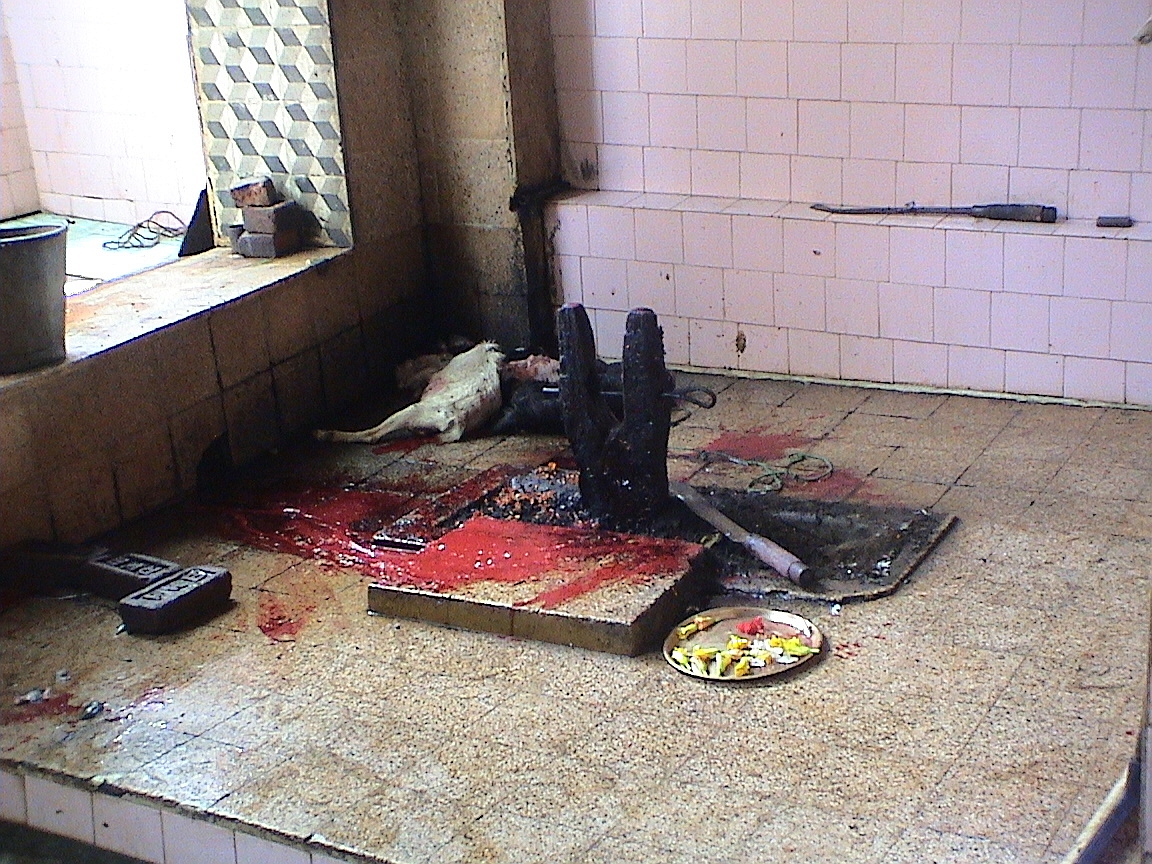
Siva and Kali

There are many different deities that can be found in the Hindu tradition, two of which are Siva and Kali.  This article will be focusing on these two gods through the discussion of different myths associated with them, primarily dealing with those myths that associate the two of them together.  Before getting into the different myths, it may be beneficial to first introduce these two gods a little further.  This will provide a better understanding of the various characteristics that are associated with each of the gods, which will be beneficial in the discussion of the different myths presented later in the article.

Siva, whose name when translated means “auspicious”, is primarily identified as the supreme ascetic, or yogi.  He is depicted with long matted hair that is often tied up in a topknot.  He has bracelets of snakes, a trident, and is usually riding a bull (Nandi).  Siva is known as “the destroyer,” who is responsible for destroying the cosmos at the end of time.  He is also known as “the creator,” who through his ascetic practices stores up his seed, the source of all creation, and is often depicted with an erect phallus known as the linga, which is one of the most worshipped symbols in Hindu practice (Rodrigues 296-297).  An interesting aspect of Siva is that his persona is often described as embodying a bipolar character (Rodrigues 296).  On one hand, Siva is the ideal ascetic (yogi) spending all of his time in meditation generating knowledge, and storing his seed preventing creation, while on the other hand he is described as extremely erotic by nature.  Stories found in the Puranas associate Siva with Parvati and provide evidence to his erotic nature.  Another interesting note is that Siva has also been described as being confused, or torn, between these two different aspects, at times trying to understand why Parvati appeals to him since he is such a perfect ascetic (O’Flaherty 4-7).

Kali, whose name can be translated to mean “dark time,” symbolizes the destruction that time brings to all things (Rodrigues 319-320).  She is described as being dark skinned and wild looking, with her tongue sticking out.  She is usually naked wearing only a belt of severed arms, a necklace of human heads, serpent bracelets, and the bodies of children as earrings.  She is frequently found on a battlefield with weapons and a severed head in her hands, usually drunk on the blood of her enemies, and engaged in a furious rampage (McDermott and Kripal 26).  The origin of Kali varies in different myths, some of which will be discussed later.  Many of the myths involve her being brought into being during times of battle, which result from the transformation of different female goddesses such as Durga, Parvati, Sati, and Sita (McDermott and Kripal 24-26).

There are many different myths in Hinduism that show an association between the two deities, Siva and Kali.  The exact degree of this association is under debate, with many claims identifying Kali as a consort of Siva (McDermott and Kripal 23).  One story supporting the consort theory can be found in the Mahabhagavata Purana.  In this story Kali and Sati are identified as the same being.  Kali, as the Great Goddess, creates Brahma, Visnu, and Siva.  They are then each required to fulfill a test for the honor to win her as their wife.  For this test she appears before them in a horrible form that actually made Brahma, and Visnu both turn away from fear.  Siva, being the only one that did not turn away, won the right to marry her after her birth as Sati, the daughter of Daksa (McDermott and Kripal 47).

Another story that supports the consort theory of Kali and Siva involves the creation, and death of Ganesa.  Ganesa was created as a son to Siva and Durga, while Siva was away.  Because Siva was gone, Durga ordered Ganesa to guard the door while she took a bath.  When Siva came back he discovered this young man guarding his door.  Siva was not aware that this young man was his son, as he had been away at the time of Ganesa’s creation.  After trying to get into the house, and being stopped by Ganesa, Siva chopped off the head of Ganesa (which the gods later replaced with an elephant’s head in an attempt to calm Durga).  Upon discovering what had happened to her son, and after being unable to find Ganesa’s head, Durga became enraged, turning black.  She then started to kill men, and drink their blood, and the gods started to call her Kali Ma (McDaniel 236-237).

As is shown by the story of Ganesa, many of the stories about the origins of Kali actually have her being created through the anger, or grief of other goddesses.  The goddesses, through their emotions (usually anger), are transformed into Kali.  Another example, also involving Durga, occurs during the battle with the demon Mahisasura.  Durga was created by the gods to destroy Mahisasura who, due to a boon given to him by the gods, would only able to be killed by a naked female.  Durga had gone into the battle without knowing this condition.  Eventually she was notified of this boon, and after stripping noticed that Mahisasura would stare at her yoni, providing her the opportunity to finally defeat him.  After Durga had destroyed Mahisasura, she became so embarrassed and enraged by this boon the demon had, that she turned into Kali and set about trying to destroy the world.  Kali (Durga) felt that a world with such gods should not be in existence.  The gods then, out of fear, turned to the ascetic Siva to try to calm her down.  Siva, seeing the world was in danger, lay down in front of Kali, so that while she was dancing in her fit of destruction she would step on him.  The moment Kali stepped on Siva she stopped her dance out of shame and embarrassment for having stepped on her husband, and turned back into Durga (McDermott and Kripal 84-85).  Another interpretation of this story actually suggests that Siva was sent to have sex with Kali to calm her down.  By her dancing on top of him, his linga actually entered her, and she stopped her dance of destruction calming down and turning back into Durga (McDaniel 238).

The Linga-purana portrays Kali as a result of the transformation of Parvati.  In this story Parvati is summoned to destroy Daruka as he, like the demon Mahisasura, can only be destroyed by a female.  Parvati then enters into Siva’s body, transforming herself from the poison in his throat, into the blackened, bloodthirsty goddess Kali.  Once she has transformed, and with the help of some flesh eating spirits (pisacas), she is then able to destroy Daruka, and his army.  Following the battle, Kali then becomes enraged and more bloodthirsty, threatening to destroy the world prematurely, until Siva again comes along, and is able to calm her down (McDermott and Kripal 25)

The god Siva accompanied by Kali and Ganesa, is depicted on a wall at Veeramakaliamman Temple in Singapore

As most of the stories seem to indicate, in many situations involving Siva and Kali, Siva appears to play a large role in the calming, and controlling Kali.  Kali is usually portrayed as a bloodthirsty goddess who is often found on a battlefield in some kind of rampage. Kali’s behavior is also often described as erratic, causing her to be easily angered.  Siva has been known to use different techniques to control Kali, including the laying in front of her after the battle with Mahisasura.  During another similar rampage, Siva appeared on the battlefield as an infant, and is able to calm Kali by drawing out her motherly emotions (McDermott and Kripal 36).  In another story Kali and Siva engage in a dance contest in the forest (Smith 145).  In this story, Kali, having just defeated Sumbha and Nisumbha, takes up residence in a forest and begins to terrorize its inhabitants.  One of these inhabitants is a devotee of Siva, and goes to him for help in ridding the forest of Kali.  When Siva shows up he challenges Kali to a dance contest, which he eventually wins by performing his tandava dance (McDermott and Kripal 26).

As mentioned before, Siva always takes the role of calming Kali, not the other way around.  Some stories, however, indicate that Kali is rather successful at bringing out the wild and destructive side of Siva as well.  They both are said to feed off one another’s destructive tendencies, which often result in frenzied dances, threatening to destroy the cosmos.  One such instance is told in Bhavabhuti’s Malatimadhava, where Siva and Kali are found dancing madly around Kali’s temple, with the destructive nature of the dance frightening all those present, including the goddess Parvati (McDermott and Kripal 26).

The question of who is dominant in the relationship seems to be a major topic of debate in the Hindu tradition.  Images that portray the two together almost always show a naked Kali on top of Siva either engaging in sex in the “reverse position,” where the female is on top, or just with Kali standing on top of Siva, like in the story of the defeat of Mahisasura (though some argue that the image does not actually represent the location of a battlefield, but actually occurs on a mountaintop). There are also arguments as to whether it was actually Siva’s idea to lie in front of Kali, or if Kali had actually been able to throw him to the ground during his attempt to stop her rampage (McDermott and Kripal 82-85). Kali is also shown to be sticking her tongue out which has been widely interpreted as representing her embarrassment and shame (lajya) for stepping on her husband.  Another interpretation of the image is that Kali is shown dancing on the corpse of the world at the end of time, which is symbolized by her dancing on Siva who is responsible for the destruction of the cosmos (McDaniel 242-243).  The Mahabhagavata tells a different story where Siva, after having forgotten that his wife Sita was the Supreme Goddess (Kali), sees her transformed appearing as Kali, and asks for the boon to always appear at her feet as a corpse as a sign of devotion (McDermott and Kripal 49-50).  Many also identify the image as portraying the relationship between purusa and prakrti, where Siva is the inert purusa, and Kali represents the creative and active aspect of prakrti (McDermott and Kripal 53).

There are many different stories and images that include Siva and Kali.  As should have been made evident in this article, there is also a lot of controversy over the interpretation of these many sources.  These interpretations, especially those dealing with the proposed dominance of one god over the other, seem to depend largely on the degree to which each god is being worshipped.  Those that focus their worship on Siva, such as many ascetics do, would argue that he is above Kali on the hierarchy, which would be in contrast to those worshiping Kali, or that of the divine female power (McDermott and Kripal 86).

References and Further Recommended Reading

Harding, Elizabeth (2004) Kali. Delhi: Shri Jainendra Press.

McDaniel, June (2004) Offering Flowers, Feeding Skulls. New York: Oxford University Press.

McDermott, Rachel Fell and Kripal, Jeffrey J (2003) Encountering Kali: In the Margins, At the Center, In the West. Los Angeles: University of California Press.

O’Flaherty, Wendy Doniger (1973) Asceticism and Eroticism in the Mythology of Siva. London: Oxford University Press

Olson, Carl (2007) Hindu Primary Sources: A Sectarian Reader. Piscataway, N.J.: Rutgers University Press

Rodrigues, Hillary (2006) Hinduism-The Ebook. Journal of Buddhist Ethics Online Books Ltd.

Smith, David (1998) The Dance of Shiva. Cambridge: Cambridge University Press.

Related Topics for Further Investigation

Kali

Siva

Sati

Sita

Ravana

Deviahatmya

Durga

Parvati

Ganesa

Daruka

Camunda

Linga-purana

Mahabhagavata

Canda

Munda

Raktabija

Sumbha

Nisumbha

Daksa

Candika

Noteworthy Websites

http://en.wikipedia.org/wiki/Kali

http://en.wikipedia.org/wiki/Shiva

http://www.goddess.ws/kali.html

http://www.kriyayoga.org/devi/Kali100.jpeg

http://www.mahavidya.ca/

Article written by: Zack Olsen (April 2010) who is solely responsible for its contents.

Abhinavagupta


Abhinavagupta was said to be one of the greatest philosopher of his kind in his life time (Dupuche 3). Abhinavagupta was born into a Brahmin family in Srinagar, in the Indian state of Kashmir. His family was renowned for their profound dedication towards God, religion and for their partiality to intellectual pursuits. In other words they were, as a family, devoted to learning and gaining knowledge.  He lived from about 950 AD to 1020 AD and accomplished a great deal in his fields of study over those 70 years (Muller-Ortega 45).

Abhinavagupta believed his parents, Narasimhagupta his father and Vimala his mother, when they claimed that we was conceived through their union as Siva and Sakiti, which in turn produced a yogini-child meaning the “depository of knowledge” in whom this yogini-child had the form of Siva (Dupuche 4).

Abhinavagupta’s name is quite interesting when explained by its Hindu meaning and it is thought that Abhinavagupta was given his name by one of his masters. His name can be summarised as:

“That person is ‘Abhinavagupta’ who remains vigilant in the course of everyday activities; who is present everywhere (abhi), in the objective domain as much as in the subjective domain, and dwells there without limitation. He sings the praise (nu) without ceasing to concentrate on the energies of knowledge and activity. He is protected (gupta) by this praise even though he lives under the presser of temporal affairs.” (Dupuche 4)

In other words, Abhinavagupta was born with knowledge and had the means to share it as a philosopher, teacher, poet, musician, exegete, logician, dramatist and a theologian [to learn more about Abhinavagupta’s name, see Dupuche (2003)]. He also believed strongly in the power of language and speech, as a great asset, to spread his immense knowledge (Isayeva 164-165).

When looking into Abhinavagupta’s ancestry an important fact comes to light. An ancestor of his named Atrigupta, who was born in Madhyadesa (now most likely Kannauj) India, traveled to Kashmir on the request of a great king named Lalitaditya around the year 740 AD. The importance of this is that Atrigupya’s move from Madhyadesa to Kashmir brought Abhinavagupta’s family blood line to Kashmir (Dupuche 4).

As a young child Abhinavagupta was pained greatly by the death of his mother, and her death had a great effect on the rest of his life. His first teacher was his father Narasimhagupta. His father began by teaching him Sanskrit grammar so that he could then go on to read, write and teach himself.  Abhinavagupta would often travel through Kashmir to visit teachers. Not only did he study under Hindu teachers but also with Buddhist and Jain teachers (Muller-Ortega 45).  His love for learning brought him to study any and everything that he could learn under his different teachers, this included: literature, drama and aesthetic theory, traditional texts of dualistic and monistic Saivism, darsana, Krama, Trika, and the doctrines and practices of Kaula (Muller-Ortega 45).

Abhinavagupta himself was a great teacher and his students held him on high regards. They saw him as an incarnation of Siva. They would describe him in ways that made him seem more God like than human (Muller-Ortega 45).  He also took great joy in discussing philosophical arguments with his fellow knowledge seekers (Gerow 188).

Eventually, his studies took him out of Kashmir to Jalandhara where he found Sambhunatha who was a tantric master in the Kaula traditions (Muller-Ortega 45). The Kuala tradition is a reformed version of Kula which refers to families or groupings of the yoginis and of the mothers; however the mothers are also considered a group of goddesses.  Holistically, Kuala refers to the corporeal body, body of power, the cosmic body and the totality of things. The Kuala tradition incorporates the idea of overcoming dualism of impure and pure/divine and human or good/evil and the understanding that ordinary life is the expression of Siva in union with his Sakti (Dupuche 16).  Abhinavagupta’s knowledge and texts contributed greatly to the traditions of this practice (Muller-Ortega 48).

There are many books with writings by Abhinavagupta that have been translated to English but there are still many of his works that are very complicated and make it difficult to translate; in order to properly translate the rest of his works it would take persons with knowledge in not only all of the six systems of Indian philosophy but also knowledge in Buddhism, Tantra and more (Marjanovic 13).

Abhinavaguta wrought two important texts on the topic of aesthetics, these being the Dhvanyaloka-locana and the Abhinava-bharati ((Muller-Ortega 47).

Among the most popular of Abhinavagupta’s works is the Gitarthasamgraha; this additionally goes by the name Bhagavadagitartha-samgraha. The English translation of this Gita text outlines the non-dualistic philosophy of Kashmir Saivism as described by Abhinavagupta; it also explains the nature of the highest reality in Kashmir Saivism.

It details the process of creation, and explains the theory of causation (karyakaranabhava), insights into Jnana-karma-sammuccayavada and descriptions on what is occurring in the last moments as a soul is leaving the body and in addition it has some descriptions of the practice of yoga (Marjanovic 14-22).

Abhinavagupta wrote Tantraloka (Light on the Tantras) which falls in with tradition of tantric Saivism.  It differs from the orthodox Vedic tradition which Abhinavagupta demotes to the lowest position in Siva’s hierarchy of revelations to mankind.  He suggests that Vaisnavas do not come to know the supreme category due to pollution of impure knowledge (Dupuche ii). The Tantraloka is the most voluminous of all the literature written by Abhinavagupta; it comprises of twelve volumes, and includes a commentary by Jayaratha called Viveka (Muller-Ortega 47).

Abhinavagupta lived about 70 years and in his lifetime he never married.  This is said to be due to his great dedication to his religious practices (Muller-Ortega 45). In order to posses the findings and knowledge of Saivism, Abhinavagupta had to reach the highest state of consciousness. This is characterized by jnanasakti (power of knowledge). Once this is reached the knowledge will flow through the individual so they can then share it, teach it, write it etc. (Singh 14). This dedication to finding the knowledge within would have taken an extensive amount of time. Over his life Abhinavagupta wrote many works, thus far twenty-one are available for reading but there are as many as twenty-three other writings that have been lost. His major period of writing occurred mainly between 990 AD and 1014 AD. It seems that he split his works into separate time periods based on the three topics of texts. The first was the Alankarika period, with all of the texts dealing with aesthetics. The second was the Tantrika period with all of the texts on Tantra, and lastly, was the Philosophical period with all of the texts dealing with philosophy. With this being said it has still been very difficult to date most of his writings, due to them not containing historical information that can be used to date the piece (Muller-Ortega 45). Abhinavagupta was a highly influential thinker in his time and his literature is still significant to this day.

REFERENCES AND FURTHER RECOMMENDED READING

Dupuche, John R. (2003) Abhinavagupta: The Kula Ritual. Delhi: Shri Jainendra Press.

Gerow, Edwin (1994) Abhinavagupta’s Aesthetics as a Speculative Paradigm: Journal of the American Oriental Society, 114: 186 – 208

Isayeva, Natalia (1995) From Early Vedanta to Kashmir Shaivism. Albany: State University of New York Press.

Marjanovic, Boris (2003) Gitartha-samgraha: Abhinavagupta’s  Commentary on the Bhagavad Gita. Varanasi: Indica Books

Muller-Ortega, Paul E (1989) The Triadic Heart of Siva. Delhi: Sri Satguru Publications

Singh, Jaideva (1988) Abhinavagupta: A Tradition of Wisdom. Albany: State University of New York Press.

Singh, Jaideva (1988) Abhinavagupta: Para-trisika-Vivarana The Secret of Tantric Mysticism. Delhi: Motilal Banarsidass Publishers.

Rodrigues, Hillary (2006) Hinduism The eBook An Online Introduction. Journal of Buddhist Ethics Online Books.

Related Topics for Further Investigation

Siva

Kashmir

Tantric

Yoga

Mantras

Sanskrit

Exegesis

Kaula

Kashmir Shaivism

Sakiti

Brahmin

Noteworthy Websites Related to the Topic

http://en.wikipedia.org/wiki/Abhinavagupta

http://www.ikashmir.net/abhinavagupta/index.html

http://www.thenewyoga.org/guru_abhinavagupta.htm

http://www.koausa.org/Glimpses/abhinava.html

http://abhinavagupta.net/

http://www.britannica.com/EBchecked/topic/1261/Abhinavagupta

http://en.wikipedia.org/wiki/Tantra

http://www.svabhinava.org/HumorPhd/index.php

Article written by: Sarah Nielsen (March 2010) who is solely responsible for its content.