Yudhisthira

Yushithira is the eldest of the five Pandava brothers in the Mahabharata. The Mahabharata is the most voluminous epic poem in the world (see Sarma 88), being composed of 100,000 verses. It is said to have been composed between 400 B.C.E and 400 C.E. by a sage named Vyasa (see Olson 224-225). The story is about the Pandava brothers (Yudhisthira, Bhima, Arjuna, Nakula, and Sahadeva), who lose their kingdom and fight their cousins, the Kauravas, to gain it back. Yudhisthira stands for duty and righteousness. He is also known as Dharmaraja, and he is the son of the god Dharma.

“The Mahabharata is Yudhisthira’s education” (see Hiltebeitel 4), and “can be seen as a treatise on Dharma or religion” (see Bae 139).  The main story starts with the two brothers Dhrtarastra (who is blind) and Pandu (who is pale). Dhrtarastra and his wife Gandhari give birth to a hundred sons, the Kauravas. Pandu, because of a curse, could not engage in sexual relationships. Thus, he asked his wife, Kunti, to use a mantra in order to invoke a god and conceive a child. Kunti invokes Dharma, Vayu and Indra, and manages to conceive three sons through them: Yudhisthira, Bhima, and Arjuna. Madri, Pandu’s second wife, also uses the mantra and gives birth to twin brothers: Nakula and Sahadeva. After the death of Pandu and Madri, Kunti becomes responsible for the raising the kids. Because of Pandu’s death, Hastinapura was in need of a new king, and Dhrtarastra takes the throne until Yudhisthira is eligible.

The Kaurava brothers become tempted to kill the Pandavas due to their jealousy of the Pandava brothers’ successs. The Kauravas’ attempt of murdering the Pandavas was unsuccessful. As the story unfolds, Arjuna wins the hand of a princess named Draupadi, who then becomes the wife to all the five Pandavas. The Pandava brothers get half the kingdom, which Yudhisthira expands by defeating the surrounding regions. Yudhisthira performs the Rajasuya sacrifice, which makes the Kauravas extremely jealous who then challenge the Pandavas to a game of dice. This is where Yudhisthira’s weakness comes in. Yudhisthira ends up losing his kingdom, his brothers, his wife, and himself as well. Wagering Draupadi to the Kauravas poses a huge threat to Yudhisthira’s dharmic responsibility (see Hiltebeitel 219-220); Draupadi’s humiliation emphasizes this aspect of the story. Despite being given back what he lost, Yudhisthira loses his kingdom once again. Not only does Yudhisthira lose the kingdom, all the Pandava brothers and Draupadi are forced into exile for thirteen years.  There is an event during the exile where the Pandavas encounter a yaksa (spirit), which is the god Dharma in disguise. Four of the Pandavas are poisoned by the spirit, because unlike Yudhisthira, they do not answer the spirit’s riddles. Once Yudhithira successfully solves all the riddles, the yaksa grants him a wish with which he can bring one brother back to life. Yudhisthira chooses Nakula so that each mother would have at least one son alive (see Sarma 89; see Hiltebeitel 209). The years go by, and during the thirteenth year, the Pandavas disguise themselves to prevent people from recognizing them (see Bae 145). Yudhisthira, for example, “poses as a master of dicing” (see Olson 228), which is contrary to Yudhisthira in the beginning of the story. During the twelfth year of the exile, Yudhisthira has a conversation with a sage named Brhadasva about misery. The sage tells him a story about and gives him “the heart of the dice” which gives him the talent of dicing, hence his disguise.  (see Hiltebeitel 216). Once the thirteenth year is over, Duryodhana (one of the Kaurava brothers), refuses to return the Pandavas’ share of kingdom to them, he would not even give them five villages where they could reside (see Bae 145). Yudhisthira tries to negotiate but the Kauravas refused, and this escalated into war.

The Pandavas and the Kauravas ask Krsna for assistance. Krsna gives them a choice; the Pandavas end up chosing Krsna himself, while the Kauravas get Krsna’s army. Right before the war, Arjuna felt torn and did not want to fight his relatives, friends, and teachers (see Bae, 148). Krsna advices and successfully convinces Arjuna to fight; this conversation between Arjuna and Krsna is known as the Bhagavad-gita. The Bhagavad-gita is the most influential passage of the Mahabharata (see Bae 147). Right before the Bhagavad-gita, however, Yudhisthira has doubts himself. Yudhisthira questions Arjuna about “how so few can conquer so many” (see Hiltebeitel 209). During the war, many die, including Karna, the secret son of Kunti and Surya (the sun-god), who is slain by Arjuna. Near the end of the battle only four of the Kauravas remained. Yudhisthira ended up finding Duryodhana’s hiding spot, and Duryodhana agreed to fight with each of the Pandavas one by one. Bhima ended up hitting Duryodhana below the belt which threatened Yudhisthira’s righteousness. Yudhisthira offered to slay Bhima as a punishment for going against the rules of chivalry. This caused an argument between the advisors of the Kauravas and the Pandavas. Duryodhana was keen on taking revenge and killing the Pandavas, but his plan failed because his men killed the wrong people, not the Pandavas (see Ions 126). The Pandavas, after defeating the Kauravas, returned to Hastinapura.

Despite being victorious, Yudhisthira grieves and tells Gandhari that he is the one responsible for her sons’ deaths (see Hiltebeitel 210). Yudhisthira begins his journey as a ruler who performs an Asvamedha (horse-sacrifice), and protects the widows of the men who died during the battle (see Hiltebeitel 210). Yudhisthira also seeks Bhisma’s advice about king’s obligations and responsibilities. In the course of time, Dhrtarastra and his Gandhari die, which causes the Pandavas and Draupadi to leave Hastinapura and go on a pilgrimage. They were also accompanied by a dog in their pilgrimage.

During the journey, all the Pandavas, except Yudhisthira, die one by one. Yudhisthira considers each death as a form of punishment for each of the Pandava’s weaknesses. Yudhisthira finally ends up at the gates of Indra’s heaven, as he’s welcomed by Indra, Yudhisthira refuses to go in unless he’s assured that his brothers and wife were in there. He also requests that his dog be allowed into heaven because he did not want to abandon the dog. The dog turns out to be the god Dharma, his father. Once past the gates of heaven, Yudhisthira is horrified at the site of all the Kauravas being in heaven while his brothers and wife were in hell. Yudhisthira refused to stay in Indra’s swarga (heaven) and demanded to go to hell where his brothers and Draupadi reside. After witnessing the many horrors of hell, Yudhisthira finds out that “the whole scene was revealed to be the product of maya, or illusion” (see Ions 127). Yudhisthira leaves his physical body behind and, in the end, Yudhisthira, his brothers, Krsna, and Draupadi were all welcomed into heaven.

Yudhisthira’s main role in this epic is to display dharma, the importance of duty and righteousness. Yudhisthira’s righteousness has been tested twice in the Mahabharata (see Adarkar 120). His first test is the one where he would not abandon his dog; the other is when he is made to believe that his brothers and wife are in hell. Yudhisthira passes both these tests because he sticks to his dharmic behavior and makes the right choices. Yudhisthira is very important in the Mahabharata because, through him, others can learn about Dharma and what it means to be righteous. Yudhisthira is not a very popular as a deity, but he does have a temple dedicated to him known as the Dharmaraja Ratha, which is situated at Mahabalipuram in the Indian state of Tamil Nadu (see Lippe 328).

REFERENCES AND FURTHER RECOMMENDED READING

Olson, Carl (2007) Hindu Primary Sources: A Sectarian Reader. New Brunswick, New Jersey, and London: Rutgers University Press.

Bae, James H. (2003) In a World of Gods and Goddesses: The Mystic Art of Indra Sharma. Novato, CA, USA: Mandala Publishing.

Bhattacharji, Sukumari (1978) The Indian Theogony. Calcutta: Firma KLM Private LTD.

Sarma, Deepak (2008) Hinduism: A Reader. United Kingdom: Blackwell Publishing.

Smith, John D. (2009) The Mahabharata. London, New York, and Toronto: Penguin Group.

Hiltebeitel, Alf (2001) Rethinking the Mahabharat : A Reader’s Guide to the Education of the Dharma King. Chicago: The University of Chicago Press.

Ions, Veronica (1983) Literary of the World’s Myths and Legends: Indian Mythology. New York: Peter Bedrick Books.

Fitzgerald, James L. (2003) Review: The Many Voices of the Mahabharata. Tennessee : American Oriental Society.

Pathak, Shubha (2006) Why Do Displaced Kings Become Poets in the Sanskrit Epics? Modeling Dharma in the Affirmative “Rāmāyaṇa” and the Interrogative “Mahābhārata”. Springer.

Adarkar, Aditya (2005) The Untested Dharma Is Not Worth Living. Springer.

Related Topics for Further Investigation

The Mahabharata

The Pandava Brothers

Arjuna

Bhima

Nakula

Sahadeva

Karna

The Kauravas

Duryodhana

Dhrtarastra

Pandu

Kunti

Madri

Gandhari

Draupadi

Krsna

The Bhagavad-gita

Noteworthy Websites Related to the Topic

http://www.mahabharataonline.com/

http://en.wikipedia.org/wiki/Yudhisthira

http://ultrabrown.com/posts/bhima%E2%80%99s-story-thoughts-on-yudhisthira-and-the-fluidity-of-myths

http://www.indianetzone.com/3/yudhisthir.htm

http://www.indiaoz.com.au/hinduism/Mahabharata/mahabharata.shtml

http://www.urday.in/jaydrath.htm

http://www.hindunet.org/hindu_history/ancient/mahabharat/mahab_patnaik.html

http://hinduism.iskcon.com/tradition/1108.htm

http://easterlybeauty.com/en/characters/mahabharata/56-yudhisthira.html

Article written by: Rutika Gandhi (March 2010) who is solely responsible for its content.

The Silappadikaram

The Silappadikaram is a Tamil epic that is speculated to have been composed around the fourth to sixth century AD (Zvelebil 178). It is said that of the Dravidian languages “Tamil has maintained the greatest purity and has preserved some of its original literature” (Adigal VIII). Of what are called the “Great-Poems” or the “[f]ive major poetical works in Tamil” only the text of the Silappadikaram and two others survived (VIII). The author, Prince Ilango Adigal, was the supposed brother of King Senguttuvan who appears later in the story, although no other Tamil poems mentioned that the king had a brother (Zvelebil 179). There are two existing commentaries, one which is ancient (the Arumpadavuri) and the other from the fifteenth century by Adiyarkunallar (Adigal IX). This story has been translated into various languages but most are not exact in depicting the tale like the original language (Zvelebil 172).

The Silappadikaram begins in the city of Puhar in the kingdom of Chola, a bustling trading town in which Kannagi and Kovalan are to have a marriage arranged by their parents (Holmstrom 3). After the marriage Kannagi “spent most of her day learning about the household” and “[s]he knew that both Kovalan’s parents and her own looked to her to maintain the traditions and honour of her family…” thereby illustrating her devotion to her role as a wife (6,8). This role involved learning her duties as a partner and homemaker from her mother in law, then implementing her skills in a way to make home life harmonious for Kovalan and herself. Years later a dancer named Madhavi captures Kovalan’s eye.  Kovalan starts another life with this woman, even having a child with her, all the while neglecting Kannagi (12-13).  Kovalan becomes increasingly charitable in his new life, especially to those who have made mistakes, and he ends up frittering away his fortune (14). He starts to sell his and Kannagi’s own possessions and feels an overwhelming sense of guilt and restlessness (15).

One day he returns to Kannagi declaring “[a]ll these years I’ve lived with a woman who cannot tell the difference between truth and falsehood. On such a woman I have wasted all my ancestral wealth. I bring you nothing but poverty. I am bitterly ashamed” (25). Kannagi tells Kovalan to take her anklets, given to her by her mother as a wedding gift, to help him get his fortune back (25). This act shows her dedication to her husband even after years of loneliness and abandonment.  Kovalan decides they need a new start so they sneak out of Puhar at night and start their journey to Madurai in the Pandya kingdom (25-26). They stop and talk to the “renunceint” Kavundi who decides to go with the couple on their long journey (27).

Many events happen along the trip, quite a few with lessons attached.  For instance, a monk reminds the group that “each of our actions is like a seed that is sown and is bound to bring a harvest of its own kind,” which told of how karma affects people based on their behaviour (30). Another lesson comes from Kavundi who, after turning two people into jackals when they teased Kannagi, stated that “[d]isrespect is no small thing”. This once again illustrates how one’s life should be lived, in this case in regard to the treatment of others (32).  They also stop at a temple where “Aiyai, goddess of hunters” is being worshiped (35).

When the group finally gets to Madurai, Kavundi leaves Kovalan and Kannagi in the care of Madari an animal herder (47-49). When Kovalan goes to the smith to try and sell one of Kannagi’s anklets, the smith thinks Kovalan stole the piece of jewellery from the queen (53). King Nedunchezhiyan was informed of this and put out the order “[s]ee if the thief has the queen’s anklet in his possession. If that is really so, kill him immediately and bring me the jewel to the queen’s chambers” (56).  The order is carried out and Kovalan is killed (58). Kannagi receives the news of her husband’s unjust death and is devastated. She calls out to the Sun God who replies “this city which accuses him shall be destroyed by fire” (63).  Kannagi goes before the king and shows him his mistake, for the queen’s original anklet had pearls whereas the one taken from Kovalan had rubies (68). Kannagi gives the Sun God the order to “not on any account spare the wicked” and the city is burned (70). Only the goddess of the Royal Pandya house, Bharatan, was left (72). The goddess tells of how both Kovalan and Kannagi were connected in a past life. In that life Kovalan had killed Kannagi’s husband by mistake; this caused Kannagi so much grief that she had thrown herself off a cliff (74). The goddess told Kannagi that “[a] virtuous life is good in itself, but may not prevent the sins of a past life from bearing fruit”, putting into perspective why these unfortunate events had happened to Kovalan and herself (74).

The next segment of the book is a chapter about the Cheran King Senguttuvan. He heard the story of Kannagi and how she was carried from the Chera kingdom by the gods to join her husband (77). Senguttuvan decided to get a block of stone from the Himalayas to carve a likeness of Kannagi the “Goddess of Steadfastness” (80).  He marvels at how “three great Tamil Kingdoms had been linked together by the story of Kannagi”, meaning the Chola Kingdom (where the story began), Pandya Kingdom (where Kannagi destroyed the city of Madurai), and his own Chera kingdom (where Kannagi was taken by the gods) (85). Each had been a part of Kannagi’s journey and she affected people from all three kingdoms profoundly.

One thing that should be noted about the Silappadikaram is that throughout the whole story many different religious sects and rituals were mentioned. This reflects the diversity of the setting it was written in. When leaving the city of Puhar, Kannagi and Kovalan pass by “the great Vishnu temple”, “seven Buddhist Viharas”, and “wandering Jain monks” (26) all within close proximity to each other showing the obvious acceptance of multiplicity.  At the time of Kannagi and Kovalan “Brahmanism (Hinduism), Jainism, and Buddhism – were at the time harmoniously coexisting in the south” (Adigal VIII).

The Silappadikaram showed that some deep rooted traditions of India that can still be seen today. A main theme in the story is karma which is still a modern principle present in India today. In the book not only was Kovalan warned about his actions in the present causing bad future karma, the murder he committed in a past life brought him an unfortunate end. Various other traditions, such as Kannagi and Kovalan’s arranged marriage, finding an auspicious day for the ceremony, and consulting astrologers, reflects part of Indian culture that is still prevalent today.

Another interesting aspect of the Silappadikaram was the portrayal of the ideal woman. Throughout the whole story Kannagi proved how pure and true she was. Through her husband’s infidelity and misconduct she stayed faithful and chaste. When Kovalan comes back to her,    Kannagi is willing to do anything to help her husband including selling the anklets that were from her mother as a wedding gift. When Kovalan is murdered, Kannagi would have killed herself willingly for her husband immediately if she hadn’t had the duty to uphold his honour by clearing his name.  In the end, Kannagi destroys a whole city for her husband and remained loyal throughout. It is because of this that King Senguttuvan is so impressed by her story that he erects a statue in her honour, making it clear that Kannagi was a version of the ideal woman of that time.

The Silappadikaram, by Prince Ilango Adigal, is a story about a woman and her husband as they struggle with the problems of fidelity, right and wrong, and justice. The core themes of the Silappadikaram are very relevant to the human experience, which is probably why it still is a well read story today. It is a tale that produces good insights to the culture, lessons, karma, and ideals of the Tamil people who hold it dear.    

References and Further Recommended Reading

Holmstrom, Lakshmi (1996) Silappadikaram Manimekalai. Madras: Orient Longman Limited

Adigal, Ilango (1965) Shilappadikaram (The Ankle Bracelet). New York: New Directions Publishing Corporation

Zvelebil, Kamil (1973) The Smile of Murugan: On Tamil Literature of South India. Leiden :E.J Brill

Related Topics for Further Investigation

The Arumpadavuri

Adiyarkunallar

Aiyai

Jainism

Buddhism

Ilango Adigal

Tamil Literature

The Five Great Epics

Chera Kingdom

Chola Kingdom

Pandya Kingdom

King Senguttuvan

Bharatan

The Goddess of Steadfastness

Karma

Noteworthy Websites Related to the Topic

http://www.tamilartsacademy.com/books/roman%20karur/chapter18.html

http://www.attukaldevi.com/pl/story-kannagi.htm

http://www.absoluteastronomy.com/topics/Senguttuvan

http://www.hindu.com/2006/06/16/stories/2006061603461100.htm

http://www.allsands.com/History/People/indianfolklore_wji_gn.htm

http://en.wikipedia.org/wiki/Silappatikaram

Article Written by: Kelsey Erickson (March 2010) who is solely responsible for its content.

Sitala: The Goddess of Smallpox and Disease

Sitala is one of the many Hindu mother goddesses who are known for their benevolence and dangerousness. She is worshipped throughout the Indian subcontinent and is especially adored in the region of Bengal (Stewart 389). Sitala is commonly known as the goddess of smallpox and disease but may also be referred to as the Queen of Disease (Roga Raja), Lord of Pestilence (Vyadhi Pati), or Mother of Poxes (Basenta Raya) (Stewart 389). Her name means the “Cool One” which is thought to be derived from her mythical birth from the cooled ashes of the sacrificial fire (Stewart 390). The smallpox disease, which is now thought to be eradicated, was first identified with Sitala around the 16th century CE, although the smallpox disease was already present in India for hundreds of years prior to this (Rodrigues 329). Sitala is worshipped across different regions of India but mainly in West Bengal, Northern India and the state of Gujarat (Wadley 33). The three regions have different views about Sitala but all are linked by a few common ideas.  Sitala is always the “Cool One” and she is frequently represented by a golden pot, except in wealthy temples where she is depicted as a naked women with her hair disheveled, riding a donkey, and wielding a broom (Rodrigues 329).

Sitala is most well known in West Bengal where there are many temples and mangals, which are lengthy poems written in her honor. Throughout West Bengal she is associated with Jvarasur, the Fever Demon, and Raktabati, the one that possess the blood of servant women (Wadley 37). Sitala is worshipped during Phalgun which are the months of February to March. Krsnastami is seen by the Bengali almanac as the proper day of worship although only a few households hold pujas on this day due to the cost. Villages organize collective pujas according to the finances of the village, as well as the availability of performers that are needed to recite the mangals (Wadley 37). Sitala’s main association in Bengal is with the various forms of pox. The origin of worship of Sitala in this region was thought to come from a popular story about a kingdom that was infected with the smallpox disease. Sitala went in disguised as a beautiful woman to see the king and advised him to worship her. The people of the kingdom worshipped her and were relieved of the dreadful smallpox disease (Misra 135).

In Northern India Sitala, is associated with pox but she is also seen as the protector of children (Wadley 41). It is claimed that in a previous life Sitala was married to a Muslim emperor and was very faithful and devoted to the Hindu gods and goddesses, who was deified as Sitala in reward (Misra 135). She is worshipped during Caitra which is in the months of March and April or Baisakh the months of April and May because these months are in the hot season when the outbreak of the disease is the most prevalent. In North India Sitala is associated with stale or leftover food because she is thought to have been born of the cold ashes of the sacrificial fire. Festivals are held in her honor and are commonly termed basora which literally means “Leftover Food Worship” (Wadley 42). The people of this region prepare only cold foods on the day before the pujas and offer these to Sitala and eat only cold food themselves.

The third region, which worships Sitala is the state of Gujarat, where she is no longer associated with disease; instead she is seen as the giver of good fortune, husbands and sons (Wadley 42). The origin of the Sitala shrine in Gujarat is thought to be identified with Bariha Bapji or Babribahan of the Mahabharata (Misra 135). In this region she is not worshipped during the hot season but rather during the rainy season, Shravan, the months of July and August. In much of the literature from this area Sitala is often seen as being associated with Balia Kaka, the powerful uncle who was also worshipped when there was an outbreak of the smallpox disease (Wadley 42).

Although there are vast differences between these three regions and the ways in which they worship this goddess, there are a few similarities that link the regions together. All three of these regions believe that Sitala has seven sisters and may also have one brother who is not as well known. Sitala’s sisters are known as Masani, Basanti, Maha Mati, Polamde, Lamkaria, and Agwani and are all associated with one of the seven types of fevers that are prevalent in this regions.

Unlike many other goddesses, such as Parvati or Laksmi, who are usually linked with other male deities, Sitala does not have a consort (Rodrigues 280). Sitala is worshipped by all classes but she tends to get the most patronage from the poor. Although Sitala, as a mother goddess, is expected to nurture the people of India, she is usually worshipped to avoid her wrath. She is prone to anger and quick to offend any individual who disrupts the balance of hot and cold in their life or body (Wadley 45). It is believed that when this occurs she is provoked and will visit that individual leaving her mark of pox upon their body. The mark that she leaves on the body of infected individuals is often referred to as mayera daya or the grace of the mother (Stewart 390). Many faithful and devoted individuals have come to suffer from her wrath, which can be very hard to explain (Stewart 390). Some sources say that this attention is because these individuals attract her attention through the sacrifices, which causes her to want to visit these individuals in person (Stewart 390). It is said that the person who is infected with the smallpox disease becomes the abode of Sitala.

When an individual is affected by her disease many steps are taken to help that person recover, which often includes further worship to Sitala. An idol that represents Sitala is made out of the earth or cow dung and then is bathed by a holy man and the water is then given to the sick individual. Often the holy man will recite a Sitalastaka, a verse in Sanskrit which praises Sitala. When there is an individual in the house that is ill the other members of the household do not shave, there is to be no sexual intercourse, the women do not comb their hair and any women who is menstruating is not allowed to visit (Misra 136). It is thought that Sitala’s efficacy coordinated the inoculation of smallpox which produced lifelong immunity from the disease. In order for an individual to be treated at one of the many shrines of Sitala, they first had to hold a nam – rakha which is a naming of the disease ceremony. This ceremony involved taking raw sugar and placing it underneath a table where pitchers of water are placed and then a song is chanted to declare that the disease was in fact smallpox (Minsky 166). The inoculation procedure entailed scarifying an area of skin usually just above the wrist and rubbing in a paste that contained water and dried attenuated smallpox crusts (Minsky 167). Priests often would oversee the procedure if it took place at a Sitala shrine but some practiced inoculation themselves. The Priests that preside at these temples are seldom Brahmin. To ensure that the disease does not spread the individuals were placed in quarantine for twenty one days until the infectious period was over and the crusts began to fall off. The pox crusts were then collected and offered in thanks to Sitala (Minsky 167). Through these processes of inoculation the smallpox disease was seemingly eradicated.

Although the smallpox disease is thought to be eradicated the worship of Sitala still continues and this is seen as the reason why, in some regions, she has taken on different personalities that depict her as not only the goddess of disease but also the protector of children and giver of good fortune (Wadley 45). Another reason that Sitala is associated with so many different personalities is because of the changing modes of transmission of traditions and cultural practices among the Hindu religion (Wadley 34).

Bibliography

Minsky, Lauren (2009) “Pursuing Protection from Disease: The Making of Smallpox Prophylactic Practice in Colonial Punjab”. Bulletin of the History of Medicine, vol.83, No.1, pp. 164-190.

Misra, Bhabagrahi (1969) “Sitala: The Smallpox Goddess of India”. Asian Folklore Studies, vol.28, No. 2, pp. 133-142.

Rodrigues, Hillary (2006) Hinduism The eBook: An Online Introduction. Journal of Buddhist Ethics Online Books, Ltd.

Stewart, Tony (1995) Encountering the Smallpox Goddess: The Auspicious Song of Sitala. Princeton, N.J.: Princeton University Press.

Wadley, Susan (1980) “Sitala: The Cool One”. Asian Folklore Studies, vol.39, No. 1, pp. 33-62.

Related Topics

Masan

Basanti

Maha

Mati

Polamde

Lamkaria

Agwani

Jvarasur

Raktabati

Mariamman

Kali

Puja

Blood Sacrifice

Devi

Laksmi

Parvati

Related Websites

http://en.wikipedia.org/wiki/Shitala_Devi

http://www.suite101.com/article.cfm/woman_in_india/47978

http://reli350.vassar.edu/trover/sitala.html

http://www.icsi.berkeley.edu/~snarayan/anthro-pap/subsection3_4_3.html

http://www.sanatansociety.org/hindu_gods_and_goddesses.htm

Article written by: Kaitlyn Erickson (April 2010) who is solely responsible for its content.
The Kathakali Dance

Many traditions in Hinduism include the use of dance as a form storytelling. Bharat Natyam (one of the more popular forms of Indian dance) (Courtney), Kuchipudi (from South-East India, composed of “graceful movements and [a] strong narrative”) (Courtney), and Manipuri (from North-East India, performed on religious occations) (Courtney) are just a few of many dances that are found in India. Kathakali Dance is one such form that conveys a story to its audience through theatrical display.  Kathakali Dance is thought to have originated in the seventeenth century and is defined by Caldwell in Oh Terrifying Mother: Sexuality, Violence, and Worship of the Goddess Kali as “an operatic form of ritual theatre in Kerala” (Caldwell 286). The literal translation of the word Kathakali means “Story-Play” and has become a popular form of story-telling in India. As one source tells it, Kathakali came about when the Raja of the time had a dream where the Gods paid a visit and taught him a new type of dramatic dance (Barba 37). Over time the performances of Kathakali have changed slightly from their original form. In the beginning, masks were used on the actors, but later this changed to the use of makeup. The actors originally would carry out the two elements of the performance which was reciting the texts and acting them out. Now the actors take on a mime type role and are solely responsible for the acting portion of the performance and there are two accompanying singers with musicians that are responsible for the verbal telling of the story (Barba 37). It is expressed in one source that the alterations that Kathakali underwent (from the time it came to be, to the form that exists today) stopped its changes with the coming of the eighteenth century and it has remained the same from that time up until now (Barba 37).

The performance of Kathakali usual begins in the evening and lasts long into the night (Caldwell 72). It is themed around the Puranas (group of texts about ancient myths), the Ramayana (epic tales about the Prince Rama) and the Mahabharata (The Great [Story of the] Descendants of Bharata) (Courtney). Kathakali uses a lot of different forms of communication in order to convey the story being told. These forms are seen in costume use, elaborate makeup, music, song, dance and verbal noises that are not in any language but are used to project an emotion. The common themes in Kathakali are the interactions between good and evil gods; they are always an interpretation of grand events that took place with the gods (Barba 38).

The costumes used are very pronounced and designed with the inclusion of bright colours and intricate patterns, where the makeup is very striking with colours that are just as rich as those on the costume. The costumes are thought by some scholars to have a borrowed element from another type of Indian dance called mutiyettu [which, unlike Kathakali, is more of a ritual act involving becoming possessed by the gods (Caldwell 252)] (Caldwell 77). But some scholars also think that mutiyettu borrowed ideas in the ways of makeup from Kathakali (Caldwell 77). Both costumes and makeup are very important elements within Kathakali, they help in inform the audience of which character is which, especially since the actors do not talk.

In order for recognition to take place, colours are given a general designation to a particular character for representation. For instance, green is the colour used on “Satvik characters – gods, heroes, and noble kings.” (Devi 95). A white beard is designated to a higher class monkey being, while a black beard represents “forest hunters” such as Lord Siva (Devi 95). A red beard on a character is the symbol for the main Kathakali demon, and all characters have their face painted in a way that accentuates the facial features (i.e. the eyes, eyebrows, and mouth) so that facial movements that are an important part of the dance are easily viewed (Devi 95).

The roles of women are traditionally played by men. What informs the audience of gender is the use of a smooth non-blemishing base makeup colour (usually white) that helps enhance such feminine characteristics as the eyes, eyebrows and the lips (Devi 87). Another type of female that is portrayed is the demon goddess, who is much more radical, including fangs and protruding wooden breasts (Devi 96). Good and evil is a major factor in Kathakali performances and so it is crucial for the audience to be able to recognize the nature of the characters. Such an example is the meanings behind the colours in makeup used on a characters face, with green usually meaning good, red meaning anger and black meaning evil (Devi 90). The costumes worn also help in determining the type of character being portrayed. The male gods tend to have a wide circumference to the base of their outfits which are quite similar to dresses but do not go down to the floor allowing for the feet to still be seen (Courtney). The female characters tend to have more slimming dresses that reach closer to the floor, and the demon goddess character has a wider dress that looks a lot like the males outfits but involves more black and dark colours to convey the presence of evil (Courtney).

The story is narrated by individuals that do not take part in the acting. The story is told in a language called manipravalam, which is “an artificial courtly literary language combining Malayalam and Sanskrit” (Caldwell 17). The singers are also accompanied by a variety of instruments which largely consist of different percussion instruments. There are four main instruments, three being different styles of drums and the fourth being cymbals (Courtney). The other instruments include a conch shell, gong, and trumpet. (Devi 87) The actors add to the suspense of the story through the use of the beat, adding emphasis for a dramatic scene, and a build up of energy for a climatic rise.

Due to the fact that the actors have no vocal roles in Kathakali, they must convey the story through dance, hand gestures and facial expressions. Certain hand movements or swaying of the body or placing of the feet convey specific meanings. It could mean such things as a river, a cave or the growing of a lotus flower (Devi 104-105). The hands, and more particularly the fingers positions and movements are a type of sign language (mudras) used to express the alphabet in a type of Sanskrit language (Barba 38). The story is told not only in the movement of the limbs but also what is expressed on the face. The eyes have a very active role in the Kathakali and it is something that the actors have to be trained in, to be able to perform properly, for the eyes are to move with the arms and hands, with a lot of eye rolling and shaking, they are almost always moving (Nritta Drishti which means ‘dancing of the eyes’) (Devi 106). An example of the silent communication that takes place through the movement of the face can be seen in the expression of fear where the actor “raises one eyebrow, then the other, opens his eyes wide, moves his eyeballs laterally and rapidly, his nostrils flare out, his cheeks tremble and his head revolves in jerky motions.” (Barba 39-40). Although the actors have no lines to speak, they do include yells, screams, and cries to emphasize the events taking place in certain parts of the performance (Devi 106).

Kathakali dance has survived up to present day and are still performed. The stories told through the form of dance have the power to reach out and touch its audience without them having to be able to understand the language. With the aid of costumes and the actions of the interpretive actors, even if no means is conveyed the performance is still able to captivate.

Bibliography

Barba, Eugenio and Simonne Sanzenbach (1967) “The Kathakali Theatre” The Tuane Drama Review Vol. 11, No. 4. Cambridge: The MIT Press.

Caldwell, Sarah (1999) Oh Terrifying Mother: Sexuality, Violence and Worship of the Goddess Kali. New Delhi: Oxford University Press.

Courtney, David and Chandrakantha (2010) “Kathakali” Music of India. Real Audio. (Thursday, March 11, 2010) http://chandrakantha.com-musicofindia.

Devi, Regini (1990) Dance Dialects of India. 2nd Ed. Delhi: Jainendra Prakash Jain At Shri Jainendra Press.

Related Research Topics

Kali

Kerala

Puranas

Ramayanas

Mahabharat

maipravalem

Malayalam

Sanskrit

mudras

Article written by: Christina Erickson (April 2010) who is solely responsible for its content

Vibhisana


Vibhisana was one of the Raksasas [demons] and the brother of Ravana in the Hinduism epic the Ramayana. Vibhisana was the son of Visravas and Malini and was Ravana’s younger half brother. Ravana was the ten-headed demon king from the Hindu epic Ramayana. Vibhisana also had a half sister named Surpanakha who was the demoness who tried to seduce Rama in the epic Ramayana (Garret 707). Initially, Vibhisana followed his brother, Ravana. Vibhisana and his other half brother, Kumbhakarna, went to devote themselves to Dharma under the leadership of Ravana. They showed complete devotion, which earned them boons from Brahma (Garret 707). Vibhisana did this by eating withered leaves for a thousand years and by continuously engaging in religious practices. When Brahma came to the brothers to give them a boon, Vibhisana asked that his boon be that he always acted righteously. Brahma also granted Vibhisana immortality because of his great dedication (Scharf 259). Once the brothers had received their boons, they returned to their positions under the leadership of Ravana. Ravana took over leadership of Lanka from Kubera, the current ruler. In Lanka, Ravana attacked and killed demons and gods. These acts gave him the name Ravana meaning “he who makes others cry” (Parmeshwaranand 1360). They defeated Kubera enabling Ravana to become the leader of Lanka. Vibhisana stayed with his brother in Lanka and married Sarala, who was the daughter of Sailusa (Parmeshwaranand 1360).

While living in Lanka, Vibhisana and his brother had several altercations.  The first occurred when Ravana ordered Hanuman to be put to death because Hanuman said that Ravana could not be saved from Rama. Vibhisana told his brother not to kill Hanuman because he was an ambassador and they were to be protected. The next altercation was because Vibhisana did not seem to be able to understand what Ravana wanted. Ravana asked Vibhisana to go retrieve Sita. However, there was confusion over whether she was to be bathed. Vibhisana made her bathe, which was not correct. Sita returned with Vibhisana, Ravana became angry at both of them (Richman 209). The final altercation led to Vibhisana leaving Lanka because he wanted Ravana to give back Sita to her husband. This fight is further described in the epic Ramayana (Garret 707). This is the epic where Vibhisana was depicted although its main focus was on Rama.

The Ramayana began in a kingdom ruled by the king, Dasaratha. He had three wives, but had no children. He used a horse sacrifice [asvamedha] in order to have a son. From this ritual, all of his wives became pregnant. Kausalya, the most senior wife had a son named Rama, who would be the heir to the throne. When Rama is almost a man, a rsi came and insisted that Rama come with him to kill a demoness named Raksasi. Rama went with the rsi and successfully killed Raksasi. On their way back to the kingdom, they stopped at a svayamvara [the event where she chose her life partner] for a princess named Sita.  This was where Rama won her hand in marriage. The queen was happy that Rama was selected until her servant persuaded her into thinking Bharata should be king instead. The Queen used a boon given to her from Dasaratha. She asked that Rama be exiled for 14 years. Both Sita and Rama’s brother, Laksmana, went with him into exile.  One day in the forest, a demoness [Vibhisana’s half sister, Surpanakha] tried to seduce Rama, but he would not allow it because he was married to Sita. The demoness was so angry, she threatened Sita, which caused Laksmana to cut off her nose, ears, and breasts. The demoness wanted revenge, so she went to get help from the powerful ten-headed King Ravana, her half brother. Hearing of Sita’s beauty, Ravana decided to abduct Sita because he wanted her for himself (Rodrigues 218-227).

Vibhisana wanted Ravana to return Sita back to her husband. He did not want a war to occur between Rama and Ravana’s armies (Parmeshwaranand 1360).  His brother was extremely angry at Vibhisana for saying such outrageous things and kicked Vibhisana from his chair. Vibhisana was so upset that he left Lanka. Vibhisana’s mother tried to get Vibhisana to stay and take half of Lanka instead of leaving. Vibhisana’s mother, Malini, described the beauty of Lanka to him through song. The song goes “The god of wind sweeps the floor here in Lanka, the rain god sprinkles cow-dung water to keep it clean, the fire god himself cooks in our kitchen, three hundred thirty three million gods take shovels and crowbars and work for us as slaves” (Richman 131).  After Vibhisana left Lanka, he went to his brother Kevera’s court. Siva was there and told Vibhisana he should follow Rama and leave his brother, Ravana. Meanwhile, Rama had just realized Sita had been taken (Rodrigues 218-227). Vibhisana was on his way over to the desert to join Rama’s side. In order to get revenge on his brother, he told Rama all of Ravana’s military plans to ensure that Rama had the upper hand in battle (Garret 707). He tells Rama to go over to Lanka and capture Ravana’s ministers.  Vibhisana leads the troops through the southern entrance of Lanka. They attack the monkey troops and they kill Ravana’s ministers. During the combat, Vibhisana realizes that Rama and Laksmana are unconscious and he revives them using eye salve (Scharf  259). After Rama is revived, he kills Ravana. When Vibhisana sees that his brother is dead, he performs Ravana’s death rituals. Both sides had many casualties with almost every man from Ravana’s family dead or dying (Mittal 246). However, Rama’s armies won the war and took over Lanka. Rama gave Vibhisana Lanka and Vibhisana was crowned as king.

Vibhisana is still seen as the reason for the fall of Lanka (Parmeshwaranand 1361). Rama became the King of Ayodhya after he made Vibhisana king of Lanka. Vibhisana went on a trip to visit Rama at his kingdom, Ayodhya. On this trip, Vibhisana was given a golden chariot with the image of Raganatha on it. This image was to be worship back in Lanka. He was told that the image of Raganatha on the chariot should not touch the ground. However, on his journey back to Lanka, the image was too heavy and Vibhisana ended up having to put it down at Srirangam. After he put it down, he could not lift it back up. From then on the image faced south, instead of facing east, the way it should have (Rodrigues 360).

One day, while Vibhisana was king of Lanka, another battle took place. It began because Candragupta, who was a son of Ravana, abducted Vibhisana’s daughter-in-law.  Vibhisana went and told Rama about what had happened. Vibhisana, Rama, Laksmana, Sugriva, Hanuman, as well as their monkey allies, went to battle in the city of Sahasramukha over the abduction. The fighting lasted three days and ended in the death of all the Raksasas [demons] (Parmeshwaranand 1361).

In conclusion, at the beginning of his life Vibhisana was completely devoted to following under his brother, Ravana. He was so devoted that Brahma granted him boons. As the story progressed, Vibhisana eventually turned his back on his whole family. He betrayed his brother by leaving his leadership, and followed Rama instead. In order to get revenge on his brother, he gave away Ravana’s military secrets which led to the death of almost all of Ravana’s family including Ravana himself (Parmeshwaranand 1361). The most interesting fact about Vibhisana is that the boon he asked for was that he never mediate any unrighteousness and yet his actions didn’t seem very honorable. Perhaps the paradox of his boon was that his family’s actions were not honorable and therefore, Vibhisana could not join them.
REFERENCES AND FURTHER RECOMENDED READING

Dutt, Romesh (1910) The Ramayana and Mahabharta condensed into English verse. J.M. Dent and Sons Ltd.

Garret, John (1989) A Classic dictionary of India. New Delhi: Atlantic Publishers.

Mittal, J.P. (2006) History of Ancient India: From 7300 BC to 4250 BC. India: Atlantic Publishers.

Parmeshwaranand, Swami (2001) Encyclopedia Dictionary of Puranas, Volume 1. New Delhi: Sarup and Sons.

Richman, Paul (1991) Many Ramayanas: the diversity of a narrative tradition in South Asia. California: University of California press.

Rodrigues, Hillary (2006) Hinduism The eBOOK: An Online Introduction. Journal of Buddhist Ethics Online Books Ltd.

Scharf, Peter (2003) Ramopakhyana: the story of Rama in the Mahabharta. U.S and Canada: RoutledgeCurzon.

Turner, Patricia (2000) Dictionary of Ancient Deities. Oxford University Press.

Venkatesananda, Valmiki (1988) The concise Ramayana of Valmiki. New York: State University of New York Press.

RELATED RESEARCH TOPICS

Ashvamedh

Bharata

Brahma

Candragupta

Dasarath

Hanuman

Kausalya

Keveras

Kubera

Kumbhakarna

Laksmana

Lanka

Malini

Raganatha

Rama

Ramayana

Raksasi

Ravana

Sailusa

Sarala

Sita

Siva

Sugriva

Surpanakha

svayamvara

Visravas

RELATED WEBSITES

http://www.absoluteastronomy.com/topics/Ashvamedha

http://hinduism.about.com/b/2009/08/02/what-is-a-swayamvar.htm

http://www.valmikiramayan.net/

http://www.hindunet.org/ramayana/discouse.htm

http://www.sacred-texts.com/hin/rama/index.htm

http://www.indiadivine.org

Article written by: Sarah Edmonds (April 2010) who is solely responsible for its content.
The Hoysala Dynasty

The Hoysala dynasty ruled in southern India from the 11th to 14th Century and were located in southern India in the southern part of Karnataka (Kulke et. al. 113).  The Hoysalas are believed to have come from a hilly region in this area.   Their empire reached its peak of power early on and slowly declined until it’s eventually disappearance into history leaving only temples that were constructed under their reign.

The Hoysala begin as a vassal state of a larger kingdom called the Calukya.  They eventually gained their own independence through military might.  They had a relatively fast rise to power because the area was politically unstable.  This was because none of the kingdoms had any huge advantage over the other, creating a balance of power that could easily shift back and forth (Kulke et. al. 114).  This lead to a situation where a great deal of small kingdoms didn’t last for long periods of time intermingled with a few large ones that would assimilate the smaller kingdoms.  Nrpakama was the first of the Hoysala kings with his capital in Sosavur (Yaguchi 184).  Nrpakama’s capital was located in an area that is believed to be where the Hoysala dynasty originated.  The Hoysala kingdom was located between two large powers at the time, the Calukya and the Cola.  The area that became the Hoysala kingdom had been a buffer area between these two large kingdoms in the past (Foekema 13). This made it so the Hoysala had to choose sides and became a feudatory of the Calukya (Foekema 14).  The Calukya allowed the Hoysala to grow over time allowing them to become a medium sized kingdom creating the Calukyas own demise.  There is little certainty as to when Nrpakama took the throne or when he passed it on to his son Vinayadita.  This uncertainty can be attributed to their relative size and how unimportant they were during this time.  They are only vaguely mentioned in an epigraph with no specifics.  Vinayadita succeeded at expanding his power very successfully during his reign and moved the capital to Dorasamudra (Ramanathan 326).  The Hoysala were very prosperous under the Calukya, but knew that this prosperity could not continue with their desire to expand.  The Calukya would not give them free reign forever and allow a potential enemy to develop.  The Hoysala were always just a buffer state to help protect the Calukya from the Cola kingdom in the south.

Exquisite and profuse sculptures adorn the Hoysalesvara Temple at Halebidu in Karnataka

Ballala I was the first to not continue his loyalty to the Calukya emperor instead building up military power (Yaguchi 184).  This occurred largely because the Calukya became engaged with the Cola dynasty and kingdoms to the north of them.  This made it so the Calukya Kingdom was unable to respond to the Hoysala’s rebellion.  The Hoysala Dynasty had reached a point where it was large enough to fend for itself in this war torn area.  In 1106 AD, Ballala I began to rule in his own name instead of the Calukya emperor (Rice 528).   Ballala I however died and was succeeded by his younger brother, Visnuvardhana in 1108 BCE, who continued with his brother’s cause of expanding the Hoysala kingdom (Yaguchi 184).  It took Visnuvardhana 25 years, but by that time he had taken suzerainty of the Calukya emperor and created a new capital (Yaguchi 184).  The Calukya became embroiled in a series of wars with neighbouring kingdoms giving the Hoysala kingdom the chance it needed (Yaguchi 184).  To attain Hoysala independence a series of brutal wars were fought in which the Hoysala had become renowned for their ferocity (Foekema 14).   Most of the territory of the Calukya was eventually taken by another kingdom, but Hoysala secured its independence.  Visnuvardhana crushed the Cola forces taking claim over some of their lands that were bordering his kingdom.  The Hoysala’s, at this point, destroyed their two largest enemies, making them the dominant power in their area for the time.

Visnuvardhana became increasingly interested in construction projects throughout his empire, creating edifices for Visnu after he had converted Vaisnavism of the Srivaisnava sect (Yaguchi 184).  This construction continued under his son Narasimha I, the next king  in the Hoysala dynasty. Since he focused so heavily on construction Narasimha I lost territory in the northern area of his kingdom (Yaguchi 184).  Ballala II was the next in line, taking the throne in 1173 AD, pushing the Hoysala dynasty to the height of its powers (Yaguchi 184).  He gained a great deal of territory especially in the southern Tamil region.

Narasimha II took the throne in 1220 AD from his father Ballala II.  He became more involved in the Tamil region because of his marriage to a Cola princess (Yaguchi 184).  The Hoysala reached its pinnacle during his rule, even assimilating what was left of the Cola kingdom.  He managed to gain the Cola kingdom while losing territory in the north caused by a rebellion of a vassal state that even attacked his capital.  After this point the Holysala dynasty began its decline until its eventual disappearance into history.

The Hoysala’s power began a steep of decline when it was difficult for one king to rule their kingdom effectively.  A second capital was created in the Tamil region and the capitals were ruled by two step brothers, Narasimha III and Ramanatha.  The brothers had conflicting interests and began to fight amongst themselves.  This allowed outside forces to attack the Hoysala with less fear of a unified response.  Eventually the Hoysala kingdom was repeatedly invaded by foreign forces. These invasions continued the decline of the Hoysala kingdom.  This began with the Seunas, a kingdom from the North of the Hoysala invading Narasimha III territory several times (Yaguchi 184).  It was eventually realized that if the Hoysala were to survive they would have to unite again and become a unified kingdom.

The kingdom was eventually reintegrated under Ballala III, but it was too little too late.  This new unity came as the Muslim empire pushed south trying to convert people to Islam and take control of their land.  The Muslims originally only wanted tribute, but that didn’t last as they tried to achieve political control.  Ballala III realized that there was no chance of defeating the Islamic empire due to their sheer size.  Kingdoms that were larger than his own were wiped out by the huge Muslim forces.  Ballala III chose instead to accept Muslim lordship in order to survive (Foekema 16).  The Hoysala continued to prosper under the Muslims, but that didn’t last because of their desire to be free of the Islamic rule.  The Hoysala rulers knew that if they were to stay under Muslim rule there would be huge changes to their culture and religious beliefs.  The Hoysala participated in a revolt in southern India against the Muslims.  Ballala III died during the fighting and his territory became part of a Hindu kingdom that encompasses south India.  Their land was swallowed up by a growing Hindu kingdom concerned about protecting their religious beliefs.   Ballala III’s son Ballala IV was not given an opportunity to rule the Hoysala kingdom, putting an end to two hundred years of Hoysala rule (Foekema 16).  The Hindus managed to fend off the Muslims creating for the first time, a large Hindu kingdom in the south called the Vijayanagara Empire (Foekema 16).  Ballala IV’s kingdom became a part of this empire to help ensure that the Hoysala were not ruled again by the Islamic empire.  This was the end of the Hoysala dynasty and the beginning of the Vijayanagara kingdom.

The Hoysala developed a political system with governances similar to modern systems (Pollock 263).  The Hoysala centralized their power unifying their emperor at a time when tribal alliances were the only thing holding many nearby kingdoms together.  A great deal of their success comes from their ferocity in battle which is represented in their crest with a royal warrior stabbing a lion.

Under the Hoysala rule there was a great development in poetry and art.  The prosperity that they gained from their kingdom was put into building of temples, which had been a tradition.  This tradition of building temples is known as Dravida and originated sometime in the 6th or 7th century (Foekema 11).  Very few of these temples were actually commissioned by the dynasty itself, but largely due to the peace that they created in their kingdom.   Due to the peace created in the kingdom many small communities built their own temples.   Their temples were not different than those from neighbouring kingdoms, what was special was the consistence of them, with them being far more of the temples located in this area.  There were no more of their temples built after their fall.  Instead temples being built were constructed in a new style from elsewhere in India, similar to the ones found in Tamil Nadu (Foekema 12).  Due to the assimilation of the Hoysala Kingdom rather than a destructive invasion the temples have been left standing. Their temples have become a major tourist and pilgrimage attraction in south India and will continue for future generations.

It took 100 years for the Hoysala dynasty to gain independence and another 100 to reach the peak of their power.  It then took 150 years for their decline and eventual disappearance into a far larger kingdom.  The Hoysala were not completely destroyed, only assimilated into an empire that covered a range that had never been seen in south India.  This ensured that what had been created under the Hoysala rule survived to the modern day.  The architectural legacy of the Hoysala Kingdom enhances the mosaic of modern India.

References and Related Reading

Yaguchi (2005) “On the Spatial Units of the Hoysala Temples A Study of Spatial Composition             of the Hoysala Temples.” Gifu Shiritsu Joshi Tanki Daigaku Kenkyu Kiyo 54 Pp. 183-189

Rice (1915) “The Hoysala King Bitti-Deva Vishnuvardhana.” Journal of the Royal Asiatic        Society of Great Britain and Ireland Pp. 527-531

Kulke and Rothermund (2004) A History of India. 4th edition. New York: MPG Books Ltd

Pollock and Sheldon (2004) “The Transformation of Cultural-Power in Indo-Europe, 1000-1300.” Medieval Encounters 10(1-3) Pp 247- 278.

Ramanathan (1969) “The Possible Origins of a Closed Community” Bulletin of the School of Oriental and African Studies 32(2) Pp 323-343

Foekema (1996) A complete guide to Hoysala Temples. New Delhi, Shakti Malik

Related Research Topics

Hoysala Temples, Cola Dynasty, Calukya Dynasty, South India temples, South India history, formation of Vijayanagara kingdom

Related Websites

http://www.kamat.com/kalranga/deccan/hoysala.htm

http://en.wikipedia.org/wiki/Hoysala_Empire

http://www.gloriousindia.com/history/hoysala_dynasty.html

http://www.hoysala.in/

http://www.indianetzone.com/5/hoysala_empire.htm

http://www.indfy.com/karnataka-india/history.html

Article written by: Doug Sedgwick (April 2010) who is solely responsible for its content.

Sacred Sound

The concept of sacred sound, where the spoken word has an intrinsic connection with the transcendent or the divine is not unique to Hinduism; however, within its various theologies and philosophies one will find a very robust discourse on how sound – in its many forms – relates to and helps define the human spiritual condition. From the Vedas and the earliest teachings of the Hindu tradition, through grammarian texts, as well as Yogic and Tantric philosophies and even in the classical music of India the concept of sacred sound is pervasive, important and the subject of much discussion (Beck 5). Sacred sound exists not just as a concept but plays an important role in the practice of Hinduism, permeating the daily routine through the ritual use of mantra, defining the life of the Hindu from birth to death and beyond.

The Vedas are some of the most sacred of scripture in Hinduism, they are given the designations sruti, meaning that they are authorless – having been heard and discerned by the rsis. The origins of the texts are oral, and were passed down through strict oral tradition in the sacred language of Sanskrit for generations before being committed to the page. The content of the Vedas is steeped in instructions for the appropriate pronunciation of sacred utterances known as mantras as well as the correct application of these powerful sonic tools in rituals (yajna) and for daily life. The pre-eminence of sound in the Vedas is exemplified through its role in creation: “By His utterance the universe came into being.” (Brhad Aranyaka Upanisad 1.2.4). And even more significantly by its personification in the goddess Vak. In the Rg-Veda Vak is viewed “as a powerful female potency who solely pervades and sustains all aspects of life…” and associated with Sakti the Great Goddess, through her personification as the metrical powers of Vedic mantras (Beck 28).

Mantras, which are one of the most prominent manifestations of the sacrality of sound within the Hindu tradition, are considered by some to be so powerful that their inappropriate use could cause harm to an ignorant practitioner; for this reason correct use is often restricted to Brahmin priests and proper instruction is to be ensured by a guru (Coward and Goa 12). The power which is present in a mantra could be utilised for specific ritual ends, but additionally mantra may be used as a salvific instrument, which is a nearly universal concept within Hinduism. The mantra as a tool of sacred sound leading to “…release (moksa) from beginning-less and seemingly endless cycle of birth-death-rebirth (karma-samsara)” is a concept developed in the Upanisads. Various schools of Hindu philosophy such as Mimamsa, grammarian and Yoga, as well as sectarian movements such as Tantra, Vaisnavism and Saivism all incorporate the use of sacred sound as a path to moksa, while maintaining distinct explanations for the mechanism behind it.

A yajna, ( a Vedic ritual performed by a Brahmin priest) has two fundamental components: the sacrificial fire and the recitation of verses from the Vedas as sacred mantras. The sonic component of Hindu rituals is so important that many mantras are considered rituals in and of themselves (Beck 31). The spoken word is linked to the performatory aspect of the ritual, and consequentially associated to the divine through the sacredness of the Vedic verses and the Sanskrit language. Ritual use of sacred sound permeates the spiritual life of a Hindu practitioner; for example, the initiation into the spiritual community is done through a rite of passage known as the upanayana or the sacred thread ceremony. Not only is the ceremony itself defined through the recitation of sacred mantras, but additionally it is the occasion on which the young Hindu is invested with the Gayatri Mantra. This mantra is said to contain the entire wisdom of Vedas, and is to be recited at the beginning and the end of each day (Coward and Goa 19). One can see how integral the mantra is to the ritual practice and everyday spiritual life in Hinduism.

The concept of god manifest as the word is known as Sabda-Brahman. The orthodox philosophical school of Mimamsa expounds the idea that each word or sabda is a manifestation of some aspect of the eternal divine cosmic order known as rta. From the perspective of a Mimamsata “…the ultimate reality is nothing other than the eternal words of the Vedas…” which exist even between cycles of creation; the word or sabda is the sum of creation, Brahman (Coward and Goa 33). A comprehensive theory of Sabda-Brahman can be found within the works of grammarian writers, the most paramount of whom being Panini, Katyayana, Patanjali and Bharthari. While the grammarians and Mimamsa agree that each sabda is sacred, “a major division exists between those who conceive of Ultimate Reality itself as Absolute Sound (Sphotavada)” and the view that sacred sound is embodied solely in the Veda, known as Varnavada (Beck 53). Indian grammarians hold that all sounds have inherent meaning or artha, which is revealed through a process known as sphota. Therefore to the grammarians it is manifest in all sound whereas the Mimamsa restrict Sabda-Brahman to the Vedas. Interestingly, the literature on the subject of this debate has been very influential in the modern field of linguistics and “the impetus for serious study of language and phonetics in the West seems to have come initially from India” (Beck 50).

In the philosophical school of Yoga, the concept of sacred sound is developed through the nada, a term which like sabda refers to sound. Nada however, encompasses sounds which are resonant or reverberating, whereas sabda is more specifically related to linguistic sound. Examples of nada include rolling thunder or the nasal vibration which is created when chanting OM. As in the Mimamsa and grammarian writings sacred sound, in the form of nada is associated with absolute reality to form Nada-Brahman. A whole branch of Yoga known as Nada-Yoga is devoted to achieving release through meditation on sacred resonating sound in the form of Nada-Brahman. While the chanting of the Pranava, the sacred mantra (OM/AUM) is one way of meditating upon the nada; another method involves focusing inward and listening to subtle inner sounds. Some Yogis believe that if one can make nada the entire focus of ones mind by listening to increasingly subtle inner sounds one can come to the realization that Atman is Brahman and achieve the goal of salvation through release known as moksa (Beck 93). In Yoga, like the sectarian traditions, (Viasnavism, Saivism and Saktism), the concept of sacred sound is often related to a specific deity, such as Isvara.

The mantra most commonly related to Isvara is the Pranava which while central to the philosophy of Yoga is also very important for the rest of the Hindu tradition. OM is considered the divine sonic representation of god; it is the sound which begins the Vedas, the Upanisads and the Vedanta Sutras and therefore considered the beginning of “…the divine journey, or the search for transcendental knowledge…” (Rosen 217). While giving instruction to Arjuna in the Bhagavad Gita, Krsna proclaims: “I am the wetness in water / the light in the moon and the sun; / I am Om in the Vedas. / ‘Om’ is God’s magic word” (Gajjar 135). While it often precedes sacred texts, many mantras begin or end with the Pranava including the one prescribed in the Bhagavad Gita as ideal for achieving union with Brahman: “Those who want to reach God say Om Sat Tat / These three words explain God” (Gajjar 275).

The Yogic association of sacred sound to the divine personality of Isvara has its parallels in the sectarian traditions. In Vaisnavism, Saivism and Saktism, divine sound is associated with the deities Visnu, Siva and Sakti respectively. “In the Hindu theistic experience mantras have both meaning and power – power to purify the mind and reveal the transcendent lord to the devotee in an existential encounter” (Coward and Goa 41). Tantra has influenced all three but especially Saivism and Saktism. Tantra conceives of sacred sound as the divine feminine, the active principal in a dualistic conception of the universe where the neuter Brahman divides itself in the during the act of creation into both the masculine and the feminine. “Several Tantric cosmogonies describe Nada-Brahman (cosmic sound) as being the vibration resulting from the sexual act of Siva and his consort Sakti” (Beck 124). This relates back to the manifestation of sacred sound in the form of the goddess Vak in the Vedas as discussed previously.

Indian classical music is rooted in the sacred scriptures of Hinduism, and plays its own part in defining the sacredness of sound within the tradition. The combination of the world’s oldest instrument (the human voice) along with other classical instruments such as the sitar and tablas is used to make sonically rich recitals of sacred verses. The classical style of Indian music and dance is known as sangita. The theological importance of musical sound “…gives rise to its ultimate equation with Nada-Brahman in the tradition of sangita” (Beck 107). The arts of sangita – vocal music, instrumental music and dance – are related to a rich theory of music numbers and astrology, and play a vital role in the recitation of the Sama-Veda (Vijayadevji 27). This again illustrates the importance of sacred sound in performance of ritual and is yet another example of the diverse role that it plays in Hinduism.

From the resonating Pranava, pronounced at the beginning of sacred scriptures, to the anthropomorphization of sonic vibration as the Great Goddess Sakti and the divine word Vak. Within the philosophical schools as well as the theistic traditions, one finds sacred sound as a principal factor in the theology of Hinduism. The sacred use of sound can viewed as an adjunct to ritual performance, but also as a tool for various paths which lead to ultimate release or moksa. While the reverence of sound is not overall unique to India the concept is broadly developed and widely pervasive throughout the whole of Hinduism.

REFERENCES AND FURTHER RECOMMENDED READING


Beck, Guy L. (1948) Sonic Theology: Hinduism and Sacred Sound. Columbia: University of South Carolina Press.

Coward, Harold and David Goa (1991) MANTRA Hearing the Divine in INDIA. Chambersburg: Anima Publications.

Gajjar, Irina N. (2000) The Gita: A New Translation of Hindu Sacred Scripture. Mount Jackson: Axios Press.

Rosen, Steven J. (1955) Essential Hinduism. New Dheli: Pentagon Press.

Vijayadevja, Maharana of Dharampur (2004) Indian Music; its origin, history and characteristics. New Dheli: Sanjay Prakashan.

Related Topics for Further Investigation:

Artha

Bhagavad Gita

Bharthari

Brahman

Gayatri mantra

Guru

Ishvara

Karma

Karma-samsara

Katayana

Mantra

Mimamsa

Moksa

Nada

Nada-Brahman

Nada-Yoga

Panini

Patanjali

Pranava

Rsis

Sabda

Sabda-Brahman

Saivism

Sakti

Sangita

Siva Sphota

Sphotavada

Sruti

Tantra

Upanayama

Upanisads

Vaisnavism

Vak

Varnavada

Vedas

Vishnu

Yajna

Yoga

Noteworthy Websites Related to Topic:

http://hinduism.about.com/od/meditationyoga/a/yoga.htm

http://hinduism.ygoy.com/hinduism/om.php

http://hubpages.com/hub/Sri-stands-for-the-sacred-sound-of-cosmic-auspiciousness

http://hindu-practice.suite101.com/article.cfm/mantra_yoga

http://en.wikipedia.org/wiki/Hindu_philosophy

Article Written By Sean Desrochers (March 2010) who is solely responsible for its content

Siva and Parvati

There are numerous myths separately depicting Siva and Parvati, as well as being together.  As a couple, the majority of these myths can be found in the several of the Puranas, telling many tales on how Siva and Parvati came to be. Although Parvati can been seen as the reincarnation of Siva’s first wife Sati, their stories are very much different.  According to the Puranic myths of Siva and Parvati, their story begins with the demon Taraka. Taraka, the king of the demons, was oppressing the gods and creating havoc in the celestial world. The god Brahma had granted Taraka one boon. Taraka wished that no god could slay him except for the one who is born of the god with braided hair (Siva) (O’Flaherty 1975:155).

To avoid further chaos caused by Taraka, Brahma’s main concern was to find a woman or goddess who was capable of luring Siva into a sexual encounter or marriage (Kinsley 42).  This is a difficult feat because Siva is yogi who takes pleasure in tapas, which is described as a potentially destructive heat derived from extreme ascetic practices (Kinsley 42). Many texts describe Siva’s celibacy and the ongoing physical, emotional and mental battle between Kama and Siva. In one variation of this tale, Kama enters Siva’s heart where an immediate sexual desire stirs throughout his body (O’Flaherty 1973: 149). Siva is outraged by this attempt and expels Kama from his body using heat, causing Kama to leave his human form. As a last attempt, Kama shoots the arrow of desire into the heart of Siva and is immediately scorched and turned into ashes from the flame exerted out of Siva’s third eye (O’Flaherty 1973: 149). Rati, Kama’s wife who was distressed by the sight of her husband’s burnt body, started rubbing his ashes all over her body protesting that she was going to kill herself. Siva consoled her and reassured her that Kama would be reborn again, which is illustrated later on in the tale of the couple (Kramrisch 352).

Parvati whose name means “she who dwells in the mountains” was born to Himavat and Mena (Kinsley 41). According to Brahma’s plan, Parvati was born to practice austerities in order to marry Siva, and when united in marriage with Siva, their combined tapas will be so intense during love making that they would be able to create a son strong enough to destroy the demon Taraka (Kramrisch 350). In many ways, Parvati knew that they needed to be together in order to save the cosmos and everything in it; they were destined to be with each other. During the seduction of Siva, Parvati visits Siva trying to interrupt his meditations, where Siva dismisses her over and over again.  Her determination was as firm as the Mountain, her father (Kramrisch 356). She eventually leaves the palace, abandons the householder status and becomes a renouncer, much to the dismay of her mother, in order to practice austerities within the forest (Kramrisch 356 & Kinsley 43).

The austerities performed by Parvati, described in most versions of this myth, outdo many of the great sages (Kinsley 43). Eventually, her tapas generates so much heat that the universe begins to heat up, forcing Brahma to grant her a boon to acquire Siva as a husband, which is instantly rejected by Siva (O’Flaherty 1973: 153). This rejection causes Parvati to make the universe smoke which eventually frightens Siva, who is shaken from his own meditation (O’Flaherty 1973: 153). Brahma promises Parvati that Siva will come to her. Using her tapas, she heats up Siva’s seat on Mount Kailasa and Siva is forced to appear before her (O’Flaherty 1973: 153). He was swayed by Parvati and was drawn to her as an ascetic. Siva decided to test Parvati’s resolution, the intensity of her asceticism, the clarity of her mind, the purity of her devotion,

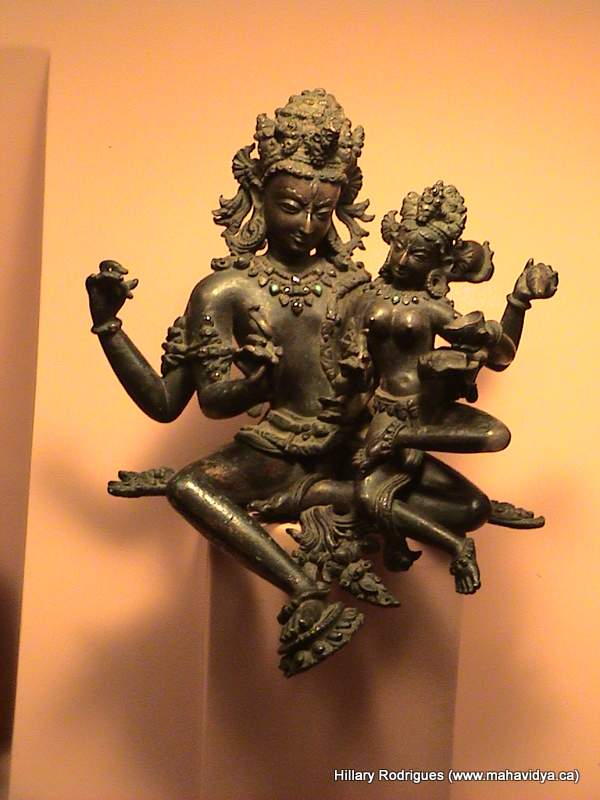
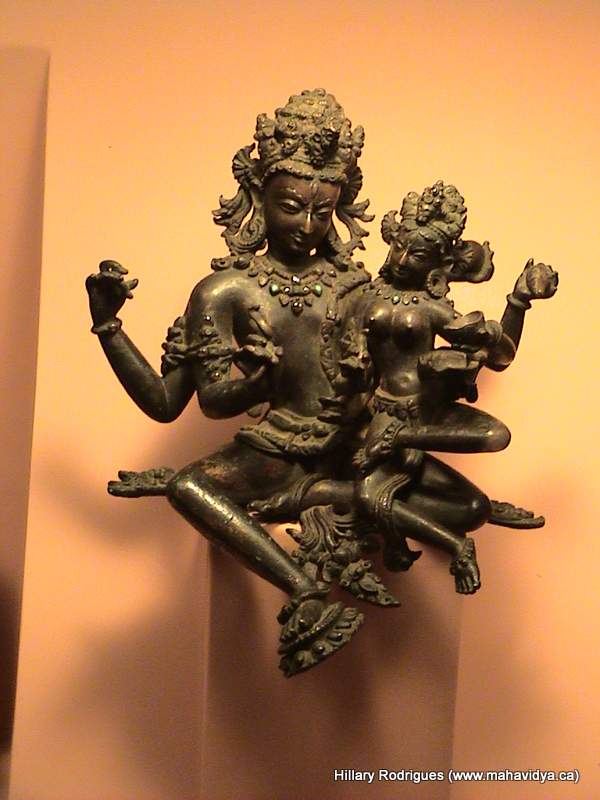
Bronze Masterpiece depicting Siva and Parvati (Patan Museum, Patan, Nepal)

and her knowledge (Kramrisch 356-357). Seven sages were sent to Parvati to dissuade her from her duty and described Siva as being “naked, ferocious, dweller of the cremation grounds, the carrier of skills, a hermit, statue-like in action, a beggar, mad, fond of collecting ugly and terrible things, and inauspiciousness incarnate” (Kramrisch 357). Parvati, in response to their tests, does not deter in her mission and replies to the sages that they do not know the Great God (Kramrisch 357). Delighted with her determination and strength, they return to Siva retelling him what took place. He then goes to Parvati’s parents to ask for her hand in marriage; Parvati’s parents are honoured. The marriage ordeal is described in great detail in many variations of the myth with a common theme. During the marriage procession, Mena, Parvati’s mother sees Siva for the first time. She is outraged by his appearances and threatens to commit suicide and faints when told that the odd-looking figure in the marriage procession is her future son-in-law (Kinsley 43). He turns into something more suitable and beautiful in response to Mena’s cry.

After their marriage, Rati, Kama’s widow is said to have brought Siva to the ashes of Kama where Kama, as beautiful as before and wielding bow and arrows, emerged from the ashes (Kramrisch 363). Siva and Parvati then retreat to his mountain dwelling, Mount Kailasa, where they engage in intense sexual activity. Their lovemaking becomes so intense that it is said to have shaken the cosmos, frightening the gods (Kinsley 43). Parvati, according to Brahma’s plan, longed for a son of her own. As their lovemaking continued, the gods, in some texts, became impatient and scared of the child that would come from these two great deities. In one instance, the gods interrupt Siva and Parvati during sexual intercourse, causing Siva to spill his semen outside Parvati (Kinsley 43). This fiery, potent seed was transferred from one container to another, in many variations of the myth, where eventually it settles in a suitable place, often in the Ganges River, where it is incubated and born as the child Karttikeya.  The boon granted by Brahma to Taraka, the king of the demons, had been fulfilled and the child born of Siva seed defeats Taraka and rescues the world from utter chaos. After some time, Karttikeya finds his parents, where Parvati accepts the child as her own (Kinsley 43).

The Puranas identify Parvati’s willingness to have another child. Siva, on the other hand said ‘I am not a householder and I have no use for a son’ (O’Flaherty 1973: 211). However, Parvati still insists on having a child telling Siva that once they conceive a child he can return to his yoga, leaving all of the parental responsibilities to Parvati (O’Flaherty 1973:211). Siva yet again refuses to give into her request. Instead, in desperate want of a child, she creates Ganesa from the dirt and sweat of her body and commands him to guard the entrance of her house against any intruder (Kinsley 44). When Siva tries to enter their hermitage, Ganesa denies his entry. This infuriates Siva and leads him to decapitate young Ganesa. As a result, Parvati becomes upset and demands that Siva restore Ganesa’s life (Kinsley 44). Siva restores Ganesa to life yet with the head of an elephant and is said to have been put in charge of all Siva’s troops and heavenly attendants (Kinsley 44).

Siva and Parvati’s marriage and family life is portrayed as harmonious, blissful and calm. Some quarrels, recounted by some of the Puranic myths, occur throughout their marriage, where they leave each other for a brief period of time to practice their austerities, but eventually end up together recovering from their altercation because of the intimate love and devotion they have for each other.  Siva is a god of excesses, both ascetic and sexual, and Parvati plays the role of modifier (Kinsley 49). Much of the tension and conflict exhibited by this divine couple is identified with the concept that Parvati is Siva’s sakti, or power, which is often personified in the form of a goddess (Kinsley 49). Her role as sakti is active, in that she is sometimes identified with prakrti (nature), whereas, Siva is identified with purusa (pure spirit). Without Parvati, Siva’s power ceases to exist. Parvati’s sakti not only complements Siva, she completes him. The reason for Parvati’s existence is just that; the celestial world would not exist if it weren’t for their undying love for each other. Many metaphors illustrate this dependence on the couple as complementary opposites throughout the Purana texts. It can be argued that the two are actually one-different aspects of ultimate reality- and such are complementary, not antagonistic (Kinsley 50).


REFERENCES AND FURTHER RECOMMENDED READINGS

Kinsley, David (1986) Hindu Goddesses. Berkeley: University of California Press.

Kramrisch, Stella (1981) The Presence of Siva. United States of America: Princeton University Press

O’Flaherty, Wendy D. (1975) Hindu Myths. London: Penguin Group

O’Flaherty, Wendy D. (1973) Siva: The Erotic Ascetic. London: Oxford University Press.

Rodrigues, Hillary (2006) Hinduism: The eBook. An Online Introduction. Journal of Buddhist


Related Topics for Further Investigation

Taraka

Brahma

Asceticism

Austerities

Tapas

Mount Kailasa

Kama

Puranas

Kali

Sakti

Prakrti

Purusa

Ganesa

Karttikeya

Inauspiciousness

Rati

Noteworthy Websites Related to the Topic

www.webonautics.com/mythology/shiva_parvati.html

www.lotussculpture.com/parvati1.htm

http://en.wikipedia.org/wiki/Parvati

http://en.wikipedia.org/wiki/Shiva

http://www.religionfacts.com/hinduism/deities/shiva.htm

Article written by: Rachael Collette (March 2010) who is solely responsible for its content.

Siva and Demons

Siva is regarded as one part of the Great Hindu Trinity, alongside Brahma and Visnu. Brahma is the creator, Visnu the preserver and Siva the destroyer of the universe (Ghosh 13). Siva resides on Mount Kailasa along with his wife, Parvati. While he is known as the destroyer of the universe, Siva possesses a myriad of contradicting qualities. He is both terrible and benign; the supreme ascetic, yet a symbol of sensuality; granter of boons to those who are most devoted to him, and destroyer of those who displease him. It is these qualities which result in some interesting encounters with various demons.

While we can call some of the beings that Siva encounters and battles with “demons” in English, there is not always a clear-cut line between good and evil in Hinduism. Although gods are supposed to be different from demons, there is not always a clear cut distinction between the good characteristics of one and the evil characteristics of the other. While most Hindu demons behave in the way that is expected of them in the West – stealing, killing, raping, generally being evil – there are some demons in Hindu mythology that are righteous and practice asceticism. It is through this asceticism that the gods grant boons to these “good” demons, and it is through the abuse of these boons that they become evil. Siva’s mythology tells of encounters of both “evil” demons and “good” demons, and has even granted boons to some “good” demons, only to have them turn around and use their boons against him.

It is possible for demons to be born from gods, and for gods to cleanse demons of their “demon-ness”. The story of Andhaka illustrates both concepts. Once, Parvati covered Siva’s two eyes, and a drop of sweat fell into his third eye. From this, the demon Andhaka was born, with Parvati as his mother and Siva as his father. Siva saw the evil that Andhaka was capable of and gave him away to the demon king Hiranyaksa to raise. When Andhaka was older, he inherited Hiranyaksa’s kingdom. After meditating and sacrificing pieces of his own flesh, Andhaka was able to request a boon from Brahma. Andhaka wanted to live forever, but as all things must eventually die, Brahma could only grant him near immortality; Andhaka had to declare the conditions for his death. Wanting to make the conditions near impossible, Andhaka wished that his death would only come when he developed feelings for his own mother and that even if he desired his own mother, only Siva could kill him. One day, while in the forest, Andhaka encountered an ascetic and his beautiful wife. Andhaka tried to seduce the woman and demanded that the ascetic surrender his wife, as a man who had renounced his worldly ways would have no need for a beautiful woman. The ascetic refused, to which Andhaka sought to do battle with him, not knowing that the beautiful woman he lusted after was Parvati, his mother. This meant that the ascetic with whom he challenged to battle was Siva. Siva impaled Andhaka with his trident and burned him with his third eye. Siva’s third eye was so powerful, he not only burned away Andhaka’s body, but also his sins and demonic ways. Then Siva gave Andhaka a form with three eyes, a blue neck, and matted hair, and Parvati adopted him as her son (O’Flaherty 1973:191).

When seduction is used by both Siva and his enemy, Siva emerges supreme by virtue of his sexual powers (O’Flaherty 1973:184). Siva once commented on Parvati’s dark complexion, which angered her. She left to perform austerities to lighten her skin color and assigned her attendant, Viraka, to guard the door, fearing her husband’s lust would get the better of him and he would sleep with another woman before she could return. While she was gone, Adi, the shape-shifting son of Andhaka, learned of her absence, and devised a plan to avenge his father’s death by killing Siva. Adi figured that if he could destroy Siva’s linga (phallus), Siva himself would be ultimately destroyed. He snuck into Siva’s palace by transforming himself into a snake and slithered past Viraka undetected. He then transformed himself into Parvati, but placed sharp teeth inside the vagina. When Siva saw Adi in his Parvati form, he embraced him/her, but was suspicious that Parvati would return before completing her austerities. He began to look at his wife more closely and seeing that the Parvati in front of him was missing a birthmark, Siva suspected that it was a demon in disguise. He then placed a thunderbolt on the tip of his linga, and while making love to Adi, killed him with it.

So far, Siva has been shown to be able to spawn demons and to kill demons, but Siva also from time to time helped demons out. The demon Bana is one of these cases. Bana was the son of the demon Bali, but Siva and Parvati adopted him as their own son. With the backing of Siva, Bana became strong and hungered for war. He once complained to Siva that there were no wars to fight and that he was depressed. Siva smiled and told him that when his flagstaff fell, a great war would come to him. When Bana’s flagstaff broke, he happily relayed Siva’s message to his minister, Kusmanda, but Kusmanda, who was more level headed than Bana, could sense trouble brewing. Bana’s daughter, Usa, wanted a husband and Parvati told her that one night she would have a dream where a man would come to her and join with her in sexual union. The man in that dream would be her future husband. Sure enough, one night she had this dream and the man was Aniruddha, the grandson of Krsna. The problem lay in the fact that Krsna and Bana were sworn enemies. Usa asked her friend Citralekha to find Aniruddha and bring him to her, which she did. The two had a secret love affair, but Bana found out and sought to punish Aniruddha. Aniruddha proved to be an experienced fighter and Bana could not defeat him in physical combat. Under the advice of Kusmanda, Bana resorted to magic instead and managed to tie Aniruddha down with ropes made from snakes. Bana was about to kill Aniruddha, but the wise Kusmanda suggested that since the boy was such a great warrior, it might be better to inquire as to who he was and to protect him instead of killing him. If he did manage to secretly marry Usa, it would not look good if Bana killed his own son-in-law. Meanwhile, Krsna heard about Aniruddha’s capture and mobilized a great army to Bana’s capital, set on either rescuing his grandson or avenging his death. Bana’s army and Krsna’s army collided on the battlefield, but Krsna’s force proved to be the better and Bana was forced into a corner. This was unacceptable to Siva, who felt he needed to protect his adopted son, so he sent his own army to help Bana and even stepped on the battlefield himself. The war turned into a battle between Siva and Krsna, who was an avatar of Visnu. The Earth was under great stress from the war and Brahma requested that Siva step out of the fight, since both Siva and Visnu were invincible, so the fight would be never-ending. With Siva gone, Bana had no chance of victory and was facing defeat, but Siva took Bana away with him and granted him immortality. Aniruddha was rescued and was married to Usa and Bana’s kingdom was given to Kusmanda to rule.

These were only three examples of Siva’s encounters with demons. With Siva’s unique contradicting characteristics and the ambiguity of evilness of demons in Hindu mythology, there are a vast number of demon encounters that were not mentioned. Even the three examples given were only one version each of a myriad of versions for the same story. However, unlike Western mythology, where there is usually a distinct black and white aspect to good and evil, where gods are good and demons are bad, in Hindu mythology, sometimes the gods are good and the demons are bad, but other times, the gods do terrible things and the demons are righteous. Similar to India’s class system, “god” or “demon” is like a class that one can be born into. How one acts in that class is of their own volition.

REFERENCES AND RELATED READINGS

Bhattacharji, Sakumari (2000) The Indian Theogony. New Delhi: Penguin Books India.

Bhattacharyya, Narendra Nath (2000) Indian Demonology: The Inverted Pantheon. Daryaganj:  Manohar Publishers & Distributors.

Ghosh, Mandira (2007) Shiva and Shakti in Indian Mythology. Gurgaon: Shubhi Publications.

Michaels, Axel (2008) Siva in Trouble. New York: Oxford University Press.

O’Flaherty, Wendy Doniger (1973) Siva The Erotic Ascetic. London: Oxford University Press.

O’Flaherty, Wendy Doniger (1976) The Origins of Evil in Hindu Mythology. Los Angeles: University of California Press.

RELATED TOPICS FOR FURTHER INVESTIGATION

Adi

Andhaka

Aniruddha

Asura

Bali

Bana

Brahma

Hiranyaksa

Krsna

Kusmanda

Mount Kailasa

Parvati

Siva

Tripura

Usa

Viraka

Visnu

NOTEWORTHY WEBSITES RELATED TO THE TOPIC

http://en.wikipedia.org/wiki/Shiva

http://www.harekrsna.com/philosophy/associates/demons/siva/andhaka.htm

http://www.bronzecreative.com/shiva-hindu-god-statue-nataraja-lord-siva.htm

http://www.hinduism.co.za/siva.htm

http://www.tamilstar.org/mythology/krishna/

Article written by Allan Chiem (March 2010) who is solely responsible for its content.

Mathematics in India

There is little known about the history of Indian mathematics; this is due to a small amount of authentic records containing their mathematics.  The first known mathematics was preserved in the city Mohenjo Daro, during the time of the Indus Valley Civilization.  The Indus Valley Civilization is thought to have been settled around 2,500 B.C.E.  Mathematics was found everywhere in Mohenjo Daro, from its advanced architecture to its methods of measurement, counting and weighing items. The Indus Valley Civilization rivaled the other great ancient civilizations of its time in both knowledge and architecture styles. Examples of their architectural advancements were their tiled bathrooms, brick buildings, and temples, which all required a high level of geometrical understanding (Eves 181).

There is also evidence of a written numerical system imprinted on seals from the Indus Valley Civilization, consisting of the numbers one through thirteen depicted by vertical lines. After the findings at Mohenjo Daro there was little evidence of numbers being written down, but there is evidence of maths and numbers in the Vedas, specifically, the usage of the number eight in the Rgveda.  These writings suggest that even though there is nothing directly stating the numbers, the people of the Indus Valley Civilization must have had a very sophisticated numerical system.  This is in contrast to the Romans whose numerical system did not go farther than ten to the exponent of four, where the Indus Valley Civilization at the same time had knowledge of denominations as large as ten to the exponent of twelve, which is suggested by the Yajurveda Samhita (Singh 20).

After the Indus Valley Civilization disappeared the Aryan peoples started expanding into India. Indian mathematics can be split into two periods; the first of the two, coined the Sulvasutra (also written as Sulbasutra) period, which goes up until 200 C.E.   The Sulvasutras are also texts that are appendices to the Vedas. The literal meaning of Sulvasutra is “the rules of the cord”; the texts written in this period are dated sometime between 800B.C.E. and 200 C.E. (Cajori 84).  It was during this period the great grammarian Panini, who perfected the Sanskrit language and the Buddha became very influential.  There are three different types of ganita (mathematics) found in ancient Buddhist texts; the first is finger arithmetic (mudra), the second mental arithmetic (ganana) and the third higher arithmetic (samkhyana)(Singh 7).

It was also in this period that mathematics were taught and learned for the purpose of geometry, to build temples and aid in other architecture.  The Sulvasutras themselves were part of the Kalpasutras, and explained how to construct the sacrificial altars used in Hindu rituals. The Sulvasutras also contained some of the first references of the formula known around the world today as the Pythagorean Theorem. It is stated in the Sulvasutras the diagonal “…produces as much as is produced individually by the two sides”, which shows they understood the idea of Pythagorean Theorem before it was ever proven as a theorem (Berlinghoff 139).  Among the geometrical rules referring to the Pythagorean Theorem, there are references to the expression of the square root of two down to five decimals; others such as Heron the Elder in 100 B.C.E. also knew a similar method of approximation (Cajori 43).

One of the most famous rulers of the Mauryan Empire (King Asoka 272-232 B.C.E.) gives us an insight as to how early on the Hindu people were using the number system we use today.  King Asoka built stone pillars in every major city in India, many of which still stand today.  It is on these stone pillars we find the earliest examples of the Hindu-Arabic number system that is currently used.  It is not only on these pillars that you can find written numbers, on the walls of a cave at the top of Nanaghat hill (near Poona) are numerous inscriptions of numerals. A more complete list of these numerals can be found in another cave, with these writings dated in the first or second century C.E.  There are different theories as to where these symbols came from.  Some would say they were from the Indus Valley Civilizations pictographic writing; another theory is that they have evolved from the Egyptians pictographs (Singh 26-28). Independently of where they came from, these depictions do not use the zero and decimal system that we now associate with Indian Mathematics (Eves 19).  Even though these are some of the first depictions of our number systems there was no evidence to show the Hindus ever used any other number system (Singh 8).

There is little known about why the base ten system was used, but it is speculated it was due to how we count on our fingers. The Hindus were also one of the first to use a symbol to indicate a place value of zero; the Hindus used a small circle to indicate that the place value was empty.  The mathematicians of India were not only one of the first to have a symbol for the missing place, they were also the first to explore zero as an actual quantity in itself. Thinking about numbers in this way was one major step above the mathematics of the ancient Greeks.  It was thinking about numbers in this abstract way that enabled the Hindus to start doing math algebraically. Unfortunately, the usage of the base ten systems and zero as a number both took centuries to be accepted in European mathematics. It was after this period Hindu Mathematics was able to really flourish (Berlinghoff 80).

As the Sulvasutra period came to an end, Indian Mathematics started to turn towards other practical uses.  This period was called the astronomical and mathematical period, which dated from 400 C.E. to around 1200 C.E. (Cajori 84).  This period was heavily influenced by outside forces; with India being invaded by other empires came outside knowledge of geometry, astrology and other mathematics.  Unlike other countries that quit placing emphasis on investigating sciences while invasions took place, India turned the situation into an opportunity to learn from these new people.  With this new knowledge the Indians placed more emphasis on learning which lead to founding universities.  As a result India became a center for learning everything from the sciences to the arts.  Mathematics had always been one of the most honored sciences, as suggested by the Vedanga Jyotisa, which states: “As the crests on the heads of peacocks, as the gems on the hoods of snakes, so is ganita at the top of the sciences known as the Vedanha.” (Singh 7).

From then on mathematics was found in many different literary works such as the Puranas.  The Puranas are literary works designed to spread education about historical and religious information among the peoples.  Even the oldest of these works have references to place values and the base ten system; there are similar references in Patanjalis Yoga-Sutra.  One of the first important astronomical works was written anonymously and is titled the Surya Siddhanta, which is translated as “Knowledge from the Sun”. The Surya Siddhanta contained mathematics related to astronomical events but however, it did not have a specific section on mathematics.  It did, however, have a more important role in influencing another great piece of literature, written a century later.

Varaha Mihira wrote the Panca Siddhantika, which contains a comprehensive summary of the trigonometry known by the early Hindus.  An anonymous document written on birch bark was found in 1881 that had been buried since perhaps the eighth century.  It is likely a copy of an older manuscript dated (from the style of verse) around the third or fourth century (Cajori 84-85). It contains methods of algebraic computation.  This arithmetic is termed patiganita, coming from the words, pati, which means “board” and ganita meaning “science of calculation”.  Thus patinganita, is the science of calculation that requires it being written.  However, sometimes the carrying out of arithmetic was called dust-work or dhuli-karma because they would write their arithmetic in the sand instead of on a board.

After the Panca Siddhantika was written, the Hindu astronomer Aryabhata wrote his self entitled Siddhanta, which contained a whole chapter on mathematics.  This chapter included one of the best estimations of the irrational number pi (π), the only closer estimation of the time had been made only fifty years prior by a Chinese scholar Zu Chongzhi.  After the Aryabhata, it was common to include a chapter in astronomical texts specifically on the mathematics being used.  Following Aryabhata mathematics continued to thrive in India, spurring on the work of Brahmangupta.

Brahmangupta’s work the Brahma-sphuta-siddhanta (“Revised System of Brahma”) contains two chapters on mathematics, and some of the first rules for negative numbers. Both Aryabhata and Brahmangupta could solve linear equations, with Brahmangupta taking it one step further to solve more difficult equations containing squares.  He was also one of the first to work with negative quantities; regarding them as debts, he stated rules of addition, multiplication, subtraction and division of negatives. Even with these rules stated by a well-known scholar, people and mathematicians alike were still skeptical of these non-tangible numbers.  It was later when Bhaskara II took Brahmangupta’s ideas and generalized them, giving a method of solution of equations nx²+b=y² (whenever a solution existed), as well as solutions with negative numbers (Berlinghoff 25-28, 93-94).

After Bhaskara II, there were few recognized mathematical works, but we do have the works of Sripati.  Sripati wrote a Ganita-sara, which can be translated as the “Quintessence of Calculation”, which helped refine the Hindu method of completing the square (Cajori 94).  During this time period there were great advancements in geometry.  Aryabhata’s advancements in a method of approximating sines, led to his table of sines, which correspond to the particular angle.  This was the beginning of the emphasis on estimation (Berlinghoff 186).

Indian mathematicians took the idea of approximation to another level, taking simple ideas and using them to develop sophisticated formulas to solve or approximate difficult solutions to problems.  With an interest in algebra Indian mathematicians were able to compute square and cubed roots.  They were also able to do the sums of arithmetic progression, this led to mathematics being investigated for its own sake, which you can see in how the problems were worded.  They had essentially the same formula for the quadratic equation as we do today, with their version being expressed in words, as many of their formulas were.  The problems in their texts were often posed in a playful manner, an example from Bhaskara II, describes monkeys skipping through a grove and applying them to the mathematics at hand (Berlinghoff 27).  Many of the mathematicians of India made discoveries of approximation by building upon one another; the formulas becoming more sophisticated as time goes on, it was these discoveries that anticipated ideas later rediscovered by European mathematicians.

Due to the location of India, in comparison to European countries, Indian mathematics almost always traveled to European countries through Arabic mathematicians.  These Arabic mathematicians learned of astronomy, among other ideas as well, and took the Hindu trigonometry and expanded upon it.  It is through this translation of ideas, that many of our mathematical terms are derived; for example “sine” comes from the Hindu jya (a cord for measurement) that the Arabs changed to jiba, which then came to be falsely interpreted as cove which is sinus in Latin, ultimately leading to the modern day “sine” (Berilinghoff 187).

Hindu mathematicians were the first to create many of the numbers and formulas we use today.  It was their number system that allows us to do simple math efficiently and effectively, instead of the minute system used in the Roman Empire. The Hindus were advanced in their geometry, which enabled them to build elaborate temples and cities.  There is also evidence of numbers and their place value system in the Vedas.  This enabled the Brahmins (priestly class) to learn and explore mathematics.  However, it was not only the Brahmins that were able to engage in mathematics, but also the Kshatriyas who took care of war and government matters.  This led to the practical uses of mathematics for temple building, geometry, and most importantly astronomy and helped to pave the way for future generations.

References and Further Recommended Readings:

Berlinghoff, William P. & Gouvea, Fernando Q. (2004) Math through the Ages. Washington: Oxton House Publishers, The Mathematical Association of America

Cajori, Florian (1980) History of Mathematics. New York: Chelsea Publishing Company

Dani, S. G. (1993) ‘Vedic Maths’: Myth and Reality Economic and Political Weekly, Vol. 28 No.31 pp1577-158. Economic and Political Weekly. http://www.jstor.org/stable/4399991

Eves, Howard (1964) An Introduction to the History of Mathematics. New York: Holt, Rinehart and Winston

Flood, Gavin (2004) The Blackwell Companion to Hinduism. Malden, MA: Blackwell Publishing

Gheverghese Joeseph, George (2000) The Crest of the Peacock: Non-European Roots of Mathematics. Princeton: Princeton University Press

Grattan-Guinness, Ivor (1994) Companion Encyclopedia of the History and Philosophy of Mathematical Sciences. New York: Johns Hopkins University Press

Selin, Helaine & D’Ambrosio, Ubiratan (2000) Mathematics Across Cultures: The History of Non-Western Mathematics. Dordrecht, Boston, London: Kluwer Academic

Singh, Avadesh Narayan & Datta, Bibhutibhushan (1935) History of Hindu Mathematics- A Source Book. Allahabad: Allahabad Law Journal Press

Related Topics for Further Investigation

Aryabhata

Bhaskara (I and II)

Brahmangupta

Indus Valley Civilization

Mauryan Empire (King Asoka 272-232 B.C.E.)

Puranas

Rgveda (Vedas in General)

Sripati (Ganita-sara)

Sulvasutra

Surya Siddhanta

Vedanga Jyotisa

Related Websites

http://www.hinduism.co.za/vedic.htm – History of Mathematics in India

http://en.wikipedia.org/wiki/Sulba_Sutras

http://www.archive.org/stream/arabhatiyawithc00arya@page/n3/mode/2up

http://www.math.tamu.edu/~dallen/history/1000bc/1000bc.html

http://library.thinkquest.org/C004708/history.php

Article written by: Kirby Carlson (April 2010) who is solely responsible for its content.