Kabir

Kabir, also known as Kabir the Great, is one of the most famous saints in the Indian tradition (Partin 191). He is a unique saint because both Hindus and Muslims are attracted to his teachings as well as in his sayings (Vaudeville 5052). Some may say he was kind of a mystic poet due to his teachings. His teachings mainly consisted of poems and songs, which were in a language that most Hindus understood. He belongs in the category of the first generation Hindi poets, which contained a Hindi dialect. This dialect is not “amenable” to the classifications of linguists (Partin 191). His works are in the form of mystical poetry of various strengths, which allow the literary aspects to come across with philosophical and religious significance (Stahl 141). Kabir is an individual who was able to give expression to personal experiences of inner divine or absolute reality (Heehs 1).

There is little on the history of Kabir, such as what his personality was like, as well as a detailed biography on him. What is known is that Kabir was born as a low-caste Muslim, also known as a Julaha, around the city of Banaras during the fifteenth century (Vaudeville 5052). He was born in 1440, and passed away in 1518 (Stahl 141). It has been claimed that Kabir was born into a family with a Muslim father who greatly influenced his life (Stahl 141). We know that Kabir was born into a caste of weavers, who had recently become Muslim converts, and was raised in a Muslim lifestyle. It is also believed that Kabir was married, with children, and made his living as a weaver, as the rest of his caste did (Bly ix). However, it is unknown how many children Kabir fathered or who his wife was. Kabir’s family belonged to a caste of married “Jogis” or “Jugis”, which are devotees or performers of jog. By practicing this sect of yoga, they believed they may attain a union with the Supreme Being (Bailey 1). Kabir was also involved in the bhakti movement, which was a reaction against Buddhism, as well as parts of the Vedanta philosophy (Stahl 142). Bhakti was related to Vishnuite devotion, where God is seen as the main object of devotion (Partin 194).

Kabir viewed the world as a moment fading between two deaths in a world of transmigration. He discusses self interest, the woman as ‘a pit of hell’, and man turning to his innermost self in order to find what is true (Vaudeville 5053). He did not see the significance in bonds between family members, because he believed those relations rested on self-interest (Vaudeville 2052). Another main belief of Kabir was that death encompasses all, and there would be no escape for one except to its own heart. For example, the only way to rid one’s self of negatives in life, such as egoism, would be to search one’s own soul to find the answers (Vaudeville 2052). Only those who find the answers or the “diamond” within oneself, has a chance at achieving eternity. This is relatable to the idea of jivatma in Hinduism, which is representative of the individual soul. It was believed by Kabir that if man turned away from the outside world, and focused only on the interior world, then one could be drawn to his innermost conscience. One’s innermost consciousness is related to the status of God, according to Kabir (Partin 196).

The words of Kabir appear to be very tragic, but also show his uniqueness as a poet. The tragedy is present when he discusses the insignificance of family, and how many things remains a mystery in life (Vaudeville 5053). His words are full of metaphors and various rhymes. The works of Kabir are regarded for both their literary qualities, as well as their spiritual qualities (Heehs 26). As a person, as well with his words, he is compared to the Buddha, due to his great voice in India (Vaudeville 2053). Rather than having a positive outlook on the world like many do, Kabir was very pessimistic and focused on intrinsic actions. Some may call him ungodly, but he seems to be one of the masters of “interior religion” (Partin 192). There are many words of Kabir, also known as Kabirvanis. However, there is not a book or authoritative version of them (Vaudeville 2052). The poems, verses and songs recited orally by Kabir were collected by his disciples, as well as various followers (Hess 3). It is believed that Kabir had been illiterate and was unable to ever write anything down. Many followers and critics of his work say, “I don’t touch ink or paper, this hand has never grasped a pen. The greatness of four ages Kabir tells with his mouth alone,” in order to describe what Kabir may have been like, and why his works were orally passed on through generations (Hess 3). There is no way to prove that Kabir was illiterate. However, it is known that Kabir preferred his words to be passed on orally, rather than by paper. His message was so popular that they were widely imitated before they could be written down. Kabir’s works were largely an oral tradition in the beginning, and in most instances, still are. The main topic of Kabir’s songs seems to be that God is the ultimate truth (Dass preface). The oldest dated words of Kabir are found in the Guru Granth of the Sikhs, compiled by Guru Arjun in the Punjab around 1604 (Vaudeville 5052). The poetry was also a union of both the Islamic and Hindu traditions (Stahl 143).

There are many stories about Kabir, but the most famous one involves his death and cremation. It happened in the city of Magahar. As Kabir was about to die, two different groups gathered in order to fight over what would happen to Kabir’s body. The two groups were the Muslims and the Hindus. It is said that after Kabir went into his tent to die, his body vanished, and all that was left was a heap of flowers (Vaudeville 2052). The flowers were divided between the two parties as a way of symbolizing both groups’ possession over the body. The Muslims buried their half of the flowers, whereas the Hindus cremated theirs, and arisen a memorial tomb, also known as samadhi, over it. Since the time of his death, a story has circulated claiming that Kabir was born to a Brahman virgin widow, who committed him to the Gangas, and he was later saved and raised by Julahas. This story attempted to “Hinduize” the saint (Vaudeville 2052).

Some Muslims in the past viewed Kabir as being a Sufi because many of his “words” are similar to those of a traditional Sufi (Vaudeville 2052). Even though Kabir was opposed to some practices of the Islamic religion, he still associated himself with Sufi groups (Partin 195). Modern Muslims and Hindus, however, accept the “words” of Kabir. He is also seen as the unifying force between the two religions, even though he himself expressed rejection of “two religions”. Kabir was also against idol worship and caste distinctions, this was because he used several Vaisnava names to speak of God. He, in turn, saw the idols as lifeless stones (Partin 192). Kabir also discusses the importance of purity, fasting, pilgrimages and other ritual practices throughout his various works. A verse Kabir’s pertaining to the ritual washing, discusses the importance of physical and spirtual cleansing. Kabir states, “What is the good of scrubbing the body on the outside, If the inside is full of filth? Without the name Ram, one will not escape hell, even with a hundred washings!” (Kabir 192). His notion of God also seemed to be more than that of worshipping a personal god, as he alludes to a reality that is beyond words, rather than a god (Vaudeville 2052).

Another interesting fact about Kabir, and his poems, is that he sometimes speaks as a man, and other time speaks as a woman. An example is, “This woman weaves threads that are subtle, and the intensity of her praise makes them fine. Kabir says: I am that woman” (Bly xv). This is interesting because it gives Kabir various identities through his literature.

Kabir, who does not have much of a bibliography is seen as being very popular in various religions. He is one who, through his own intimate experience, believed that God is “the One,” “the True,” and “the Pure” (Partin 201). According to Kabir, God is the only one who is able to meet the challenge of death, because he is the perfect guru (Partin 201). Kabir believed the only way one can interact with God, was to delve into the very depths of one’s own soul, and only then, would God be able to speak with one. Even though Kabir may have rejected the teachings of other religions, he was still followed by many, and created his own group.

Bibliography

Bailey, Jan (2006) Jogis http://www.shivashakti.com/jogi.htm.

Bly, Robert (2007) Kabir: Ecstatic Poems. Boston: Beacon Press.

Heehs, Peter (2002) Indian Religions: A Historical Reader of Spiritual Expression and Experience. New York: New York University Press.

Hess, Linda Beth (2001) The Bijak of Kabir. New York: Oxford University Press.

Partin, Harry and Charlotte Vaudeville (1964) “Kabīr and Interior Religion.” History of Religions 3: pp. 191-201.

Stahl, Roland (1954) “The Philosophy of Kabīr” Philosophy East and West 4: pp.141-155.

Vaudeville, Charlotte (2005) Kabīr Encyclopedia of Religion. Ed. Lindsay Jones. Vol. 8. 2nd ed. Detroit: Macmillan Reference USA, 2005. p5051-5053

Related Topics

Jog

Bhakti

Vedanta

Sufism

Buddhism

Vaisnava

Samadhi

Guru Granth

Related Websites

http://en.wikipedia.org/wiki/Kabir

http://www.boloji.com/kabir/

http://www.cs.colostate.edu/~malaiya/kabir.html

http://www.poetry-chaikhana.com/K/Kabir/

http://www.vidyasoft.com/interest/poems/kabir.html

http://philtar.ucsm.ac.uk/encyclopedia/hindu/devot/kabir.html

Article written by: Megan Heck (March 2009) who is solely responsible for its content.

The Gupta Dynasty

Ancient India experienced prolific cultural and political advancement under the reign of the imperial Guptas. The Guptas carried the torch of classicism and it was under their reign that early India saw significant advancements in mathematics, art, architecture and drama (Saunders 106). These progressions are attributable to strong leadership by the great rulers of the Gupta Empire as well as advantageous connections through marriage and the practice of relatively peaceful external relations (Avari 156). The relatively blissful condition in which the Guptas reigned is portrayed well by Fa Hian, a Chinese pilgrim who had the opportunity to witness the Guptan civilization under Chandragupta II. Fa Hian, praised the lifestyle of the Guptas who “ruled without corporal punishment… [and] abstain from taking life or drinking wine…” (Saunders 105).

The empire, originating from a relatively small land plot in the “western Ganga plains” (Avari 155) grew quickly and eventually encompassed the majority of continental India. The vast expansion of Guptan territory is connected to the conquests and acquisitions of the great Guptan emperors. The first of these distinguished rulers was Chandragupta I, who would be succeeded by two emperors that would successfully transform continental India. Samudragupta was a leader of great power and influence and it is under him that the Guptas vastly expanded their territory. He swelled their lands by subduing much of Bengal and by obtaining some influence “as far west as the Indus river, and over most of central and eastern India, as far south as Kanchi.” (Robb 39). Samudragupta was a skilled tactician on the battlefield, according to writings inscribed on an Ashokan pillar; Samadragupta was responsible for the submission or defeat of over a dozen ancient Indian kings (Avari 157). Like most monarchs, Samadragupta was a well rounded intellectual and scholar. His son, Chandragupta II (Vikramaditya) would reign until 415 C.E. and would also expand Gupta territory significantly through marriage as well as military conquest (Avari 158). His great military campaign would be against the Shakas of western India, who he would eventually subdue (Robb 39). Ancient Gupta coins exemplify the importance of the ksatriyas (warrior) expansionist type mindset. Coins dating from the reign of Chandragupta II depict the king, armed with a bow combating a lion (Emeneau 86).

The Gupta dynasty expanded its territory through a policy of militarism but within its own borders, the Guptas displayed an enlightened sense of the arts and political structure. Literature flourished under the Gupta dynasty, many works were written in Sanskrit and it is believed that the Guptas played a significant role in legitimizing the language. Like his father, Chandragupta II was a well rounded scholar and had a definite affinity for the arts. Chandragupta II encircled himself with poets and intellectuals (Avari 171). The Shakuntala is one of the most notable pieces of literature to come out of the Gupta dynasty. It is a play that tells a story of romance between Shakuntala and King Dushyanta (Avari 171).

Politically, the Guptas moved towards a system of medieval feudalism. Although the Gupta emperors were considered to be all powerful they did not rule by a system of absolutism, but were governed by a policy of rajadharma (royal dharma). Which basically prescribes that royalty be governed by “fundamental ethical considerations” (Derrett 606). The policy did not promise protection and justice but that the “king should rule his subjects (including of course, the brahmins) in such a manner as to give general satisfaction…” (Derrett 606) Essentially, the Gupta emperors ruled with a political hierarchy in which conquered kings could be spared and could continue to rule their respective kingdoms within Gupta territory as long as wealth was shared (Avari 159). Bureaucracy was kept basic and the Guptas ruled lightly, allowing for the highest degree of cooperation between the various differing and newly annexed or conquered Gupta communities.

The Guptas were generous with land. The distribution of land plots throughout their domain allowed them to maintain a continued sense of order over their large territories. Grants entitling members of the society to land were not uncommon and were most often given to men that belonged to the priestly class (brahman). The Puranas uncover some evidence as to why land was so commonly distributed to the brahman. According to the sacred text, land could be contributed as a way to obtain a certain level of religious merit (Avari 164). Land could also be bestowed upon crown officers, military generals or skilled craft workers (Avari 163). As opposed to the reasoning behind the donation of land to the priestly class, the giving of land to the other castes can be explained by way of payment, as international trade between Rome and the Levant was diminishing (Avari164).

Although the Guptas were in many ways ahead of their time with respect to social order and government they continued to follow a somewhat rigid order of caste. The Chandalas (outcastes) were prosecuted, as they are to some extent in modern India. Members of the lowest caste were required to live outside of population centers. When entering a town, they were obliged to make their presence known by creating audible noises with two pieces of wood, warning people belonging to more distinguished castes of their coming (Smith 171). This being said, there is some evidence that points towards a certain degree of caste mobility under the Guptas. Land grants allowed groups that were largely outside the realm of caste to be included within it (Avari 166). There was also some evidence that pointed towards the reduction of the connection between caste and occupation as lower castes were in some cases able to perform the duties of the upper castes (Avari 167).

The great Gupta Empire can be compared with the other great civilizations of history. This classical age saw advancements not only on a cultural level but to some extent on a social level. Through military conquest and strategic marriage, the Guptan emperors would rule most of continental India for over two hundred years. Constant invasions from the North West, by the White Huns would eventually weaken the Guptas and end this classical age (Thapar 286).

REFERENCES AND OTHER FURTHER READING

Avari, Burjor (2007) India, the Ancient Past : a History of the Indian Sub-Continent from c. 7000 BC to AD 1200. New York: Rutledge.

Derrett, Duncan (1976) “Rajadharma.” Journal of Asian Studies, 35, no. 4, 597-609. http://www.jstor.org/stable/2053673.

Emeneau, Barry (1953) “The Composite Bow in India” American Philosophical Society, 97, no. 1, 77-87. http://www.jstor.org/stable/3143734.

Robb, Peter (2002) A History of India. New York: Palgrave.

Smith, Vincent (1981) The Oxford History of India. New York: Oxford University Press.

Saunders, Kenneth (2002) Great Civilizations of India. New Delhi: Shubhi Publications.

Thapar, Romila (2003) Early India: From The Origins to AD 1300. Los Angeles: University of California Press.

Related Topics for Further Investigation

The Kushans

Karma Sutra

The Visit of Fa Hsien

Skandagupta Chandalas (untouchables)

The Shakuntala Noteworthy Websites Related this Topic

http://en.wikipedia.org/wiki/Gupta_Empire

http://encyclopedia.stateuniversity.com/pages/9245/Gupta-Empire.html

Written by Evan Gregory (Spring 2009), who is solely responsible for its content.

Saiva Siddhanta

Saiva Siddhanta is a bhakti (loving devotion) tradition. This system is a dualist (this is somewhat problematic but will be discussed in the section on philosophy) form of Saivism that has ancient roots in north India, though is most popular now in southern Tamil regions of India (Prentiss 1996). The goal of this system is ultimately liberation (moksa) from the cycle of rebirth, achieved through the Lord (Siva).

Hillary Rodrigues translates Saiva Siddhanta to mean “the ultimate goal of Saivism” (Rodrigues 270). In a definition that expands from a literal translation to one more anchored in the Indian philosophical system, Dr. S.C. Nandimath tells us that Saiva Siddhanta “means a system of Saivism, the doctrines of which are logically proved and are accepted as true” (Nandimath 80). The portion about being “logically proved” will come up again when we turn to Saiva Siddhanta philosophy. In the past, Saivism and even Saiva Siddhanta had a very strong presence and development in northern India (Gwalior state for example), though now it appears to be most influential in southern Indian Tamil regions and Sri Lanka (Prentiss 1996).

Saiva Siddhanta is an ancient system that has an equally long textual tradition. Tracing its history through its literature we see that Saiva Siddhanta seems to have gone through earlier phases to later become the influential tradition it is now. According to the tradition the Saivagamas are the original works, but according to Nandimath “available copies are very corrupt; therefore an attempt to determine their age on linguistic evidence must be abandoned at present” (Nandimath 80). This is important because it directs us towards a more historical study, as does Nandimath’s approach to Saiva Siddhanta literature. In the earliest phases the literature appears to be somewhat ambiguous. The tradition appears to be found in inscriptions as early as 6th or 7th (Nandimath 80) century with the Pallava king Rajasimha. Nandimath also tells us that there is a very important link with the Saivacayas. He argues that the Saivacaryas became prominent around 900 CE (Nandimath 82) and had links with Saiva Institutions (mathas). It is through monasteries, and mathas that Saivism, and particularly Saiva Siddhanta was spread through out India. According to Nandimath the Saivacaryas were not simply Saivites; many were followers and teachers of Saiva Siddhanta. Vairocani and Srikanthasiva are said to significant Saivacarya teachers of Siddhanta doctrine. This demonstrates that as early as the 6th or 7th century, Saiva Siddhanta existed in some form and that it was spreading and still popular nearly one-thousand years later. This has been a short history of a massive amount of literature of Siddhanta Saivism produced over around two-thousand years of existence.

Ultimately, all Saivism sects directly trace their lineage back to the sage Durvasa. Somananda wrote that there was a time in which all rsis, the Saiva Sastras and their knowledge disappeared. This seems to have been heralded as a particularly spiritually bleak time. As mythic accounts tell, Siva took pity on the mortals and went to a particularly chaste sage named Durvasa, and charged him with spreading the sastras (Nandimath 83). Durvasa in kind “charged [his three sons]… with establishing spiritual order and of teaching men again the…Saiva faith and doctrine in their three aspects of Unity, Diversity, and Diversity in Unity” (Nandimath 83-84). Tryambaka is the immediate ancestor (after Durvasa) of Somananda, who is held to be responsible for establishing Kashmiri Saivism. There is disagreement as to which branch of Saivism was originally established by Somananda in Kashmir. Dr. S.C. Nandimath argues that because Tryambaka was charged with teaching the aspect of Diversity (here the dualist or rather the pluralist Saivism), it is most likely that Somananda and his ancestors also taught the dualist version of the Trika; “Trika refers to the triad of God, souls, and bonds, with which the philosophy deals” (Rodrigues 566). This is problematic because Trika generally is used in reference to a non-dualist philosophy, and has for some time. Rohan A. Duniwala states that Amardaka was “one of the reputed founders” (Dunuwila 26) of the pluralist Saiva Siddhanta. The issue here is on the specific roots and founders of Saiva Siddhanta. The position that Nandimath takes is based on an interpretation of the mythic account of the origin of Saivism (in which Somananda (descendent of Tryambaka) actually taught a dualist version of the trika), where as the argument that Dunuwila makes is based on tracing the history of literature (Dunuwila 27).

Saiva Siddhanta is a dualist tradition, though in reality this tradition appears to be pluralistic. The simile most often evoked to explain the basic elements of Saiva Siddhanta is that of the pot (Nandimath 145). Here Saiva Siddhanta claims “three important eternal entities” (Ibid). The three eternal entities are explained in terms of the evolution of the universe; here the name Siddhanta is evoking the logic previously mentioned. To start Saiva Siddhanta does not deny the reality of the material world. In fact, the existence of the material world is crucial to understanding Saiva Siddhanta. The three basic elements are the Lord (Siva), Matter (the world) and the Soul. These elements are eternal and are eternally different. In this system Siva “is both transcendent, yet immanent in all aspects of creation” (Rodrigues 270). To better understand what the above quote means we can think of the evolution of the universe as being conceived in this way: the Lord creates a pot (Lord and Matter), and only creates a pot for the use of a consumer (soul)(Nandimath 145-146). Through this simile we again see that all is dependent on the Lord and yet is distinct from him. Liberation, as is implied, is achieved through the Lord. The critical distinction in Saiva Siddhanta (that distinguishes it as pluralistic) is that once a soul becomes liberated and realizes it is like the Lord, the soul does not then become (or become united with) the Lord after liberation (i.e. “three eternal distinct entities” and “the Lord is immanent and yet transcendent”). While caught in the cycle of rebirth the soul is completely dependent on the Lord as the source of all knowledge and especially of liberation. By saying that the soul realizes it is like the Lord the system is recapitulating the idea that makes this system dualist; it is saying that the soul is intelligent like the Lord and also is liberated like the Lord. The important piece of information here is that the soul is like the Lord and is never equated with the Lord as per the three eternal entities. This is a major point of philosophical difference between Saiva monists and dualists, as both take Siva to be the immanent factor in the world. The point is that for monists once liberation is achieved the soul is no longer distinct from the Lord (in this system the only reality is Siva), while for dualists (or more appropriately pluralists) the soul and Siva are eternally different.

Bibliography:

Dunuwila, R. A. (1985) Śaiva Siddhānta Theology. Delhi: Motilal Banarsidass

Nandimath, S. C. (2001) Theology of the Saiv¯agamas : a survey of the doctrines of Saiva Siddhanta and Veerasaivism. Thiruvananthapuram : International School of Dravidian Linguistics

Prentiss, Karen Pechilis (1996) Tamil Lineage for Saiva Siddhānta Philosophy. History of Religions, Vol. 35, No. 3 (Feb., 1996), pp. 231-257. Published by: The University of Chicago Press

Rodrigues, Hillary (2006) Hinduism: The eBook an Online Introduction. Published by: Journal of Buddhist Ethics Online Books, Ltd.

Related Terms:

Saivacayas

Mathas

Vairocani

Somananda

Durvasa

Tryambaka

Amardaka

Srinatha

Siva in Srikantha form

Matta-Mayura matha

Websites:

Wikipedia:

http://en.wikipedia.org/wiki/Shaiva_Siddhanta

Saiva Siddhanta Church:

http://www.himalayanacademy.com/ssc/

Saivism.net

http://www.saivism.net/sects/siddha/siddhasaivism.asp

Vedic Books (a good source for books on a variety of topics relating to Hindu religion/spirituality)

http://www.vedicbooks.net

A general google search that has a lot of promising websites:

http://www.google.ca/search?hl=en&q=Saiva+Siddhanta&btnG=Google+Search&meta=

Written by Calvin Gee (Spring 2009), who is solely responsible for its content.
The Yoga Sutras

The Yoga Sutras are ascribed to varying dates around the second century CE (Rodrigues 201). They are not recognized as the establishment of yoga, because yoga and concepts of self-discipline and meditation had been practiced for thousands of years before the writing of the Sutras. Buddhist texts indicate that methods of dhyana (meditative state) (Rodrigues 405) and samadhi (contemplative absorption) (Rodrigues 562) had been well established by the time of the Buddha (Dasgupta 47). Patanjali, a great Sanskrit grammarian, is sometimes credited with the creation of the Yoga Sutras. However, many scholars think the grammarian Patanjali was a different person. Although Patanjali contributed greatly to the growth and doctrines of Sankhya school of Yoga, commentators like Vyasa [To read further on the commentaries by Vyasa see Baba (2005) to help clarify the explanation on the Sutras] concluded that Patanjali was not the originator of yoga but that he was its “editor” (Dasgupta 51). This is position is reinforced when analyzing the character of the book. The Sutras are divided into chapters (pada), which leads on to believe that Patanjali was providing a system of organization to knowledge that already had a thorough foundation. The first three chapters, or padas, are “written by way of definition and classification” (Dasgupta 52) which indicates that this knowledge was “already in existence” (Dasgupta 52). The fourth chapter appears to be a later addition.

If the title of this great work is correctly translated it provides an intensified clarity of the purpose and direction that the Sutras are intended to take. Yoga, essentially meaning to “yoke” and is rooted in Sanskrit literature within the word yuj, (Dasgupta 44) meaning to join and to form a union or connection (Dasgupta 43). Yoga is essentially the act of yoking and/or joining the senses. In older Upanishads the word is understood “in the sense of austerity and meditative abstractions productive of mighty achievements” (Dasgupta 43); this is consistent with the era, as the practice of austerity was popular amongst many devoted Hindus and Buddhists and several other religious philosophies. The word yoga originally applied to the control of steeds and in several sacred texts the senses are often referred to as “uncontrollable horses” (Dasgupta 44). This understanding of the word as a controlling action, or perhaps inaction, is entirely plausible, as the practice of yoga further develops to tame the senses through intense meditation and physical discipline. (Sutra meaning, “thread,” provides the organizational consistency that is needed when such a definitive work is being written. These sutras, or threads, help weave together the fabric of the principles and philosophies of yoga. This provides a legible and tangible blanket of knowledge that allows for expansions and meditation on specific principles to amplify one’s practice.) It is important to understand the linguistic features of the practice of yoga for it helps portray a long history that predates the creation of the Yoga Sutras.

The sage Patanjali depicted according to the myth linking him with the anjali (folded hand gesture)

Yoga cannot be learned by oneself; it is a lifelong spiritual journey that requires the guidance of a guru (“teacher”) (Eliade 10) to further one’s practice. A guru of yoga is often referred to as a yogi (masculine) or yogini (feminine) and he/she is often committed to a journey of samsara (rebirth) and the attainment of moska or nirvana (Eliade 11) liberation or transcendence of rebirth. There are different Hindu schools that claim one should access or attain moksa or nirvana. Yoga is one of the six orthodox Hindu schools and is best represented by Patanjali’s Yoga Sutras and its subsequent commentaries. Patanjali’s work is framed hand-in-hand with the Samkhya philosophy [see Worthington V for an in depth analysis of the Samkhya philosophy. It is important to note and understand the six orthodox schools of Hinduism and the connection and differences interconnecting them all]. Samkhya and yoga are inextricably intertwined with one another and bear much resemblance to one another. It should be noted that Patanjali’s work is the “coordination of philosophical material” (Eliade 16) and the physical practice, which elevates it to an almost philosophical system as opposed to a “mystic tradition” (Eliade 16).

The Yoga Sutras consist of four chapters (pada). The first chapter is the “chapter on yogic ecstasy” (samadhipada), containing fifty-one aphorisms or sutras; the second called sahanapada, contains fifty-five sutras and is the “chapter on realization”; the third chapter, vibhuti, “marvelous powers” also contains fifty-five sutras. When analyzing the fourth chapter it is important to note the amount of sutras because it has noticeably fewer sutras, suggesting perhaps it was a later addition (Eliade 13). The fourth pada has only thirty-four sutras and is called the kaivalyapada, “isolation” (Eliade 13).

The first chapter, samadhipada, pertains to the consciousness of the mind. It is the understanding of thought, or vrtti, and how the human mind is a natural roadblock to reaching the true self. The samadhipada outlines several techniques that try to harness the mind and avoid distractions. In the samadhipada: (Sutras 38) Patanjali proposes a physical guideline to obtain a mental achievement. It appears that by practicing proper breathing techniques one gains control over a sense that is almost entirely involuntary, which reinforces the union of physical and mental to obtain control and release of the constant fluidity of the conscious.

The sadhanapada is the “practical way” of attaining a spiritual awakening. Patanjali discusses the eight limbs of yoga [For further information on the eight limbs of yoga, visit Doran’s website] as a way of practicing union of the mind and body and dismissing obstructions to spiritual attainment. The obstacles that block the path to the attainment of union are outline in this pada, sadhanapada (Sutra 10) and illustrates that the acknowledgement of these hindrances will help dispel them. The sadhanapada also makes note of other branches of yoga and the importance to achieving oneness of mind and body i.e. Ashtanga yoga (meaning the eight limb practice).

The third chapter called the vibhutipada is an expansion on the powers that are “matured with practice.” Gaining and controlling such subtle powers leads to a state of awareness and contemplation (samadhi).

The kaivalyapada is the final stage and goal of yoga and the isolation of one’s self. This chapter essentially focuses on liberation, or moksa, as the yogi/yogini has learned to separate himself/herself from the bondages that obstruct true consciousness. This pada is, as noted, most likely a later addition to the Sutras, as it no longer focuses on the directional guidance, but rather it is a concluding remark on the practice and end point of a spiritual pathway (Johnston).

The Yoga Sutras is undoubtedly one of the most influential texts on yoga, and is influential within the Hindu tradition and for any practicing yogi and/or yogini. The composition of the Sutras does not mark the birth of yoga; rather, it is the systematizing of the yogic pathways towards spiritual attainment. The Sutras provide an organized approach towards the practice of yoga and the union between physical and mental aspects of the human body. The purpose of the Yoga Sutras is not to provide a narrow hallway towards spiritual awakening; rather, it is a guide and allows for meditation and contemplation of every pada and physical step. This text is not self-explanatory, but the journey that the self takes with the help of the Yoga Sutras explains the connection between theory and practice.

REFERENCES AND RECOMMENDED FURTHER READINGS

Varenne, Jean. Yoga and The Hindu Tradition. Chicago: University of Chicago Press, 1976.

Whicher, Ian. The Integrity of the Yoga Darsana: A Reconsideration of Classic Yoga. New York: State University of New York, 1954.

Rukmani, T.S.. Yogasutrabhasyavivarana of Sankara. 1 and 2, Samadhipadah and Sadhanapanah. New Delhi: Munishram Manoharlal Publishers, 2001.

Dasgupta, S.N. Yoga Philosophy: In Relation to Other Sytems of Indian Thought, India: Shri Jainendra Press, 1930, 2974, 1979.

Eliade, Mircea. Patanjali and Yoga. United States of America: Shocken Books, 1975.

Baba, Bangali. Yogasutra Patanjali. Motilal Banarsidass Publishers, 2005.

Johnston, Charles. The Yoga Sutras of Patanjali: The Book of the Spiritual Man. Kensinger Publishing, 2006. NOTEWORTHY WEBSITES ON THIS TOPIC

http://www.yogamovement.com/texts/patanjali_book1.html http://www.swamij.com/yoga-sutras.htm http://www.sacred-texts.com/hin/yogasutr.htm

http://www.srds.co.uk/begin/samkhya.htm (Worthington V) http://www.expressionsofspirit.com/yoga/eight-limbs.htm (Doran)

RELATED TOPICS AND TERMS

Ashtanga Yoga

Dhyana

Eight Limbs of Yoga

Guna

Hatha Yoga

Moksa/Nirvana

Om

Raja Yoga

Samkhya Philosophy

Six Orthodox Schools

Vyasa

Article written by: Kelsay Gault (March 2009) who is solely responsible for its content.

The Jagganatha Temple

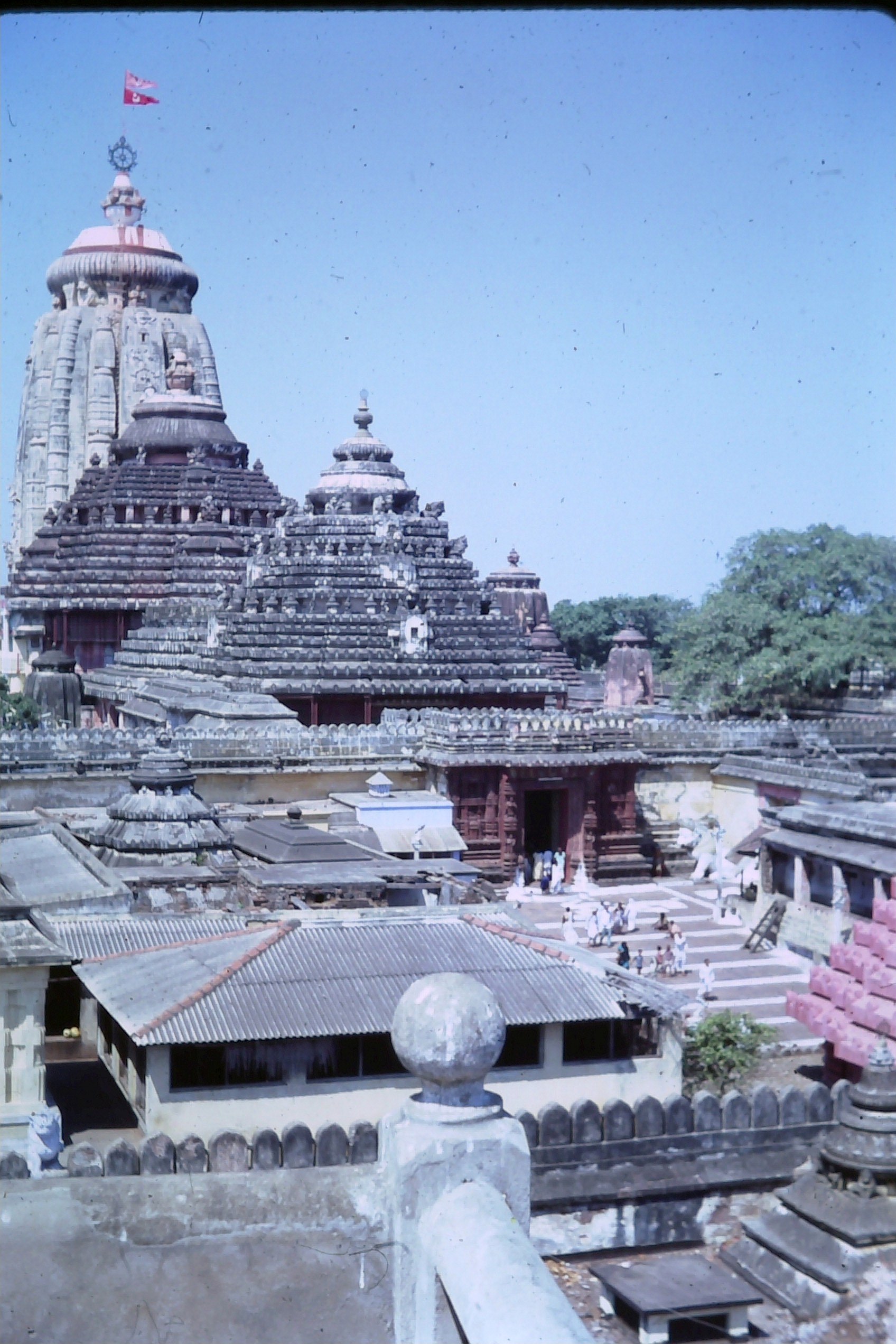
The Jagganatha Temple is a major Hindu temple and religious shrine located in Puri. Puri is a city in the eastern Indian state of Orissa on the Bay of Bengal. Puri is the modern name of this holy city, yet a large number of pilgrims call it Jagganatha Puri. Jagganatha Temple is the most famous temple in Orissa, and one of the most famous in India (Fabri 103). The word Jagganatha refers to Natha (master) of Jagat (universe). The origin of the Jagganatha cult has been traced back to time of the Veda (Pasayat 5). The city and temple is considered by Hindus to be one of the four dhams in India. The dhams are believed to be the abodes of Hindu gods, and the holiest places of pilgrimage (Patnaik 1). The building of the temple was started by the Ganga king Chodagangadeva, but scholars are not unanimous regarding the period of its construction (Satapathy 46). Although the exact date is debatable, construction began sometime in the 11th to 12th century. The temple construction was finished by Chodagangadeva’s descendant Raja Ananga Bhima Dev III (Pasayat 5).

Jagganatha Temple is a huge building that dominates the seaside town, and the tower can be seen from seven miles away (Fabri 148). The temple has a flight of stairs with 22 steps and measures 63 meters in height. The temple complex covers an area of over 400,000 square feet, and is surrounded by a high fortified wall. The outer wall is heavily decorated with carved divine figures and other floral and geometrical motifs and measures 202.7 x 196.3 meters (Patel 72). The complex contains at least 120 temples and shrines. The main temple is a curvilinear temple and on the top is the srichaka (an eight spoke wheel). The temple tower is on an 8 meter elevated platform (Patel 71). The temple has four gateways at each cardinal direction. The Singha Dwar (lion gate) is the eastern gate, the Aswa Dwar (horse gate) is the southern gate, the Vyaghra Dwar (tiger gate) is the western gate, and the Hasti Dwar (elephant gate) is the northern gate. Centuries of whitewashing the temple has obliterated almost all evidence of its antiquity and art. The whitewashing has built up a layer of surface coating estimated at over a foot in depth which hides the facade (Fabri 103). The temple is built of Khondalite stone without the use of mortar; instead iron dowels have been used to keep the stone blocks in position. There has been profuse damage done to the temple structure overtime caused by the iron dowels oxidizing, water seepage and structural pressure (Patel 72). There have been a lot of conservation efforts in the recent years to repair damages to the temple. During the process of conservation the original look of the temple was maintained, nothing new was added nor was the original look disfigured at any time.

The Jagganatha Temple in Puri, renowned for its chariot festival, known as the Ratha Yatra; Odisha, India

The temple is revered as the home of Lord Jagganatha, the Lord of the Universe; his origin and worship is shrouded by myths, legends and traditions (Mahalik 1). Lord Jagganatha is a revered and ancient deity, who was originally worshiped by tribes (Mahalik 1). In the temple there are wooden images or statues of the worshipped deities that exhibit strong tribal influences. The deities Jagganatha and his elder brother Balabhadra and sister Subhadra, are carved out of wood and are peculiarly handless. The legend goes that a carpenter Vishwakarma carved the deities out of a log. He instructed everyone not to disturb him while he was in the temple carving. Unfortunately the queen got impatient and went in the temple before Vishwakarma was finished. He was so upset that he left without finishing and that is why the statues are unfinished. The deific images are carved out of wood from the specially-grown Daru (Neem) trees every 12 to 19 years according to the lunar calendar (Patnaik 4). When the old statues of Jagganatha, Balabhadra and Subhadra are replaced with new ones the brahmapadartha (the life substance) is taken out of the old statues and is placed in the new statues (Satapathy 159). The three deities are kept in the Garbhagrha (sanctum sanctorum) of the temple unless they are taken out for a festival (Barik 19). The persons entrusted with the Sevapuja (ritual services/activities) of the deities are known as Sevakas. The tradition plays a pivotal role in the temple and the Sevapuja rites are not only numerous but also remarkably varied (Pasayat 6).

It is said that there are twelve important yatras (festivals) celebrated at the Jagganatha temple, but there are many more observed at the temple. The temple is most famous for the Ratha Yatra. The Ratha Yatra is one of the holiest rituals in Hinduism; it is also known as the Car or Chariot Festival. It is an annual festival held in Puri at the Jagganatha temple on Asadha Sulkla Dwitiya, which is the second day of the bright fortnight of Asadha (June-July). On this day, the three deities are taken out of the temple and loaded onto very large wooden rathas (chariots). The deities are carried to their rathas in a traditional ceremonial manner called Pahandi when Lord Jagganatha and Balabhadra are swung back and forth. Tradition states that Lord Balabhadra comes out first, followed by Devi Subhadra and then Lord Jagganatha (Barik 20). Lord Jagganatha’s ratha is known as Nandighosha; it has 16 chakras (wheels) and the colors of the fabrics that cover it are red and yellow. Lord Balabhadra’s ratha is known as Taladhwaja; it has 14 chakras and the fabrics that cover it are red and green. Devi Subhadra’s ratha is known as Debadalana; it has 12 chakras and the fabrics are red and black (Barik 20). Four small brass statues of the deities Sudarsana, Madanamohana, Lord Rama and Lord Krsna are also put onto the rathas. Once all the deities are placed on their respective rathas the floor of each ratha is swept by the Gajapati Maharaja of Puri. “This signifies that even the highest sovereign power of the state is only a sevaka (servant) before the almighty” (Barik 20). The rathas are then each attached to four horses and ropes are tied and then pulled by devotees irrespective of caste, creed, sect, religion or sex (Patnaik 4). The rathas are taken to Sri Gundicha Temple, which is about three kilometers away from the Jagganatha Temple, along the Bada Danda (Grand Road). The festival ends once the deity statues have been brought back to the Jagganatha temple; the festival lasts for nine days. Another Jagganatha festival, the Chandana Yatra begins the construction of the rathas. It starts from Akshya Trutiya which is the third day of the bright fortnight of Baisakha (April-May) (Barik 18). And Niladri Mahodaya is celebrated on the eighth day of the bright fortnight of Baisakha (April-May). The festival is to celebrate the day Lord Jagganatha was first worshipped in this Kshetra (holy precinct). For this festival, an abhisek (bath) is performed and 108 pots of consecrated water are offered to the deities (Barik 19).

Related Topics for Further Investigation

Hindu Pilgrimages:

Allahabad

Ayodhya

Shri Badrinathji

Barsana

Gangotri

Goverdhan

Shri Kedarnathji

Mathura

Varanasi

Vrindavan

Yamunotri

Hindu Yatras (Festivals):

Amarnath Yatra

Chardham Yatra

Kailash Mansarovar Yatra

Vaishno Devi Yatra

Diwali

Holi

Hindu Temples:

Angkor Wat

Varanasi

BAPS Shri Swaminarayan Mandir (Toronto)

Gurmandir Temple (Toronto)

Noteworthy Websites Related to Jagganatha Temple

http://en.wikipedia.org/wiki/Jagannath_Temple_(Puri)

http://www.hvk.org/articles/0802/85.html

http://www.jagannathtemplepuri.com

http://www.templenet.com/Orissa/puri.html

http://www.iskcon.com/culture/holy_places/j_puri.html

http://www.time.com/time/magazine/article/0,9171,892784-2,00.html

http://www.indialine.com/travel/orissa/puri/jagannatha-temple.html

http://jagannath.nic.in/

http://www.veda.harekrsna.cz/encyclopedia/rathayatra.htm

References and Further Recommended Reading

Barik, Sarmistha (2007) Festivals in Shri Jagannath Temple. Department of Information an Public Relations Government of Orissa.

Bhardwaj, Surinder Mohan (1968) Hindu Places of Pilgrimage in India. University of California

Fabri, Charles Louis (1974) History of The Art of Orissa. London: Longman Group Ltd.

Michell, George (1977) The Hindu Temple. Toronto: Fitzhenry and Whiteside Ltd.

Patel, Dr. C.B. (2005) Shree Jagannath Temple, Puri and Its Conservation Scenario. Department of Information and Public Relations Government of Orissa.

Patnaik, Jitendra Narayan (2008) The Four Dhams. Department of Information and Public Relations Government of Orissa.

Patnaik, Lalmohan (2008) The Holy City Puri. Department of Information and Public Relations Government of Orissa.

Pattanayak, Pramod Chandra (2008) The Unique God, Lord Jagannath. Department of Information and Public Relations Government of Orrisa.

Satapathy, Niranjan (2000) Religious Life in Orissa. Calcutta: R.N. Bhatacharya Antiquarian Booksellers, Publishers & Exporters

Written by Jacinda Foulkes (Spring 2009), who is solely responsible for its content.

Tukaram

Tukaram or “Tuka” as he refers to himself in his poems, was a great Bhakti poet from the first half of the 17th century (Fraser & Marathe 1). Scholars have placed his date of birth to be around 1608 CE and his death or disappearance in 1649 CE (Abbott i). His home was in a village called Dehu, near the Indrayani river (Abbott i). In the modern world Dehu would be by the modern city of Pune in north-western India (Abbott vi). Tukaram was born into the Sudra caste and was of the “Kunbi” sub-caste, who were mainly as farm laborers (Dharwadker 92). Tukaram was fortunate however since his family was financially secure unlike many others of the Sudra class (Dharwadker 92). Despite his class Tukaram became a poet of legendary status.

Tukaram adopted a spiritual lifestyle in order to achieve moksa, which is freedom from rebirth and karma (Abbott vii). Scholars have said that he sought to achieve Videhi which is where the individual is completely consumed by a god, which includes their body along with all earthly desires (Abbott vii). Despite his fame Tukaram’s life is shrouded a great degree of uncertainty since all texts credited to him are devotional texts that were written nearly 125 years after his disappearance and are based from the texts of Manipati (Abbott I). It is unknown if the records of Tukaram’s life and deeds are historically accurate since much of the data we have is from devotional texts.

As a poet Tukaram composed a multitude of poetry. He composed them in a specific style known as abhangs, which is a type of poem that has a specific metric composition like the Shakespearian iambic pentameter; however, this form of poetry is usually in praise of a deity (Fraser & Marathe 1). He did not write exclusively religious poetry; for instance, The Rich Farmer or Dagadacya Deva deals with a wealthy farmer, who while affluent does not cultivate virtues such as piety, generosity or patience (Tukaram 94). Many of Tukaram’s poems are either social criticism that deal with living dharmically or are devotional in nature. The devotional poems are often from the perspective of a lower caste man like the author was, and usually plead with the gods in an up front manner that tries to make sense of life’s mysteries (Dharwadker 93).

Scholars have managed to determine that Tukaram composed 1300 abhangs of the nearly 4600 abhangs attributed to him (Dharkwadker 92). Many of the abhangs are believed to have been written by Tukaram’s brother or followers and attributed to him posthumously (Fraser & Marathe 4). The majority of the abhangs were originally composed in the Marathi language with a handful composed in Hindi (Dharkwadker 92). Scholars today have not been able to piece together any chronology for compositions of the poems (Fraser & Marathe 3). Throughout Tukaram’s abhangs, no spiritual ideal or tantra is touted as superior, although some scholars have drawn parallels between his proposed lifestyle and Buddhism (Fraser & Marathe 4). The majority of Tukaram’s poems end with a short aphorism in regards to the subject of the poem. The aphorism is either headed or closed with two words “Tuka says.” Despite the wide range of topical matter in his poetry, Tukaram is considered one of the greatest of his time and is regarded with respect by all different castes (Fraser & Marathe 3).

Tukaram’s early life was financially secure, however, the beginning of his life was filled with hardships. His older brother became a renouncer and left the family after his wife’s death (Dharwadker 92). Tukaram was forced to take over his older brother’s responsibilities (Dharwadker 92). At thirteen years old Tukaram was married to a girl named Rukmabai who had severe asthma and later took a second wife by the name of Jijabai (Dharwadker 92). Tukaram’s parents died when he was at the age of seventeen and he was forced to support his family (Dharwadker 92). A famine struck India from 1629-1631 and during this disaster his first wife Rukmabai and eldest son perished (Dharwadker 92).

All was not lost however since during the famine he became religiously awakened (Dharwadker 92). He became a devout follower of Vitthala of Pandharpur from the Vaisana pantheon [Vitthala was an avatar of Krsna] (Dharwadker 92). At this point he retired to a mountain known as Bhambanath and meditated. It was here that Krsna appeared before him in serpent form (Abbott 83). Some deemed Tukaram mad, and when he returned to his family his business fell apart (Abbott 94). According to devotional texts his wife who had become sick of living in poverty attempted to murder Tukaram, however, he cursed her with boils and she relented (Abbott 228).

After Tukaram’s awakening he began to gather a great number of followers during the next 15 years (Dharwadker 93). Tukaram’s initial fame among the people was due to the skill of how he presented his bhajana and katha works (Fraser & Marathe 1). A bhajana is a hymn in praise of deity while a katha is a sermon regarding the contents of a sacred work that has hymns inserted into it (Fraser & Marathe). Despite his vast popularity, Tukaram’s criticism of Hindu rituals and social mores are cited for the causing outrage among the Ksatriya and Brahman castes (Dharwadker 93). Devotional texts, by contrast, note that his miracles were actually the cause of the unrest among the upper castes (Fraser & Marathe).

His main antagonists were Ramesvar Bhatt, a Brahmin priest, and Mumbaji Gosavi (Fraser & Marathe 1). Ramesvar Bhatt ordered Tukaram’s exile and had all his books thrown into a river. In the devotional texts one of the first miracles to occur after his awakening was the books’ miraculous recovery nearly thirteen days after their disposal into the river (Abbott 213). Tukaram then returned from exile and Ramesvar stopped antagonizing him after this miracle occurred (Fraser & Marathe). Devotional texts cannot agree on whether Tukaram simply forgave Ramesvar for his actions (Fraser & Marathe) or cursed Ramesvar to have a tainted body that would always burn like it was on fire, a curse which took some time to recover from (Abbott 211). However, there is further disagreement on the reason for the curse, some devotional texts claim that the curse was actually placed on Ramesvar for an unrelated fouling of a ceremonial pool (Abbott 209). His other antagonist Mumbaji Gosavi assaulted him physically (Dhawadker 92). Tukaram eventually overcame these enemies and gained enough renown that a king named Shivaji invited him to reside in his palace in Raigad. However Tukaram refused the generous offer and simply advised him on how to run his kingdom better (Fraser & Marathe 2).

Tukaram’s numerous miracles have been recorded in devotional texts about his life. The main text in regards to Tukaram’s deeds is Mahipati’s Bhaktalilamrita in chapters 25-40. While Tukaram may seem larger than life to us, one must keep in mind that many of his miracles are no different from those performed by the figures of Christianity and Islam; Jesus of Nazareth and Muhammad. According to the devotional text Bhaktalilamrita, there were numerous miracles that Tukaram performed during his life and some of the more notable ones had considerable effects on those around him. One of Tukaram’s first minor miracles was taming a fierce dog that had killed a few local men. After taming the dog it became loyal to him (Abbott 243). Another minor miracle was creating oil for a Brahmin couple that he was visiting and whose lamp oil had run out (Abbott 265). Tukaram created an Abhang that could cure demonic possession and used it to cast out a demon from a possessed person (Abbott 248). Tukaram changed a well of brackish water in fresh water for a village (Abbott 263). Tukaram also apparently could raise the dead (Abbott 266) and turn iron into gold (Abbott 265).

Devotional texts also record numerous instances when Tukaram had divine properties and was protected on numerous occasions by the gods. For instance when Tukaram was being attacked by samnyasins who were insulting his poetry, they stopped when he transformed into a deific (Abbott 271). The gods also intervened at numerous points in his life aside from saving his texts. For instance, when king Shivaji returned to visit him a second time, an army of Muslim soldiers attacked his village in search of the king; a deity then descended and took the form of king Shivaji and led the soldiers away, allowing the king to escape (Abbott 280).

Tukaram’s death is even more enigmatic than his life. Tukaram’s disappearance is often debated over since it is reputed by devotional texts that he ascended into the sky riding on the celestial avatar of Visnu, “Garuda” (Dharwadker 93). Other devotional texts claim he disappeared in a flying chariot made of light that showered flower petals on those below (Abbott xi). During his ascension he was reputably watched over by Brahma, Visnu, and Siva (Abbott 315). Historically, however, it is not known what actually happened to him. However, there was a note found in a Dehu manuscript that said “’Tukoba started on a pilgrimage’ and wasn’t seen again” (Fraser & Marathe 2). This note of disappearance has been interpreted by some authors that Tukaram had been assassinated by a Brahman whom he had continuously upset throughout his life (P 2113). Regardless of his actual fate Tukaram ceased to write in 1649 CE. A final unusual detail is that unlike most other Bhakti poets Tukaram did not leave behind any monuments that are a tradition of the Marathi people (Dharwadker 93). Tukaram was a great man who has left us a legacy of wonderful poetry.

One cannot hope to understand a poet without reading some of his poetry and as such it would be prudent to include two samples of Tukaram’s poetry. Therefore included here is two poems of the multitudes composed by Tukaram. The first poem is the aforementioned The Rich Farmer or Dagadacya Deva which deals with social mores (Dvarwadker 95). The second piece of poetry included is devotional, as it deals with a person wondering why the god can be so cruel even though they have devoted their lives to worshiping them.

The Rich Farmer (Dagadacya Deva)

He has vowed undying devotional

to a god of stone,

But he won’t let his wife go

listen to a holy recitation.

He built a crematorium

with his hoarded wealth,

but he thinks it wrong to grow

holy basil at his door.

Thieves plunder his home

and bring him much grief,

but he won’t give a coin

to a poor brahman.

He treats his son-in-law

like a guest of honor,

but he turns his back upon

his real guests.

Tuka says, curse him,

may he burn

he’s only a burden

and drains the earth.

(Dvarwadker 95).

Abhang 23

Why do you not pity me

Though you are seated in my heart?

O Narayana, cruel and merciless,

I have cried on thee unheard till my voice is lost.

Why has my spirit found no repose?

The stirrings of sense never pause.

Tuka says, O why are you angry?

We know not, O Panduranga,

Whether our guilt to be over or not.

(Fraser & Marathe 13).

Work Cited

Primary Sources

Tukaram (1909) Poems of Tukarama (5th ed.) (J. N. Fraser & K. B. Marathe, Trans.). (1909). Delhi: Motilal Banarsidass.

Manipati (1930) Bhaktalilamrita. Trans. Justin E. Abbott. (2nd ed.) Dehli: Motilal Banarsidass, 1-315.

Secondary Sources

Dharwadker, Vinay (1995) “Poems of Tukaram.” Religions of India in Practice. Princeton: Princeton University, 92-103.

Abbott, J. E. (1930). Life of Tukaram (2nd ed.). Delhi: Motilal Banarsidass. (i-xi)

Journal Articles

P, G. D. (2002) “What is a Name After All?” Economic and Political Weekly, 37(22), 2113- 2114.

Abbott, J. E. (1922) The Maratha Poet Saint Dasopant Digambar. Journal of the American Oriental Society, 42, 251-279.

Helpful Websites

www.Jstor.org

www.muse.jhu.org

www.wikipedia.com

Future Topics

Manipati

Sri Chaitanya

Mirabai

Sri Ramakrishna

Eknath

Videhi

Written by Garret Ford (Spring 2009), who is solely responsible for its content.
Kalarippayattu

Kalarippayattu is the term given to the oldest martial arts form founded in the state of Kerala in India’s southwest. The word, Kalarippayattu, broken down means: kalari or “place of training” and payattu, “exercise”. Kalarippayattu only began to be considered a martial art in 20th century during the revival of the sport (Green 2001a). Kalarippayattu, historically, is said to date back to the 11th century during a prolonged period of turmoil in the kingdom of Cera. During this time groups of Brahmins trained themselves and others in art of warfare and supported the war with the Colas. After the fall of the Cera kingdom, and the region of Kerala was divided, a group of Brahmins continued to practice their military art. The cattar or yatra, the sub-caste of brahmins also called “half –brahmins” for their devotion to the practice of arms combat, proceeded to teach, train, fight and dominate in the martial arts for centuries. Keralopathi, the legendary Kerala Brahmin chronicle tells of how the brahmakshatra, (the land where Brahmins take on Ksatriya roles) was given by Parasurama, and given instruction that the ardhabrahmana (half-brahmins) should fulfill military roles such as guards or soldiers (Mills 23-24). Parasurama, a warrior sage, is said to be the founder of Kerala and the first in the lineage of teaching families. Along with the yatras, other caste groups were trained in the art of Kalarippayattu. The Nayars were both soldiers and personal physical therapists to high-ranking officials such as district rulers or the local raja. The ideals of Kalarippayattu are also said to date back to the time of the Vedas. The concept of vital points (marman) can be traced back to the Rg Veda, in the story where the god Indra slays the demon Vrtra by attacking his vital spot with his vajra (thunderbolt) (Green 2001a).

During British rule Kalarippayattu experienced a decline because of an increase in military technologies such as firearms. It survived through the teachings of a few masters throughout the region, especially in the northern area. In 1920 Kalarippayattu started to revive with a sudden interest in the local art forms. Then in 1958, a few years after Kerala became a state government, the Kerala Kalarippayat Association was formed making Kalarippayattu an official sport. However, Kalarippayattu was still an unknown sport for most of the next few decades. Over the years that Kalarippayattu has been in practice, many forms and styles of it have emerged such as Arappukai, Pillartanni, Vatten, etc. However, many styles were lost, especially in the 19th century where there was a drive to strip power away from the Nayars and centralize power using European institutional models. Nowadays, there are three styles recognized by the Kerala Kalarippayat Association: Northern, Central and Southern, all named for their geographical region (Green 2001a).

Practitioners of Kalarippayattu focus on strict training methods and meditative practices to link the body and mind together. The basis of Kalarippayattu is the knowledge of the three “bodies of practice”: The first is the fluid body of humors and saps attained by rigorous seasonal training. The second is knowledge of the body, composed of bone, muscle, and vital spots. The third is the manifestation of the interior body through yogic practices to awaken the inner “serpent power (kundalini sakti) (Green 2001a). The learning of these practices are essential in creating the ideal state where “The body becomes all eyes”, which is a state of heightened awareness of all your surroundings and being able to act on impulse and instinct, much like an animal (McDonald 1570-1571).

Training in the art of Kalarippayattu is done in a kalari, which traditionally would be a pit dug in the ground, however, modern practitioners go to gyms (McDonald1569). The kalari itself is seen as a temple, with varying number of deities that are worshipped daily during the training season (Green 2001a). Training is traditionally started at age 7 and is for boys and girls. The training season is carried out during the cool monsoon season (June – August) (Zarrilli 25). Clothing prescribed is usually a loin cloth for males and loose fitting clothes for women. Entering the kalari is much like entering a Hindu temple: enter with your right foot first, and touch your forehead and chest with your right hand. The student crosses the kalari and pays respect and performs puja (worship) to the guardian deity of the kalari. Practice usually begins by oiling the body (McDonald 1570) and then start going through body exercise sequences (meippayattu) which link yoga asana-like poses, steps, kicks, jumps and turns and hand-arm coordination’s performed in increasing speed and difficulty. The poses are designed after dynamic animals such as the horse, peacock, serpent and so on (Green 2001b). When students are ready physically, spiritually and ethically, they are allowed to move onto weapons training. It starts with wooden weapons such as the long staff, and then is moved on to combat weapons like swords, and spears. Ideally, if practitioners are ready, the weapon should become an extension of their body-mind. Armed combat, much like un-armed combat is designed to attack and defend the body’s vital spots (Green 2001a). During the training period, special dietary, behavioral and observances are taken on that resemble one of the eight limbs of Patanjali’s yoga. These may include never sleeping during the day and not staying awake at night, no sexual intercourse during training, to never misuse what is learned, and to be a good person (Zarrilli 25).

Along with physical exercise, meditation and massage are important aspects of Kalarippayattu training. Meditation is a way to increase concentration, and through different methods one can attain a higher form of one-point concentration. One method is to repeat particular mantras. Past masters of Kalarippayattu possessed mantra “tool boxes”, with mantras each having its own purpose such as one to worship a specific deity or another that has healing properties used during treatment of wounds. Before exercises begin, students are to massage oil on themselves and during training, full body massages are given by the master’s feet as he holds onto ropes suspended from the ceiling. These massages are done so that it will stimulate a person’s wind humor and create more flexibility and fluidity in the body (Green 2001a).

Although Kalarippayattu is a martial art, it has many other applications other than self defense. Constant discipline calms the three humors in the body: wind, phlegm, and fire. Knowledge of these humors is important to a practitioner of Kalarippayattu because when you know about the body it is easier to train and to treat injuries (Zarrilli 36). The concept of vital spots is important to both self-defense and medicine. In the 2nd century when Susruta wrote the classic Sanskrit medical text, 107 vital spots had been discovered to aid surgical intervention. With the knowledge of the vital spots, a master could injure or kill someone in a “counter application” of the previous use by striking a vital spot, or avoid them during therapeutic massages. Kalarippayattu, although a martial art, is also an important cultural aspect of Kerala and is on constant display in duels, displays of talent, or cultural applications such as dance and dance-dramas. So diverse is its use, that it is even used in a Christian dance-drama form, Cavittu Natakam displaying the Christian heroes St. George and Charlemagne (Green 2001a).

Martial arts, whether it is in Japan or India, are based on its key principles and devotional attitudes. Kalarippayattu is the unique martial art of the Kerala area and has been developing for thousands of years. Its ideals of exercise and meditation have been used in many other ways and in many other areas from medicine to warfare and even drama. The diverse use of Kalarippayattu is a testament to this dynamic and powerful martial art and to the culture that developed it.

Bibliography:

McDonald, Ian. (2003) Hindu Nationalism, Cultural Spaces, and Bodily Practices in India. American Behavioral Scientist, Vol 46, No. 11: 1563-1576

Mills, James H. (2005) Subaltern Sports: Politics in South Asia. London: Anthern Press. Pg 23- 24.

Green, Thomas A. (2001a) In Martial Arts of the World: Kalarippayattu. Santa Barbara, CA: ABC-CLIO.

Green, Thomas A. (2001b) In Martial Arts of the World: India. Santa Barbara, CA: ABC-CLIO.

Zarrilli, Phillip B. (1994) Kalarippayattu: A South Indian Martial Art and the Yoga and _ Ayurvedic Paradigms. Journal of Asian Martial Arts 3, 3: 10-50

Related Topics:

Patanjali

Sanga Tamil

Dhanur Veda

Asana Yoga

Ayurveda

Nayars

Yatra

Thang-Ta

Marmas

Marmashastram

Vadivu

Arappukai

Pillartanni

Vatten

Recommended Websites:

http://prd.kerala.gov.in/kalarippayatu.htm

www.kalariworld.com

http://en.wikipedia.org/wiki/Kalaripayattu

Article written by: Anthony Erickson (March 16, 2009) who is solely responsible for its content.

Hatha Yoga

The ultimate goal of Hatha-yoga, like all forms of yoga is to transcend the self and realize the ultimate reality (atman) (Feuerstein 38). It is different from other forms of yoga because of its focus on using the body and developing its potential so that when the person achieves atman the body is able to withstand the onslaught of ultimate reality (Feuerstein 38). Therefore, Hatha-yoga is designed the help achieve the Ultimate Reality in a finite human body. The practitioner of Hatha-yoga wants to design and construct a divine body (divya-sharira) for themselves that would guarantee immortality once atman is attained (Feuerstein 39). Hatha-yoga is also considered to be an off shoot of Tantrism as it deals with both the body and the mind, two key aspect in the Tantric practice (Feuerstein 505). The term Hatha-yoga can be explained as the union (yoga) between sun and moon or the two different aspects of the body-mind union. Most Hatha-yoga practitioners use and follow the Hatha-Yoga-Pradipika, as it is the most popular Hatha-yoga manual (Feuerstein 38).

Hindu teachings associate the creation of the Hatha-yoga tradition with Goraksa Natha and his teacher Matsyyendra Natha (Feuerstein 510). They are thought of as the founders of Nathism. Siva is considered to be the father of the Natha lineage and thus is considered to be the ultimate yogi (Feuerstein 510). Other masters of Nathism include: Jalandhari, Bhartrihari, Gopicandra, and Caurangi (Feuerstein 513-514). As well as references to these masters in Hindu traditions, there are also references to the same people in Tibetan traditions (Feuerstein 513).

In Tantric practices, the life force (prana) is divided along the spinal axis “where the dynamic pole (represented by Sakti) is said to be at the base of the spine and the static pole (represented by Siva) at the crown of the head” (Feuerstein 518). The practitioner of Hatha-yoga works to unite these two poles. For this to happen he/she must first stabilize the alternating life current that flows up and down both the left and right side of the body (Feuerstein 518). The primary objective is to intercept the left and right current and bring the energy into the central channel which starts at the anal center (muladhara) (Feuerstein 518). It is at this anal center that the kundalini [could be considered the manifestation of primordial energy (see Feuerstein 473)] is believed to be asleep (Feuerstein 518). By regularly trying to redirect the life force into the center the kundalini is mobilized (Feuerstein 518). This action could be considered forceful, hence the meaning of the word hatha as “force”. “Hatha-yoga is a forceful enterprise in which the body’s innate life force is utilized for the transcendence of the self” (Feuerstein 518). According to the Sage Gheranda, there are only seven limbs of yoga. He divides the asanas (postures) and the mudra (locks) into two different limbs while he does not regard the moral rules (yama and niyama) as independent features (Feuerstein 521).

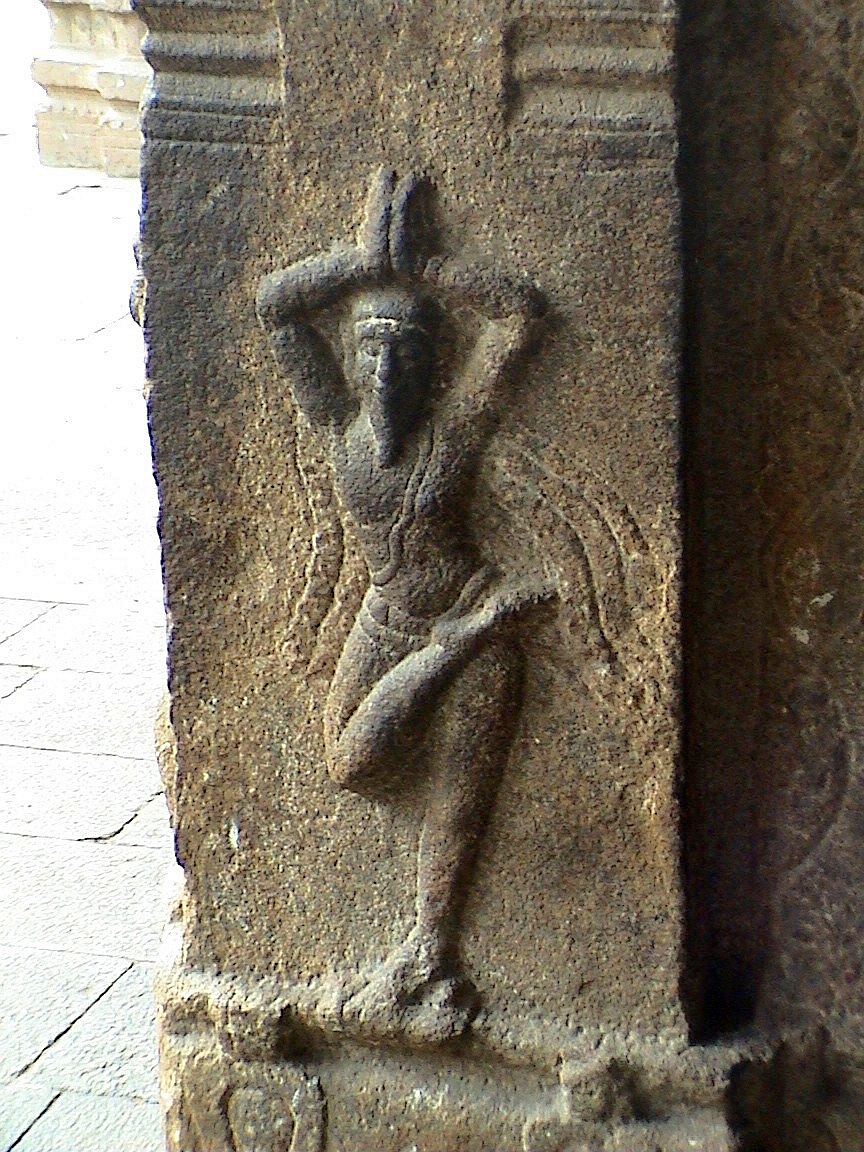
A pillar at Srirangam Temple depicting a Yogi performing a variation of the tree posture (vrksa-asana), commonly practiced in Hatha Yoga

The first step in affecting the channel of the life force into the center is breath control (pranayama), the fifth limb of yoga (Feuerstein 518). However, before working on this breath control one must undergo intense and extensive purification (Feuerstein 518). Thus, the Sage Gheranda describes six purification practices. They are as follows: dhauti (cleansing) is broken into four different techniques: antar-dhauti (inner-cleansing), danta-dhauti (dental cleansing), hrid-dhauti (heart cleansing), and mula-shodhana (root purification) (Feuersein 519). The second purification practice is called vasti or basti (bladder) (Feuerstein 519). This is follwed by neti, lauli or lailiki (to and fro movement), trataka, and finally kapala-bhati which in itself contains three different practices. These are: vama-krama (left-process), vyut-krama (inverted process), and shit-krama (shit process) (Feuerstein 520) [for a more detailed description of each of the purification techniques see Feuerstein 519-520]. Once purification has been done, the yoga practitioner may start to work on their breath control (pranayama). Sage Gheranda describes eight different types of breath control which he calls retentions (kumbhaka). These different retentions are as follows: sahita-kumbhaka (joined retention) -broken into two parts: sagarbha (with seed) and nigarbha (without seed)- surya-bheba-kumbhaka (sun –piercing retention), ujjayi-kumbhaka (victorious retention), shitali-kumbhaka (cooling retention), bhastrika-kumbhaka (bellows retention), bhramari-kumbhaka (bee-like retention), murccha-kumbhaka (swooning retention), and finally kevali-kumbhaka (absolute retention) (Feuerstein 527-528) [for a more detailed description of the different breath control techniques see Feuerstein 527-528]. According to Gheranda there are three different levels of pranayama control. The lowest level of control generates heat in the body, the second level causes tremors in the limbs and the third level actually causes levitation (Feuerstein 528).

Along with pranayama is a focus on different bodily postures (asanas), which is the second limb of yoga. These different postures also help prepare the body for the realization of atman. Siva the founder of yoga is believed to have taught these postures (Burley 73). There are a few different accounts of how many were taught (see Feuerstein 521), the Gheranda-Samhita describes the following thirty two: “siddha-asana (adept posture), padma-asana (lotus posture), bhadra-asana (auspicious posture), mukta-asana (liberated posture), vajra-asana (diamond posture), svastika-asana (svastika posture), simha-asana (lion posture), gomukha-asana (cow-face posture), vira-asana (hero posture), mrita-asana (corpse posture), gupta-asana (hidden posture), matsya-asana (fish posture), matsyendra-asana (Matsyendra’s posture), goraksha-asana (Goraksa’s posture), pashcimottana-asana (back-stretch posture), utkata-asana (extraordinary posture), samkata-asana (dangerous posture), mayura-asana (peacock posture), kukkuta-asana (cock posture), kurma-asana (tortoise posture), uttana-kurmaka-asana (extended tortoise posture), uttana-manduka-asana (extended frog posture), vriksha-asana (tree posture), manduka-asana (frog posture), garuda-asana (eagle posture), vrisha-asana (bull posture), shalabha-asana (locust posture), makara-asana (shark posture), ushtra-asana (camel posture), bhujanga-asana (serpent or cobra posture), and yoga-asana (Yoga posture)” (Feuerstein 521)[for a more detailed explanation of the postures as well as pictures of them see Feuerstein 522-523 and Burley 258-271]. While some of the postures are designed to help with sitting for long periods of time while meditating, others are designed for helping to regulate the life force within the yoga practitioner’s body (Feuerstein 521).

Linked with the postures are seals (mudra) and locks (bandha), the third limb of yoga. The seals signify far more advanced techniques and at times merge with some meditative practices. The locks are special maneuvers that are supposed to help restrict the life force within the trunk and thus stimulate it (Feuerstein 523). The seals (mudra) and locks (bandha) are named as follows: maha-mudra (great seal), nabho-mudra (sky seal), uddiyana-bandha (upward-going lock), jalandhara-bandha (Jalandhara’s lock), mula-bandha (root lock), maha-bandha (great lock), maha-vedha (great penetrator), khecari-mudra (space-walking seal), viparita-kari (inverted action seal), yoni-mudra (womb seal), vajroli-mubra (thunderbolt seal), shakti-calani-mudra (power-stirring seal), tadagi-mudra (pond seal), manduki-mudra (frog seal), shambhavi-mudra (Shambhu’s seal), ashvini-mudra (dawn-horse seal), pashini-mudra (bird-catching seal), kaki-mudra (elephant seal), bhujangini-mudra (serpent seal), and finally the five concentrations (dharana) on the five elements-earth, fire, water, air, and ether (Feuerstein 523-525)[see Feuerstein 523-525 for a detailed description of all the locks and seals].

The fourth limb of Hatha-yoga according to Gheranda is detachment from the senses (pratyahara). This involves removing attention from external- sensory objects (Feuerstein 525-526).

The sixth limb is in regards to meditation (dhyana) which can be understood as visualization (Feuerstein 528). The Gheranda-Samhita talks about three types of dhyana: “visualization having a ‘coarse’ (sthula) object, such as a carefully visualized deity; visualization having a ‘subtle’ (sukshma) object, namely the Absolute in the form of the transcendental point-origin (bindu) of the universe, as explained in connection with Tantrism; and contemplation of the Absolute as light (jyotis)” (Feuerstein 528)[for a more detailed description see Feuerstein]. According to Gheranda, with contemplation, the attention is inverted onto the inner essence of Self (atman). He explains it as the process of awakening the kundalini and it merging with atman and then rising to the center at the crown of the head bringing one to samadhi (Feuerstein 528).

Samadhi according to Gheranda is the seventh and final limb of yoga. It is liberation from the states of consciousness and separation of the mind from the body. Reaching this point is reaching the ultimate level and thus moska for the Hatha-yogin (Feuerstein 528-529).

REFERENCES AND FURTHER RECOMMENDED READING:

Burely, Mikel (2000) Hatha-Yoga: Its Context Theory and Practice. Delhi: Motilal Banarsidass Publishers Private Limited.

Feuerstein, Georg (2002) The Yoga Tradition: Its History, Literature, Philosophy and Practice. New Delhi: Bhavana Books & Prints.

Sivananda, Swami (1981) Science of Yoga. India: Divine Life Society.

Sivananda Radha, Swami (1987) Hatha Yoga: The Hidden Language: Symbols, Secrets and Metaphor. Porthill: Timeless Books.

White, David Gordon (1996) The Alchemical Body: Siddha Traditions in Medieval India. Chicago: University of Chicago Press.

Related Topics for Further Investigation

Siva

Gheranda-Samhita

Hatha-Yoga-Pradipika

Siva Nata-Raja

Tantrism

Natha

Siddha-Siddhanta-Paddhati

Yoga-Bija

Ananda-Samuccaya

Yoga-Yajnavalka

Yoga-Vishaya

Hatha-Ratma-Avali

Siva-Samhita

Yoga-Shastra

Yoga-Karnika

Hatha-Sanketa-Candrika

Raja Yoga

Jnana Yoga

Karma Yoga

Bhakti Yoga

Kundalini Yoga

Noteworthy Websites Related to the Topic

http://www.5min.com/Video/A-Guide-To-Hatha-Yoga-24861271

http://www.abc-of-yoga.com/styles-of-yoga/hatha-yoga.asp

http://yoga.about.com/od/typesofyoga/a/hatha.htm

http://en.wikipedia.org/wiki/Hatha_yoga

http://en.wikipedia.org/wiki/Hatha_Yoga_Pradipika

Article written by: Caylee Dutnall (2009) who is solely responsible for its content.

Guru Nanak

Guru Nanak was a very influential person during his lifetime. He lived during an age of change, and much of that change was due to his teachings. His main goals involved making the world a better place and trying to ensure that all people were equal. His ways of teaching were very effective and they challenged the way that people saw the world that they lived in. Guru Nanak’s lifetime can be divided into three parts; family life, travels, and retirement. It is during his travels that he did most of his teaching and during his retirement that he developed the basis for Sikhism.

Guru Nanak’s father wanted him to take over the family business and become an accountant, but Guru Nanak wanted exactly the opposite. He wanted to lead a religious life and stay detached from worldly attachments (Gurnukh Nihal 36). While he was growing up, Guru Nanak spent a lot of time with both Hindu and Muslim saints. During his childhood, he would gather his friends and discuss the power and greatness of God. He was not concerned with following what everyone else did; he followed his own path. For example, when it was his turn to participate in the Sacred Thread Ceremony, he refused to wear the traditional thread and said that he wanted one that would last for his entire lifetime (Gobind Singh 18). His father wanted to change Nanak’s perspective and decided to arrange his marriage to force him into a ‘typical’ life. Nanak was married early and his wife gave birth to two sons.

Guru Nanak spent the next ten years caring for his family (Gobind Singh 20). During these years, he spent a fair amount of time praying, as he still wanted to lead a religious life. One day after he was finished his prayers, he entered a cave and fell into a trance that lasted for three days. When he awoke from this trance, he ran out of the cave shouting “There is no Hindu and no Musalman.” With this phrase, it is believed that Guru Nanak had three meanings (Gurnukh Nihal 37). First, that all men are equal, regardless of religion or race. Secondly, that Hindus and Muslims had forgotten the true meanings of their religions and therefore no true Hindus or Muslims existed. Thirdly, that he felt he needed to end the hostility between the two groups. With this, he began his life as a missionary.

First he headed east for twelve years. He wanted to visit places that were holy in Hinduism. Along the way, he questioned Hindu practices and challenged the reasons for participating in such practices. Next, he travelled south for five years to see some important places to the Buddhist and Jain religions. After travelling south, he travelled north to the Himalayas for two years. Lastly, he travelled west to the Muslim countries for four years before coming home to spend his last years with his family. During his last years, he nominated his closest disciple, Bhai Lehna to be his successor (Gurnukh Nihal 46).

It is important to note that although Guru Nanak grew up in a society where Hinduism was very prevalent, his teachings and ideas are not based on the Vedas or the Upanisads (Seshagiri 5). His concepts are based on his own thoughts and ideas, which he formed throughout everyday life; they “came to him as and illuminations of his entire life” (Seshagiri 5). Despite this, some of his ideas agree with the Vedas and the Upanisads. For example, both Guru Nanak and the Upanisads oppose being materialistic and self-centered (Seshagiri 5). On the other hand, Guru Nanak rejected the idea of rituals as he focused more on the internal and spiritual aspects of religion. He believed that the reason for living was only the search for Truth, (Seshagiri 5) and that a chaotic and impulsive life is not the way to find Truth. He is claimed to have said, “Truth is the highest of all but higher still is truthful living” (Seshagiri 6). But, what is this Truth that he speaks of? Guru Nanak believed that God is Truth; anything related to God is Truth (Seshagiri 7).

As most people do, Guru Nanak had strong views on God, creation, and the soul. He believed that there was one God who was the creator and governor of the world. He believed that the creator God was responsible for all the other gods and goddesses. It was his view that the God is able to create all things, and the God is fearless and infinite. He also believed that the God has no mother, father, son, wife or relative (Gobind Singh 7). With regards to creation, he thought that everything came into being at the God’s command and that how He did it is beyond our understanding (Gobind Singh 10). Also, he claimed that the limit of the creation is unknown. Guru Nanak thought that the God had created earth as a school for man to learn dharma. Guru Nanak was a strong believer that everything that we do, whether it is good or bad, makes an imprint on our soul (Gobind Singh 12). The imprints combine to form habits and therefore, have an affect of how we live our lives. He also believed that the soul does not die with the body, but transfers to the next body and continues in the next life (Gobind Singh 13). While Hindus believed that there are four different dharmas for the four different varnas, Guru Nanak believed that there is only one religion, and that religion is Truth and that Truth is for all (Seshagiri 8). One of his most apparent beliefs was that men should not be divided by race, religion, or any other such division (Seshagiri 8). He said that there are two different kinds of men; God oriented and self-oriented. Guru Nanak thought that a man’s religion is not defined by words such as ‘Hinduism,’ or ‘Buddhism,’ but by the actions that he performs. He also believed that by thinking of and remembering God alone, the heart becomes pure.

In Guru Nanak’s lifetime, there occurred many social, political, and spiritual advancement, and Guru Nanak is honored for many of these advancements. He helped people notice the flaws that existed in their ways of life. He made it a goal to help people improve their lives and improve the way they treated the people around them. Overall, he tried to expose and correct the negative aspects of life that he saw developing around him. Politically, people were ignorant as to what was going on around them. He began to show people what was really going on and encourage them to change it for the better. Guru Nanak’s goal was to change the outlook people had on life. This increased religious tolerance. He had made a strong impact with his messages and any future attempt to change things back to the way they were before were expected to meet great resistance.

Guru Nanak influenced many lives and many aspects of life that continue to the present. He was a man of action and refused to sit by the side and let the world continue as it was. He had many strong ideas to get his world to live at peace and he did his best to spread those beliefs.

Bibliography

1. Mansukhani, Gobind Singh. (1968) Guru Nanak, World Teacher. Delhi: Light Press

2. Singh, Gurmukh Nihal. (1969) Guru Nanak, His Life, Time, and Teachings. Delhi: The Raisina Printery

3. Rao, K L Seshariri. (1991) Guru Nanak and the Vedantic Tradition. ATLA Religion Database with ATLASerials

Other Readings

1. Mansukhani, Gobind Singh. (1974) Life of Guru Nanak. Delhi: Everest Press

Related Research Topics

1. Sikhism

2. Religions in India

3. Sikh Gurus

4. Religions in Asia

Related Websites

1. The Sikhism Home Page

http://www.sikhs.org/guru1.htm

2. Guru Nanak

http://www.dlshq.org/saints/gurunanak.htm

Written by Caitlin Duncanson (Spring 2009), who is solely responsible for its content.

The Demon Bali

The story of the demon Bali appears many times throughout Hindu literature, showing that this figure has significance in the development of Hindu culture. For example, Bali’s tale appears in the Mahabharata, the Ramayana, and the Vayu Purana. While Bali appears in Hindu literature many times, the most important story of Bali comes from the tale of his interactions with Visnu’s avatar Vamana. Another important myth surrounding Bali is his role as a teacher of Indra. Both of these myths are significant to Hindu literature, and both myths will be discussed here.

In the Bhagavad Gita Bali is reborn as a demon after his previous life as Kitava. Kitava is branded as an evil man in this literature; however, by the grace of Siva he is granted the throne of Indra for a time. During his reign on Indra’s throne, Kitava proceeds to give away all of the possessions of Indra, including Indra’s elephant, horse, and wishing cow (O’Flaherty 127). When Indra was returned to the throne, Indra was clearly displeased by what had happened and pleaded to Yama, the god of death, to curse Kitava to hell. However, through his karma, Kitava was reborn as the son of Virocana, the demon Bali (O’Flaherty 128).

According to Hindu literature, a war began between the devas (gods) and the asuras (demons) for control over the heavens and the earth. Bali had been proclaimed king by the other asuras and was charged with removing Indra from power over the three worlds, and restoring the prestige of the demons. Bali was chosen as the king because he had virtuous qualities, and was considered to be grateful and wise. Many of the important figures of Hindu demonology were granted powerful armies to fight for Bali against the gods (Bhattacharyya 151). At the end of the war, the asuras were victorious in driving the devas from heaven. The throne that had belonged to Indra was now given to Bali, the son of Virocana (Hospital 25).

The devas, angered by the loss of their kingdom, appealed to the god Visnu for help in regaining their lost lands. It was understood by the gods that Bali was a very generous ruler, and would give his subjects any possession they asked for. With this knowledge, Visnu is reborn as the dwarf Vamana and seeks an audience with the king Bali, while he is performing a sacrifice to celebrate his victory over Indra and the other gods (Bhattacharyya 152). It is during this meeting that the main flaw of Bali is exposed. Vamana asks Bali for all of the land that he can walk in three steps. Bali is pleased with this request, seeing only a dwarf in front of him. However, as it is stated in the Vaya Purana, Vamana “…with three strides stepped over the sky, the mid-region and the earth – this entire universe.” (Hospital 28). For Bali, his generosity would be his demise as he is forced to give the kingdom to Vamana, the avatar of Visnu, who returns Indra to the throne of the universe. In O’Flaherty’s book, she quotes a Sanskrit aphorism as saying “Because of his excess of generosity, Bali was captured… Excess should always be avoided” (O’Flaherty 131).

Visnu's Vamana (Dwarf) avatara sends the demon Bali to the underworld

According to O’Flaherty, the actions of Bali in this myth go against what is considered to be Bali’s svadharma. That is to say that the duty of a demon is to interfere with sacrifice, and to kill gods (O’Flaherty 127). While it is true that the armies of Bali were responsible for the death of gods, in the myth, Bali is seen as performing a sacrifice ritual when he is approached by Vamana. Performing this ritual causes a disruption in the cosmic order of things, which Vamana is praised for restoring. O’Flaherty states in her book that “…the dharma of the whole world – owls and stars and lotuses are disturbed by the sudden imbalance in the social order, for cosmic order is maintained by the proper performance of all svadharmas.” (O’Flaherty 130). This could be understood as one of the main reasons that despite all of Bali’s virtues, he is considered to be a force of evil that disrupts the cosmic order.

In the second important myth about Bali, Indra is seeking Bali out for instruction. According to the myth, Indra finds Bali reborn as an ass. During their conversation Bali attempts to explain to Indra the significance of time and of prosperity (Hospital 74). This entire myth is centered on helping to explain the ideas of dharma in its relation to samsara. In his teachings to Indra, Bali attempts to show Indra that until an individual achieves atman, all things are transitory. Materialistic possessions, such as jewels, as well as possessions such as armies, are all subject to time (Hospital 61). The discussion continues with Bali describing his understanding of life and death as such: “Death is the end of creatures as the ocean is for rivers” (Hospital 61).

The story of Bali’s discussion with Indra contains a number of examples of behaviour that would have an impact on one’s rebirth. Bali lectures Indra on how it is wrong to mock someone who has been reborn into a lower status than they were previously. In the case of Bali and Indra, Bali says “You mock me who am in adversity. When you are as I am, then you will not talk like this” (Hospital 61). However, it is not Bali’s plan to lecture Indra on how to have a positive rebirth, rather, Bali aims to advise Indra on how to achieve atman. Understanding that time will eventually remove prosperity from one individual, and grant it to another, and that a person should not grieve at the loss of prosperity, nor celebrate the gain of it is ultimately what Bali is attempting to teach to Indra.

The story of Bali in these two myths can be seen as being related. In the first myth, Bali is responsible for actions that result in his rebirth in a lower status than he had previously. This rebirth allows Bali to understand that all things are subject to the power of time, and that without a realization of the transitory qualities of time, a person cannot achieve atman. Developing the relationship between these two myths also proves to be important, as it becomes obvious that the second myth would not have the influence it has without understanding the first myth. Having a former demon king who was reborn as an ass, to teach the god Indra about the fickleness of possessions is a much powerful lesson than one taught by someone else.

References and Further Reading

Bhattacharyya, Narendra Nath (2000) Indian Demonology: The Inverted Pantheon. New Delhi: Manohar Publishers & Distributors

Hospital, Clifford (1984) The Righteous Demon: A Study of Bali. Vancouver: University of British Columbia Press.

O’Flaherty, Wendy (1988) The Origins of Evil in Hindu Mythology. Delhi: Motilal Banarsidass.

Singh, Balbir (1984) Hindu Ethics: An Exposition of the Concept of Good. New Delhi: Gulab Vazirani

Stietencron, Heinrich von (2005) Hindu Myth, Hindu History: Religion, Art, and Politics. Delhi: Permanent Black

Related topics for Further Investigation

Vamana

Visnu

Karma

Moksa

Dharma

Svadharma

Kerala

Bhagavad Gita

Vaya Purana

Indra

Devas

Asuras

Atman

Samsara

Kitava

Websites Related to the Topic

http://www.boloji.com/hinduism/042.htm

http://en.wikipedia.org/wiki/Hindu

http://www.britannica.com/EBchecked/topic/622527/Vamana

http://www.experiencefestival.com/bali_demon

http://www.sanatansociety.org/hindu_gods_and_goddesses/vamana.htm

Written by Kris Duncan (Spring 2009), who is solely responsible for its content.