The 64 Yoginis

In the Hindu religion Yoginis are females credited with magical powers (Kinsley 287). The history surrounding the yoginis is scarce and can vary from source to source. Consensus is that the cult first appeared around the sixth to seventh century (Gadon 33). The cult did not begin to thrive however, until the ninth century and stayed fairly popular through to the twelfth century (Gadon 33). According to the scholar Vidya Dehejia, the roots of Yogini worship are outside the normal orthodox Brahmanical traditions. The Yogini traditions are tantric in nature and therefore have strong connections to rural and tribal traditions (Donaldson 617). The origin of the Yoginis appears to be in small, rural villages (Dehejia 1). They are local village goddesses, grama devatas, who look over the welfare of an individual village (Dehejia 1). Through Tantrism, these local deities were able to gain new forms and vitality as a group of goddesses who could impart magical powers to their worshippers (Dehejia 2). These powers included: anima (the ability to become very small), laghima (the power to levitate and to be able to leave your body at will), garima (the power to become very heavy), mahima (the power to become large in size), istiva (the power to control the body and mind of oneself and others), parakamya (the power to make others do your biding), vasitva (the power to control the five elements) and kamavasayitva (the power to be able to fulfill all your desires) (Dehejia 53). Village goddesses progressively transformed and merged into powerful numerical groupings (Dehejia 1-2).

Statue of a Yogini, one of a cluster of 64, who would be housed in circular, roofless temples, enabling them to fly in and out; 10th century, Sackler Gallery, Washington DC

The numerical groupings associated with the yoginis vary from text to text, but the most common grouping is sixty-four (Donaldson 620). There are very few references to yoginis being alone (Donaldson 633). The numbers eight, twelve, sixteen and sixty-four seem to elevate the yoginis to a higher status (Donaldson 633). The number eight is considered to be very auspicious and have great potency and within the Hindu religion (Dehejia 44). As the square of eight, sixty-four, has even more power and is considered to be extremely auspicious in Tantric literature (Donaldson 633). When the Yoginis are divided into groups of eight it is, usually, to associate each group with a separate deity (Donaldson 634). The groups usually take on the attributes of whichever deity they are connected with (Donaldson 634). Although the grouping of the yoginis into sixty-four is fairly uniform throughout the literature, their names, descriptions and characteristics are not (Donaldson 620).

The cult of the yoginis is often associated with a sense of fear and awe because the yoginis are sculpted with demonic expressions or other dark attributes (Gadon 33). When the yoginis are depicted in sculpture or described in text they often have the heads of various birds such as: parrots, hawks, peacocks, eagles, pigeons, and owls (Kinsley 197). They were also carved with characteristics from other animals (Donaldson 619). These include: the frog, elephant, jackal, goat, ox, cat, tiger, horse, and snake (Donaldson 619). Along with having the qualities of birds and other animals, the yoginis are repeatedly talked about as having severed heads in their hands or scattered around their feet (Gadon 33). In one story from the Padna Purana, the yoginis are called by Siva to consume heaps of flesh from a demon head that Siva has severed (Donaldson 622-623). This story talks of how they rejoiced after eating the flesh and drinking the blood of the demon, and describes them as having enormous bodies and sharp fangs (Donaldson 623). Yoginis are occasionally depicted with numerous arms, anywhere from four to eight (Donaldson 640).

There are four main traditions that are associated with the cult of the yoginis and how they developed from their tribal beginnings and became integrated into orthodox beliefs (Donaldson 618). All four of the traditions revolve around the idea that the yoginis were minor divinities to greater goddesses. The first tradition is the idea of the yoginis as aspects of the Devi or Great Goddess (Donaldson 618). The yoginis were said to be formed from different parts of the Devi, including: her voice, sweat, navel, forehead, cheeks, lips, ears, limbs, toe nails, womb, and her anger (Donaldson 618). The second tradition is the idea that the yoginis are attendant deities of the Great Goddess (Donaldson 618). This tradition is thought to have developed from earlier tradition of Siva and her gana attendants (Donaldson 619). The third tradition focuses on the yoginis as acolytes of the Great Goddess: the matrkas (Donaldson 618). This tradition describes the yoginis as being born of eight mothers and formed into eight groups (Donaldson 622). The fourth and final tradition centers on the thought of the yoginis as patrons of the goddess of the Kaulas (Donaldson 618). Through the scrutiny of numerous Tantric texts, the yogini cult became associated with a specific Tantric sect called the Kaulas (Donaldson 623).

Exploring the yogini temples has been the best way of gathering information about the cult, its practices, and their appearances. Each yogini temple reflects the unique traditions of the area that it is located in (Dehejia 94). This, therefore, leads to many different intepretations of the cult (Dehejia 94). There are certain aspects of the temples that are common. Most of the yogini temples are located in remote areas. For example, the temple of Ranipur-Jharial is located several miles away from the nearest town (Dehejia 103). The temple of Hirapur is extremly isolated, with the only way to access it being through one small dirt lane (Gadon 33). Another common feature among the temples is that they are usually formed in the shape of a circle. Both the Ranipur-Jaharial Temple and the Hiarapur Temple are formed in circles (Donaldson 666, 669).

While this information describes the consensus of Hindu scholars there are few definitive texts that contain concrete information about the cult or its goddesses (Donaldson 624). “Yogini namavalis (name-lists) stand in isolation, neither preceded nor followed by any explanatory verses on the worship or status of these deities.” (Dehejia 31). The Puranic and Tantric texts that do speak of the yogini cult, have made it clear that the reason these goddesses were worshipped was to gain an array of occult powers (Dehejia 53). Many Kaula texts refer to the fact that the followers of Kaula believe in the yoginis and will receive blessings from the yoginis in return for their worship (Donaldson 624). The texts also make reference to how those that do not follow the tradition of the yogini cult will be cursed (Donaldson 624). “Tantras that speak of yoginis, reiterate that this is a highly secret, hidden knowledge that was to be divulged only to initiates“(Dehejia 31).

Bibliography

Dehejia, Vidya (1986) Yogini, Cult and Temples: A Tantric Tradition. New Delhi: National Museum. Donaldson, Thomas E. (2002) Tantra and Sakta Art of Orissa. New Delhi: D.K. Printworld Ltd. Gadon, E. W. (2002). Probing the mysteries of the Hirapur Yoginis.  ReVision, 25, 1. p.33(9).

Kinsley, David (1998) Tantric Visions of the Divine Female: The Ten Mayavidyas. Berkeley: University of California Press.

Related Websites

http://www.khandro.net/dakini_the64.htm

http://orissagov.nic.in/e-magazine/Orissareview/oct2004/englishPdf/originoftantricism.pdf

Related Words

Siva

Kaulas

Padma Purana

grama devatas

Written by Tracy van Paridon (Spring 2009), who is solely responsible for its content.

Rama

The Hindu epics are a source of entertainment and religious guidance. Today, Rama, the titular character of the Hindu epic, The Ramayana, is seen as the ideal man, who follows dharma to rigid perfection. The Ramayana, one of the two great Hindu epics, continues to have great significance today, despite being originally composed approximately two thousand years ago. While there are thousands of variations of the epic across southern Asia, its original authorship is attributed to the sage Valmiki, who lived sometime between 200 BC and 200 AD. Rama, who is married to the ideal woman, Sita, is portrayed and celebrated today as enacting true dharma in his role as son, brother, husband and member of the ksatriya class. He is also recognized as the “incarnation of Visnu in his role as Supreme God” (Gonzalez-Reimann 203).

The Ramayana is an epic that contains over 20,000 verses. Within these verses are the adventures surrounding Rama, son of King Dasaratha of Ayodhya, and heir to its throne. Laksmana, Rama’s half-brother and inseparable companion accompanies the hero throughout his many adventures. Both Laksmana and Sita, Rama’s wife, accompany him into a fourteen-year exile to the forests, during which the trio meet with various sages, encounter and defeat demons, and learn the ways of a forest-dweller. Much of Rama’s tale centers on his rescue of Sita from Ravana, a ten headed raksasas. While Rama’s adventures within The Ramayana provide entertainment, it is his action and philosophical reasoning that provide Hindus with direction in regard to dharma.

Rama is portrayed as one who is the “embodiment of…infinite virtues” (Bhattacharji 32). He is the obedient son, ready to “give up the throne and go into exile to redeem his father’s pledge” (Bhattacharji 43). Rama displays great love and faith in his brothers, trusting that Bharata would adhere to duty, caring for his throne during his banishment, and eventually restoring him. Rama’s love for even his wife Sita “became subsidiary and insignificant in comparison with love for the brother” (Bhattacharji 36). Living as a forest-dweller, he killed demons to protect sages, for “as a prince he was obligated to exercise the protective function of the warrior class” (Goldman 34). Ruler of Ayodhya for 11,000 years after his banishment, Rama “was a true warrior hero with a strict code of heroism” (Bhattacharji 43).

Large Rama Statue, Bali

Rama’s fame for his goodness has led to an expectation among readers and followers that he is pure, and acts righteously in all circumstances. Supported and “reinforced by scholars who have…their own expectations” (Stewart et al. 244) of Rama, it is often the case that Rama is seen as a flat divinity, one that is non-complex: he is good, therefore he is dharmic. This however is not the case; Rama is complex, whether portrayed as man or as god incarnate, and strays from the righteous path from time to time. Rama’s slaying of the monkey king Vali from behind a tree “violated the fundamental law of combat by striking at the enemy from behind” (Bhattacharji 36). In killing from behind, undercover, and an individual whom Rama had had no personal conflict with, he sacrificed the ksatriya codes of honor to increase his chances of finding Sita.

Although Sita, as the ideal woman, follows her dharma and willingly stays at her husband’s side and places her complete faith, love and allegiance with him. Rama does not do his wife justice, frequently disregarding Sita’s love for him. He fails to protect her from physical harm and dishonor. Upon his rescue of her, his main goal, he reveals, was not to rescue his beloved wife, “but to ensure the piety of his… lineage” (Bhattacharji 40). Despite unshakeable proof of Sita’s chastity, Rama abandons and humiliates her three times, doubting her devotion to him.

During the rare times that Rama strays from the path of dharma, it is often for his own personal gain and image. Rama kills Vali to gain the help of the monkey king to find Sita, and avenge his tarnished image. He belittles Sita, viewing her as tainted, something that he can no longer enjoy. For his personal and family honor, he doubts her purity thrice, despite receiving ample proof and being reproached by the gods that she has stayed true to Rama alone. While scholars have discussed and critiqued Rama for his cowardly killing of Vali, and his frequent betrayal and abandonment of Sita, no explanation has truly been given that adequately explains these few transgressions from the dharmic path (Goldman 35-36). Despite these few flaws in his righteousness, Rama is still considered today as the example of the ideal man, the incarnate of the god Visnu.

Visnu is one of the most prominent gods in the Hindu tradition. Within Hinduism, Visnu has a tradition of returning to earth in varying incarnations or avatars to carry out or ameliorate dharmic situations. Rama, who, throughout the epic continuously acts dharmically, kills the demon Ravana near the end of the story. This, according to Gonzalez-Reimann, is the main reason for Rama’s assumed divinity within Valmiki’s Ramayana. Rama’s incarnation as “the great god Narayana…Visnu, Krsna and Prajapati” (Gonzalez-Reimann 208) creates an identity that is a “combination of man and god” (Gonzalez-Reimann 210). As an avatara of Visnu, Rama embodies the “protector of society and brahmanical dharma”(Gonzalez-Reimann 207). Because Rama is the representation of dharmic action, and because he is associated with the god Visnu in this way, like Visnu himself (who has a group of followers dedicated primarily to him), Rama today has an important role in some forms of Hindu worship.

Built into the very social structure of society, the Hindu practice of renunciation lays the path to knowing and awareness of the Self and moksa. The practice of devotionalism, or bhakti, can and does take many forms within Hinduism, varying from elaborate to simple offerings, or prayers. Devotionalism can be given to a single or multiple deities. Ram bhakti, which is a movement that was founded by Swami Ramananda in the 16th century, attempts to gain liberation from bondage by transferring “emotional attachments…to the spiritual realm”(Lamb 582). Of the numerous religious texts that have been written on the topic, none have been quite so influential as Tulsidas’ Ramcharitmanas. A revision of Valmiki’s The Ramayana, the text is immensely popular, and “has ultimately set the tenor for Ram bhakti…providing ideal examples for family and society relationships, for righteous action, and for selfless devotion” (Lamb 580). Followers of Ram bhakti show devotionalism through the chanting of prayers or repetition of Rama’s name. Ultimately, the relationship aspired to between devotees and the Divine is paralleled to the relationship of Rama and Hanuman; the relationship “is one of Ram[a] as lord and master” (Lamb 582).

The main character and hero of Valmiki’s The Ramayana, Rama is the righteous prince of Ayodhya, whom, accompanied by his brother and wife, has many adventures in both fictitious and actual places. Acting always in the right, Rama gives an example to modern followers of the correct way to follow dharma. Despite some of his actions being critiqued as unrighteous and morally wrong in today’s world, such actions were more or less seen as socially acceptable at the time of the epic’s composition, and Rama is still seen as the ideal man, in part due to his role as an incarnation of Visnu. Based on this fact, religious orders such as Ram bhakti have been fashioned after Rama’s example. Despite being created thousands of years ago, Rama still has relevance today, providing entertainment, rules of social etiquette, and religious prescriptions for people around the globe.

Bibliography and Related Readings

Bhattacharji, Sukumari. “A Revaluation of Valmiki’s ‘Rama.’” Social Scientist. 30.½ (2002), pp. 31-49.

Goldman, Robert P. The Ramayana Revisited. New York, NY: Oxford University Press.

Gonzalez-Reimann, Luis. “The Divinity of Rama in the Ramayana of Valmiki.”Journal of Indian Philosophy. 34.1 (2006), pp. 203-220.

Lamb, Ramdas. “Devotion, Renunciation, and Rebirth in the Ramananda Sampraday.” Crosscurrents. Winter (2007), pp. 578-590.

Stewart, Tony K. and Dimock, Edward C. (2001) “Krttibasa’s Apophatic Critique of Rama’s Kingship.” Questioning Ramayanas. Berkeley and Los Angeles, CA: University of California Press.

Related Topics

Visnu

Avatara

Sita

Bhakti

Valmiki

Dharma

Ayodhya

Tulsidas

Swami

Ramananda

Sadhana

Ravana

Raksasas

Hanuman

Vali

Laksmana

Ksatriya

Vanaprastha

Lanka

Samnyasin

Related Websites

http://en.wikipedia.org/wiki/Rama

http://www.valmikiramayan.net/

http://www.cs.ucdavis.edu/~vemuri/classes/freshman/RamayanaSynopsis.htm

Written by Lara Ulrich (Spring 2009), who is solely responsible for its content.

Mohandas (Mahatma) Gandhi


Mohandas Karamchand (Mahatma) Gandhi, the famous proponent of peace and non-violence in conflict-torn India during the early 1900’s, devoted his life to achieving an independent, egalitarian and united India. His life experiences led to his discovery of satyagraha, non-violent protest, and he implemented this tool in his work to free India from British colonial rule and to quell the civil disputes occurring within the country. In his attempts to bring India to peace, through well planned satyagrahas and his detailed Constructive Programme, he himself became a symbol in India and around the world.

Gandhi was born in Porbandar India on October 2, 1869 (Parekh 1, Chatterjee 15, Fischer 13-14). His family were members of the merchant class (Vaisyas) [Gandhi directly translates as grocer (Parekh 1, Fischer 12)] but rose to high political positions. His father, Karamchand, was prime minister of Porbandar (Fischer 13) and had many close Jaine friends [Jainism is a religion that employs strict non-violent and peaceful ideologies] (Parekh 1). His mother, Putali Bai, was a member of the Pranami (Prananath) religious sect that combined various beliefs and traditions including those of Hindus and Muslims (Parekh 1, Chatterjee 15). She was a deeply religious woman, and observed many religious fasts over her lifetime (Parekh 1, Fischer 15). Thus, Gandhi’s own political work, religious beliefs and morals were likely influenced by his early life and the beliefs of his parent’s.

Gandhi moved to England in 1888 to pursue an education as a lawyer (Fischer 27) and while there, was engulfed in western traditions and religion. He was introduced to Christianity, the Bible, especially the New Testament (Nanda 12). It was here that Gandhi began cultivating his own religious beliefs and practices in Hinduism which, over time, became infused with aspects of multiple religions including Christianity. It was at this time that Gandhi first discovered the Bhagavad Gita (one part of the larger Mahabharata epic), and its yogic teachings, especially those of Karma Yoga which epitomizes the path of selfless action to achieve spiritual liberation (Fischer 29-33, Hick 90). This text was so important to Gandhi that it became his ‘spiritual dictionary’ (Nanda 13). Upon returning to India, Gandhi experienced little success as a lawyer and eventually moved to South Africa to practice.

In South Africa at this time, Hindus were often used as indentured laborers (Parekh 3, Fischer 46) and suffered from restricted rights and freedoms. Gandhi himself was subject to many indignities, and in response became a strong proponent of Indian rights and legal equality in South Africa (Fischer 48), thus exemplifying the Karma Yoga path taught to him by the Gita. It was here that Gandhi developed and implemented his very first satyagraha. This was the use of non-violent protests to achieve, not victory over an enemy, but instead a compromise or reconciliation (Nanda 4). It was considered a form of civil disobedience, which could involve public demonstrations, non-cooperation with government policies, and even fasting as a personal satyagraha. All forms required the graceful acceptance of the consequences of their actions (Parekh 3). Gandhi achieved many successes in regards to Indian rights while in South Africa, but was also able to unify Hindus and Muslims living there. This can be credited to the fact that many shared a common language and tradition and faced similar challenges in a foreign country. To unite Hindus and Muslims in India would prove to be more difficult in the years ahead.

While in South Africa, Gandhi explored religion further, often incorporating new religious facets into his unique brand of Hinduism, including aspects of Judaism and Christianity, which he learned from various friends (Parekh 5). However, his knowledge of religion came mainly from reading influential texts, such as the Hindu epics of the Ramayana [Gandhi believed it to be “the greatest book in all devotional literature” (Chatterjee 16)], the Mahabharata and most importantly the Bhagavad Gita (Chatterjee 7, Fischer 29-30). The Gita inspired Gandhi to begin his life path of becoming a Karma yogi, and a man of action (Fischer 35-36). For Gandhi, religion was embodied in dharma (righteousness) and was the “sustaining order which upholds the individual and society and in turn has to be upheld by them” (Chatterjee 18). Thus religion was simply a moral framework for the conduct of daily life (Nanda 24). Gandhi eventually came to realize that religion played an important role in politics (Nanda 24) and was critical in maintaining a stable society (Chatterjee 18). After a period of 21 years, Gandhi returned to India, armed with his new religious views and powerful political weapon: the satyagraha.

India, at this time, was suffering from great civil unrest and religious disputes. Hindu-Muslim relations were strained and there was increasing opposition and animosity towards the British colonial government. The Indian National Congress, which had been established as a means of channeling Indian resentment of colonial rule into constitutional reforms and legal moderation (Fischer 132), had become ineffective due to poor leadership (Parekh 7). This ineptitude resulted in public revolts erupting throughout India. Gandhi, a supporter of the colonial rule at first, became unconvinced of its ability to maintain control over the increasing civil unrest. He did not agree with the oppressive measures taken to maintain order, but also could not agree with the Indian National Congress’s ineffective political strategy. Gandhi decided to implement his Constructive Programme which included measures to restructure India and restore peace and order to the country to prepare it for independence from the British government (Parekh 8).

The Constructive Programme focused both on large sweeping changes as well as small, mainly symbolic, changes including: abolishing the caste system and untouchability, equality for women, the use of indigenous languages and the adoption of a common, national language. It also promoted economic equality (including tribal peoples), the development of village industries and banning the use of foreign cloth (Parekh 8-9, Nanda 8). Gandhi believed that in order to restore peace and stability to India, Indian society would first have to become more dharmic, which could be attained if society became more egalitarian (Chatterjee 20). This idea of a dharmic society stems from the teachings of the Gita and Gandhi once said, God’s grace and revelation are not the monopoly of any race or nation; they descend equally upon all who wait upon God” (Nanda 69). Thus any person can become close to their God through personal, loving devotion (bhakti), regardless of race, gender or class (Hick 131-132). He also realized the importance of symbols as a way of attaining and maintaining equality through their ability to convey strong emotional responses in the public. He used symbols such as the spinning wheel, khadi (home spun cloth) the cow and the Gandhi cap. Gandhi himself eventually became a symbol in his own right (Parekh 9). He believed that his Constructive Programme combined with carefully thought out and meaningful satyagrahas would be the key to India’s independence (Parekh 8).

Gandhi implemented his first national satyagraha in 1919 which involved nation wide cessation of work (hartal) and mass demonstrations, in response to the further losses of civil liberties and freedoms imposed on India by the colonial government (Parekh 12). It was Gandhi’s first nation wide defiance of the British government (Fischer 176). The hartal proved to be very successful in Bombay with six hundred followers. However, when the hartal reached Delhi some demonstrations turned violent and Gandhi had to abandon it, calling it his ‘Himalayan miscalculation’ (Parekh 12, Fischer 177-178). Further oppression by the British government by banning group gatherings and demonstrations, escalated tensions in India, and on April 13, 1919 colonial forces opened fire on unarmed civilians, killing hundreds (Parekh 12, Fischer 179-180). This event was a turning point in Indian history and the stability of the British rule began to be threatened.

In response this tragic event, and in the face of exponentially increasing violence in the country, Gandhi implemented his second nation wide satyagraha: The Non-cooperation Movement of 1920 (Parekh 12, Fischer 187). Gandhi based it on his belief that the government could no longer rule effectively if its citizens refused to cooperate with its policies and set up their own alternative governing institutions (Parekh 12, Fischer 187). Gandhi also attempted to incorporate the Muslim community into his nationalist movement for independence (Nanda 97). The Non-cooperation movement was unsuccessful for two reasons: alternative governing bodies were not created because the public was not willing to give up their hard earned careers (Parekh 14) and it inadvertently caused further strain in Hindu-Muslim relations. The majority of Muslims were supportive of the British governing body as it provided them with an English education and government careers (Nanda 97).

Gandhi became increasingly concerned over the growing Hindu-Muslim conflict. The emerging Muslim middle class felt that their progress was being impeded, as they were in constant competition, with the Hindus, over jobs. Most middle class Muslims did not have the access to the level of education needed to obtain these jobs and thus felt they were at an unfair disadvantage (Fischer 220). To address their frustrations Gandhi began a twenty-one day fast to promote unity and a mutual respect and tolerance and support of a Hindu-Muslim friendship (Parekh 15, Fischer 221). However, civil unrest continued to increase until he felt that another satyagraha was necessary to avoid explosive violence, and edge India closer to independence. He decided to protest against the British salt tax of the 1930’s by having thousands of people along India’s sea coast produce salt illegally (Parekh 15-16, Fischer 268-269). Gandhi chose his salt satyagraha for several reasons: salt was important to all Indians and Muslims, and bore heavily on the poor, and showed the how corrupt and cruel the British government was (Parekh 15-16). The salt satyagraha was successful as it was able to show colonial rule was weak and could be defeated (Parekh 16). It has been considered Gandhi’s most successful attempt at non-violent civil disobedience as a means to promote compromise, through the use of powerful symbolism (Nanda 81).

Hindu-Muslim relations continued to worsen and partition of India was immanent. In light of economic and political trouble Muslim’s feared they would no longer be in control of their people and that a partition was necessary to maintain Muslim religious integrity (Parekh 20). Pakistan and the Indian Union were eventually formed out of the partition (Fischer 476). The newly formed Pakistan contained millions of Hindus, and likewise the Indian Union contained millions of Muslims. These newly formed minorities were concerned with their status under the new majority rulers and fighting erupted from within (Fischer 476). Gandhi disagreed with the partition on religious and traditional grounds and predicted the violence that resulted. Thus, he devoted the remainder of his life to quelling violence between the disputing parties, and bringing about Hindu-Muslim religious equality through pilgrimages of peace (Parekh 23, Nanda 147), because he felt that all religions could be considered equal (Hick 131). His own life became a weapon in the war against violence, and he hoped that his sacrifice would act as a catalyst promoting peace and equality throughout India, as well as Pakistan (Parekh 23).

India achieved its independence on August 15, 1947 (Parekh 23). Gandhi remained focused on his pilgrimage and on January 13, 1948 began his final satyagraha, a fast unto death (Fischer 494), which was ultimately successful in ending the religious riots in both Pakistan and the Indian Union (Fischer 502). People, moved by his selfless action, pledged to ‘establish real peace’ between the dominions (Fischer 499). However, while he had many followers, there were still some who disagreed vehemently with his ideals and as a result Gandhi had many threats on his life (Parekh 24, Fischer 503-505). Instead of worrying for his life, Gandhi believed his death would act as a symbol to the country and achieve what he could not accomplish in his lifetime (Parekh 25). On January 30th, 1948 Gandhi was assassinated (Parekh 25).

Gandhi’s death proved to be incredibly influential in the events that would follow. It effectively united people in mourning the loss of India’s most beloved political peace activist, and calmed the conflict torn nation, and was instrumental in achieving the egalitarian society Gandhi has strived for during his life (Parekh 25). Gandhi exemplified the Karma Yoga path of selfless action, and he never wavered in his attempts to achieve a dharmically stable Indian society through religious and social equality. Gandhian policies and ideologies remain in Indian society and have also spread around the world in a ‘nonviolent revolution’ (Hick 203-204). His emphasis on morality, religion and non-violent cooperative negotiations have often been used as a template to base political decisions as well as decisions made in day to day life.

References and Further Recommended Reading

Chatterjee, Margaret (1983) Gandhi’s Religious Thought. Notre Dame: University of

Notre Dame Press.

Fischer, Louis (1950) The Life of Mahatma Gandhi. New York: Harper and Row Publishers Incorporated.

Hick, John and Hempel, Lamont, C. (1989) Gandhi’s Significance for Today. New York: St. Martin’s Press, Inc.

Nanda, B. R. (2002) In Search of Gandhi: Essays and Reflections. New Delhi: Oxford University Press.

Parekh, Bhikhu (1997) Gandhi. Oxford: Oxford University Press.

Related Topics for Further Investigation

Jainism

Christianity

Judaism

Hinduism

Islamic religious beliefs and traditions

Hindu-Muslim conflict

The partition of India

Indian National Congress

British colonialism

Constructive Programme

British salt tax and the salt satyagraha

The Non-cooperation Movement

Indian Class (Varna)/Caste system

Untouchables (Candala)

Pranami (Prananath) religious sect

dharma

satyagraha

karma

Karma Yoga

bhakti

Ramayana

Bhagavad Gita

Mahabharata

khadi

Related Websites

http://en.wikipedia.org/wiki/Mahatma_Gandhi

http://www.mkgandhi.org/

http://www.gandhi.ca/

http://www.gandhiserve.org/

Article written by: Karma Tiberg (April 2009) who is solely responsible for its content.

Pancaratra Philosophy

Among the early Vaisnava schools is the Pancaratra sect. Its name is possibly derived from the Satapatha Brahmana, where a panca ratra (five night) sacrifice is mentioned (Rodrigues 178). As the story goes, the great being Narayana wished to transcend and become one with all other beings. He accomplished this by performing the pancaratra sacrifice. It is implied that Narayana was once human, then became divine, and in later texts he is seen as the highest divinity.   Because of this, there is a Siddhanta-ratnavali written by Venkata Sudhi which sets out to prove through scriptural texts that Narayana is the highest god, supreme to all other gods. This however can be disputed, for in the Mahabharata it is mentioned that Narayana himself worships an unchanging Brahman found in all beings  (Dasgupta 12).
It is generally accepted that Pancaratra emerged in Northern India as a set of universal speculations, procedures, and devotional attitudes. It did not originate as religious sect. The Pancaratrin system eventually became central for many Vaisnava Bhagvatas involved in ritual in both temples and the home. Once it entered Southern India, it became even more prosperous due to the Sri Vaisnava’s rise. Its entrance into temples was perhaps so well received since it offered formal, systematic ritual where, previously, procedures were just customary. To this day, Pancaratra continues to be a vital component in Southern India as an essential factor of the Sri Vaisnava religion and as one of two Vaisnava traditions that teach temple culture (Welbon).
In a sense, Pancaratra philosophy is monotheist. Although with different features and manifestations, there is one supreme Deity above all (Sutton 210). This Deity is manifested in five features (vibhutis) according to classical Pancaratra, which include (Sutton 241):
1. Omnipresent and inconceivable
2. Emanations (vyuhas)
3. The avataras
4. The self within (antaryamin)
5. The images worshipped in temples (arca)
Of the vyuhas, four are most important when seeking liberation. These four are all immediate relatives of Krsna and reflect the six qualities (guna) of the Supreme Being (Rodrigues 178):
– omniscience, jnana
– power, sakti
– majesty, aisvarya
– strength, bala
– vigor, virya
– splendor, tejas
The four vyuhas which reflect these qualities compose the pure realm, whereas further, intermediary emanations make up the impure, material world. Once liberation is reached, the individual’s soul, jiva, enters into an existence shared with God in Vaikuntha. Although it is “entering into God,” the individual remains independent from the Lord (Rodrigues 178-179).
In the seventh century many significant Pancaratra texts began to emerge. These are called the Pancaratra Samhitas. Writings continued to be produced into the seventeenth century. Alongside the early literature, Pancaratra doctrines entered South-east Asia (Rodrigues 178). There is some dispute among non Pancaratra groups as to the nature of the texts. However, the stance that The Pancaratras take in regard to their own writings is that God alone is capable of revealing literature heavy with rituals and special commands, and no ordinary person’s instructions could be valid. Given this, the texts of the Pancaratras are clearly considered authentic by its followers. Another question arises over whether the authors of the Pancaratra works truly based them off the Vedas, or simply wrote their own views and masked them as being from the Vedas. The argument against Pancaratra doctrines indeed originating in the Vedas is that the smrti texts founded on the Vedas contradict the Pancaratra (Dasgupta 14). Ultimately, to the Pancaratrins, the same God who created the Vedas to lead people to happiness also created the Pancaratra literature to lead people to the ultimate happiness and realization of His nature (Dasgupta 16).
The collection of literature is quite large, with few printed works. The Satvata-samhita is one of the most important samhitas and the Satvata is mentioned in the Mahabharata, and other samhitas. It is in the Satvata-samhita where the Lord declares the Pancaratra-Sastra. In addition, the various ways of worshipping Narayana and his vyuha forms are described in twenty-five chapters, as well as other kinds worship and practices (Dasgupta 21). Despite the vastness of the Pancaratra literature, the majority is filled with ritualistic detail instead of philosophy. The most important texts, philosophically, are the Jayakhya-samhita and the Ahirbudhnya-samhita (Dasgupta 24).
Eternal heaven or liberation cannot be achieved simply through studying the Vedas, performing sacrifice, offering gifts, or doing penance. Salvation can only be achieved once we know para-tattva, or ultimate reality. This ultimate reality is eternal, everywhere, and self-realized. It is nameless and lacks any qualities, but is hidden by the qualities (Dasgupta 24-25).
There are three types of creation described in the Jayakhya:
– Brahma-sarga: In the beginning, Visnu created Brahma. Brahma then, through his own conceit, polluted the creation. Out of two drops of sweat, two demons were made and they stole the Vedas causing great confusion. Visnu unsuccessfully fought them physically, but destroyed them through his “mantra” energy (Dasgupta 25).
– The evolution of the Samkhya categories: the three gunas existed together, inseparable, in pradhana. These however get separated into sattva, rajas, and tamas. From further evolutions and separations such things as the cognitive senses, conative senses, gross elements, and other things of nature are created (Dasgupta 25).
– Suddha-sarga: Pure creation where God created three agents from himself. The agents are Acyuta, Satya, and Purusa. These are considered one with God and share his same existence (Dasgupta 27).
Knowledge is seen as two-fold in the Jayakhya-samhita. There is static knowledge, sattakhya, and dynamic knowledge, kriyakhya. Dynamic knowledge requires consistent practice of the moral disciplines of yama and niyama in order for wisdom to reach its fullness (Dasgupta 29).
The Ahirbudhnya-samhita
The Ahribudhnya-samhita claims that the ultimate reality is eternal, empty of any name or form, beyond any words or thinking. It is an unchanging, all-powerful whole. Desire spontaneously arises from this reality. This desire or idea is not in any way limited, much like the nature of Brahman: intuitive and pure. When an individual destroys the sins that have collected o
ver many lifetimes and uses true knowledge, he can recognize the nature of Brahman (Dasgupta 34).
Much of the Ahirbudhnya is concerned with the nature of God. It goes into much more detail about his various qualities and how they are reflected. The power of God is embodied in two ways: static and active. The active is spontaneous and the will that leads to action (Dasgupta 36). One of the methods by which the Lord is active is through the vyuhas, which are responsible for three main functions (Dasgupta 38):
1. Creation, support, and destruction of the world
2. Protection of beings
3. Assisting those who are devoted to seeking liberation
The Ahirbudhnya provides more detail on the vyuhas and their further appearances.
Although numerous questions arise over the validity of the Pancaratra philosophical system, an interesting monotheistic approach to a polytheistic religion nonetheless.
Works Cited
Dasgupta, Surendranath (1961) A History of Indian Philosophy Vol.III. London: Cambridge University Press.
Rodrigues, Hillary (2006) Introducing Hinduism. New York: Routledge.
Sutton, Nicholas (2000) Religious Doctrines in the Mahabharata. Delhi: Motilal Banarsidass.
Welbon, G.R. (2005) “Vaisnavism: Pancaratras” Encyclopedia of Religion. Detroit: Macmillan Reference.
Related Topics
agamas
avatara
gunas
Krsna
Krsnaism
Mahabharata
moksa
Narayana
Pancaratra Samhitas
smrti
sruti
Vaikuntha
Vaisnavism
vyuha
Noteworthy Websites
http://en.wikipedia.org/wiki/Pa%C3%B1caratra
http://www.ochs.org.uk/node/475
http://www.harekrsna.com/philosophy/gss/sastra/vedas/pancharatra.htm

Written by Angela Tavernini (Spring 2009), who is solely responsible for its content.

Ravana

To individuals who are familiar with the Hindu epic Ramayana, the name Ravana has come to mean the main antagonist of the epic, the demon king of Lanka who was manipulated into kidnapping Sita, the wife of Rama. In the epic Ravana is described as the mighty king of the Raksasas with ten heads, twenty arms, and copper-colored eyes, and bright teeth like the young moon (Valmiki, Vol 2: 94-95). He gained control of his kingdom by banishing his half-brother Kubera who was the rightful king. His kingdom was the Kingdom of Lanka, which was said to be at the southern tip of India and some believe that it may be the current state of Sri Lanka as Hanuman, the monkey god, is depicted jumping over a sea to reach the kingdom.

In terms of Ravana’s ancestry, he was a Brahmin by birth as he was born the Visrava, a Brahmin sage and Kaikesi, a Raksasa princess. It is believed that Sumali, Kaikesi’s father who was the king of the Daiteyas, wanted her to marry the most powerful man in the world and chose Visrava as he was the son of Rishi Pulastya, one of the six human sons of Brahma. Ravana also had quite a large number of brothers and sister, the most famous being Surpanakha, who manipulated him into kidnapping Sita because she was insulted by Laksmana and Rama; other siblings are listed as Kumbhkarna, the sleeping giant who was quite skilled at war, Vibhisana, the dharmic Raksasa who eventually helped Rama and older half-brother Kubera, the god of wealth. Even though it is said that Ravana had quite a large of number of queens and a great harem, his favorite queen was said to be Mandodari, a woman of great beauty and wisdom. Mandodari was a pious women who was always apologetic for the misdeeds of her husband. He was the father to several children; Trisiras and Indrajit, who were killed in the battle of Lanka, and Ravani, Aksa, Devantaka, Atikaya, and Narantaka. It is recorded that all of Ravana’s wives performed Sati after his death and died at his funeral pyre.

In terms of Ravana’s kingdom, Lanka was initially ruled by Sumali, Ravana’s maternal grandfather. The ruling was then taken over by Ravana’s half brother Kubera, also known as the god of wealth, who was given the kingdom as a prize because of the austerities he performed to Brahma. Ravana eventually took over the kingdom forcibly, however it is recorded that Lanka flourished under his rule and after Ravana’s defeat; the kingdom was then turned over to his dharmic brother Vibhisana. It is believed that Lanka is the current state of Sri Lanka as the island of Sri Lanka is at the southernmost tip of India. There is also remains of a land bridge that connected Sri Lanka and India, which is known as Rama’s Bridge to this day, and some consider this as proof that Sri Lanka is connected to the Ramayana.

Bas relief depicting Ravana trying to topple Mount Kailasa, the abode of Siva and Parvati; Mahabalipuram, India

In the Ramayana there are many references to Ravana’s wickedness and evilness. First of these can be seen as his defeat of his half-brother to gain control of Lanka. This was not done through normal means as he performed asceticism for Brahma, the god of creation, and a boon was granted to him for his perseverance (Pollock 509). Ravana in turn asked for the ability to defeat gods in battle and with this ability he was able to defeat his half-brother and win his kingdom. Ravana was also well known for forcing himself upon women and it is believed Kubera had cursed Ravana after such a conquest and that is why he was not able to force himself upon Sita. The greatest misdeed of Ravana in the Ramayana is the abduction of Sita who is seen as the image of righteousness. The abduction was caused by Surphanakha’s need for revenge because of Rama’s reaction after her proclamation of love as well as Laksmana cutting off her nose and ears as punishment for insulting Rama. Ravana in turn sent fourteen thousand Raksasas to Rama, Sita, and Laksmana’s dwellings yet they were all defeated. Ravana then decided to take matters further by flying to Rama’s dwellings and abducting Sita after distracting Rama and Laksmana (Kishore 1995: 69-71). As Sita was in captivity for approximately a year, during which time Ravana repeatedly tried make her his wife using many tactics; meanwhile, Rama had prepared an army of monkeys to rescue Sita. This lead to the Battle of Lanka in which the vast army of Raksasas were defeated by Rama’a army and Ravana was slaughtered by Rama himself. However, the demise of the demon king did not come easily, as Rama had to acquire extraordinary weapons in order to slaughter him, the reason for this pertains to Ravana’s boon granted by Brahma.

Even though Ravana is depicted mainly negatively in the Ramayana, there are also positive aspects of his embedded in the epic. He is shown as a great scholar who mastered the Vedas and the arts as well. He was knowledgeable in Brahmin skills as well as Ksastriya skills. Ravana was also a great ruler, which was seen by the prosperousness of Lanka during his reign. When Hanuman first visits Lanka, he was amazed the “splendid yellow-white palaces, like to a city stationed in the sky” (Valmiki, Sundarakandam: 15) He also was said to be a fair ruler and this was cemented by the loyalty of his subjects which is seen many times in the epic. Ravana was a firm devotee of the destructor god, Siva and this devotion seems to stem from his meeting with the god at Kailash. It is said that Ravana may have written a devotional hymn to Siva, the Siva Tandava Stotra. When analyzing the epic the battle of Lanka could be seen as the clash of the two great devotional sects, Saivism and Vaisnavism because of Ravana’s devotion to Siva and Rama being the incarnation of Visnu himself.

When discussing the great demon king, Ravana, one must always consider his positive and negative aspects. Even though he is depicted as evil and wicked in the epic and his effigies are burned even today where as Rama is seen as righteousness, one must realize that for all of Ravana’s negative aspects, positive aspects must be present as well.

REFERENCES AND FURTHER RECOMMENDED READING

Dowson, John (1879) A classical dictionary of Hindu mythology and religion, geography, history, and literature. London: Trübner

Kishore, B.R. (2005) Ramayana. Diamond Pocket Books

Pollock, Sheldon (1984) The Divine King in the Indian Epic. Journal of the American Oriental Society.

Richman, Paula. (1991) Many Ramayanas: The diversity of a narrative tradition in South Asia. Berkeley: University of California Press.

Rocher, Ludo (2006) The Ramayana Revisited. Journal of the American Oriental Society.

Roy S.B. (1982) Mohenjodaro and the Lanka of Ravana: a new hypothesis. New Delhi: Institute of Chronology.

Valmiki. Dutt, M.N. trans., Arya, Ravi. Eds. – Ramayana (Volumes I,II,III,IV)I. New Delhi: Parimal Publications.

REFERENCED WEBSITES

Life and Character sketch of Ravana. http://www.indiaparenting.com/stories/krishna/rama15.shtml

RELATED TOPICS

Rama

Sita

Laksmana

The Ramayana

Hanuman

Valmiki

Dasaratha

Kaikeyi

Kingdom of Lanka

Ayodhya

Siva

Visnu

Laksmi

Visvamitra

Kusa

Lava

Bala Khanda

Ayodya Khanda

Aranya Kanda

Kiskindha Kanda

Sundara Kanda

Yudda Kanda

Uttara Kanda

NOTEWORTHY WEBSITES RELATED TO THE TOPIC

http://www.sscnet.ucla.edu/southasia/Religions/Avatars/Ravana.html

http://www.mythfolklore.net/india/encyclopedia/ravana.htm

http://www.answers.com/topic/ravana

http://www.bolokids.com/ramayana/11.htm

http://www.britannica.com/EBchecked/topic/492219/Ravana

http://www.freeindia.org/biographies/vibheeshana/page4.htm

http://www.hindubooks.org/david_frawley/arjuna/ancestry_of_ravana/page1.htm

Written by Savini Suduweli Kondage (Spring 2009), who is solely responsible for its content.

Tulsidas


Tulsidas is one of the most famous and prominent poets of Hindi literature. He wrote 12 books, but is most famous for writing Ramcaritmanas and Vinaya Patrika, both of which are very popular, influential, and significant writings in Hinduism literature. Ramcaritmanas is a recollection of the epic of Ramayana and Vinaya Patrika is an account of a sinner begging for mercy. Tulsidas is thought to be the incarnation of Valmiki and is often compared to him. [Valmiki is a sage and is accredited with writing the famous Ramayana]. Although he was born underprivileged, Tulsidas is considered to be a great sage and is responsible for a wide variety of different miracle actions. He is hugely influential throughout Hinduism and still worshiped and celebrated today.

Although the records of Tulsidas’ life are not completely uniform throughout Hinduism, there are a few versions of his early childhood that were generally accepted to be true. Tulsidas was born in a small village called Rajapur, in the district of Banda in 1532 CE. In his writings, Tulsidas often mentions or implies that he was born into poverty and that his parents did not want him. One variation of his birth account says that Tulsidas was in his mother’s womb for twelve months and that once he was born the elders told his father to get rid of him because his birth was inauspicious (Chaturvedi 21-23). Another version says that after birth his parents were distressed having to feed another mouth and tossed him into the street for him to feed with the dogs (Hawley 145). On all accounts, however, Tulsidas is specifically mentioned to not have cried during his birth and to have been born with 32 teeth intact in his mouth. During his childhood and young adulthood, Tulsidas was known as Ram-Bola. Accounts of his older childhood vary too much to have a singular recollection.

According to legends, once Tulsidas became a renowned Brahmin he was getting endless offers of marriage. He chose to marry a woman named Buddhimati (or Ratnavali) and fell desperately in love with her. It is mentioned in all records that Tulsidas could not bear to be apart from his new wife. Through custom, however, Buddhimati was obligated to go visit her mother’s place as a newly married woman. Ram-Bola, as he was known then, could not tolerate to be away from his wife for even one night and followed her to her mother’s house. When Buddhimati discovered Ram-Bola at her mother’s house she learnt of his obsession with her. She told him that if he worshiped Rama half as much as he worships her body then he would be redeemed for all of his offences. After being hurt so badly by the woman he loved so dearly, Ram-Bola finally opened his mind. He realized that he was a man of God and thanked Buddhimati for showing him his rightful path. From then on he was no longer known as Ram-Bola, but Tulsidas instead. Now he no longer desired the sight of his wife, but instead the sight of Rama (Chaturvedi 29-38).

After seeing the light, Tulsidas wandered all over in search of holiness. He roamed searching for Rama for years and decided that his long life should end in Varanasi. He left his mortal body and entered the Abode of Immortality and Eternal Bliss in 1623 CE, at the age of 91 (Chaturvedi 68).

In one excerpt from legends about his wanderings, Tulsidas runs into a ghost in the place where he washes himself in the mornings. At first this ghost is a monstrous creature, but in time it becomes purified and clean by the left over bathing water that Tulsidas does not use. The spirit begins to speak to Tulsidas, and knowing his devotion to Lord Rama, he tells him where to look for Rama’s follower Hanuman. The ghost tells Tulsidas that Hanuman will be the first to arrive and the last to leave at the readings of Ramcaritmanas. The next time that Tulsidas recites his songs of the Ramcaritmanas he notices an old man that comes early and leaves late. When he approaches this man and asks him who he is the man takes his original form as a monkey and reveals himself as Hanuman. Hanuman tells Tulsidas that he can have anything he wishes. Tulsidas says that the only thing he wants is to see Rama. Hanuman then tells Tulsidas when Rama and his riders will be coming through and Tulsidas waits for him. When the riders come through, however, Tulsidas does not know which one Rama is (Hawley 149-150). This instance in Tulsidas’ travels gives a great view of his devotion to Lord Rama and his passion for finding him.

Tulsidas is often related to and called a great sage. He is even thought to be the incarnation of Valmiki himself. There is an account of Tulsidas that many people refer to when they compare him to a sage. One of his famous books Vinaya Patrika tells the tale of a murderer who went in search of Rama to give him alms for his wrongful actions. When Tulsidas heard these cries his heart felt warm. He offered the murderer prasad and then sang him clean. [Prasad is food that is blessed by first being offered to God]. The Brahmins demanded that Tulsidas explain to them how he could absolve the sins of a murderer and then share food with him. Tulsidas told the Brahmins that although they have read the sacred books, they have not let any of the scriptures touch their hearts. The Brahmins were still apprehensive and insisted that the murderer take a test. The test was to see if Siva’s bull Nandi would eat food offered to him from the criminal’s hands. Tulsidas prayed to Nandi for the murderer, and the bull ate the food from his hands (Hawley 147). This passage is an example of what influence Tulsidas had and how he used that influence.

Another episode that describes Tulsidas’ power and his unending compassion is when he was out one day and ran into a Brahmin woman that he knew. He greeted her by saying suhagavati. [This greeting carries the connotation of “may your husband have a long life”]. The woman became deeply upset being as she was attending her husband’s funeral just then. She explained to him that her husband just passed away and she was going to perform her sati. [Sati is a ritual death of the wife after her husband dies]. However, because she announced that she was going to perform this ritual before actually doing it the ritual was guaranteed not to work and she would not reconnect with her husband on the other side. She was very upset and Tulsidas could not help but feel guilty. He was a firm believer of demonstrating Brahmin beliefs, such as sati, so he took control of the situation. He stated that if the woman truly embraced Rama, her dead husband would rise. She did so and her husband rose (Hawley 147-148).

Tulsidas is seen as a worshiper of Rama, and also as a beneficiary of that worship. Through his worship to Rama he receives many great gifts and aids. In one account of his life, Tulsidas is said to be called on by a great emperor after he heard of Tulsidas raising the dead. Once Tulsidas was in front of the emperor, the emperor demanded that Tulsidas show him a miracle. Tulsidas replied by saying that he had no superhuman power, he just knew Rama’s name. The emperor was infuriated and placed Tulsidas in prison, saying that he will release him only if Tulsidas shows him a miracle. Tulsidas then prayed to Hamuman, a monkey warrior and follower of Rama. When he did this, masses of monkey soldiers burst into the royal court. The emperor became frightened and released Tulsidas from jail. The emperor then understood Tulsidas’ importance (Chaturvedi 58-60).

Although Tulsidas left the mortal world almost 400 years ago, he is still worshiped and given great attention every day. There are several places that one can go to and witness the numerous devotions dedicated to Tulsidas. There is his house in Varanasi where the neighbourhood is now called Tulsi Ghat which means “Tulsi’s Landing”. [Tulsidas is often referred to as Tulsi]. In this house there is a specific spot of worship where it is thought that Tulsidas composed the Ramcaritmanas, which are recited everyday at his house. Another spot of reverence is just down the street from Tulsidas’ house: a temple which more directly celebrates his faith. It is a magnificent marble building called the Tulsi Manas Mandir which means “the temple to Tulsi’s Manas” [The Ramcaritmanas are often referred to as the Manas]. Every year on Tulsidas’ birthday there is a great procession with floats and many followers, all chanting from the Manas (Hawley 155-158). Tulsidas was a very influential poet, sage, and Brahmin whose works are still prominent in modern Hinduism today.

References

Hawley, John (2004) Songs and the Saints of India. Delhi: Oxford University Press

Chaturvedi, B K (2002) Mystic Saints of India: Tulsidas. Delhi: D.K. Fine Art Press Pvt. Ltd.

Lutgendorf, Philip (1991) The Life of a Text: Performing Ramcaritmanas of Tulsidas. Berkely: University of California Press

Bhattacharya, B. (2003) Bhakti: The Religion of Love. New Delhi: Pauls Press

Related Topics

Hanuman

Buddhimati (Ratnavali)

Valmiki

Vinaya Patrika

Ramcaritmanas

suttee

prasad

Nandi

suhagavati

Rama

Tulsi Manas Mandir

Websites Related to Tulsidas

http://www.poetseers.org/spiritual_and_devotional_poets/india/tulsidas

http://www.siddhayoga.org/community/families/tales_2000/tulsidas/

http://www.britannica.com/EBchecked/topic/608722/Tulsidas

http://tripatlas.com/Tulsidas

http://en.wikipedia.org/wiki/Tulsidas

Written by Rachael Strybosch (Spring 2009), who is solely responsible for its content

The Puranas

The Puranas are a group of eighteen religious Hindu texts consisting of 400,000 slokas. Their composition dates back to the 4th century CE (Wilson 22 & 24). They are often considered to be the fifth Veda. They are listed as follows, in respective order: Brahma, Padma, Vaishnava, Saiva, Bhagavata, Naradiya, Markandeya, Agneya, Bhavishya, Brahma Vaivaarta, Lainga, Varaha, Skanda, Vamana, Kaurma, Matsya, Garuda, and Brahmanda Purana (Wilson 23). They are the main source of Hinduism’s mythology, but include history as well. They are not considered to be authoritative texts of Hindu belief, but are used as guides for worship (Wilson 5). There are also another group called the Upapuranas, which are also eighteen in number. They are considered to be lesser texts, and are not as studied due to their inferior status. The Puranas focus on mainly non-vedic deities: namely Visnu, Siva, and Devi, all of which are equated with Brahman, rather than Vedic deities (Wilson 13). The sage Vyasa is said to have composed the texts. As a result, it is similar to the epic the Mahabharata and is considered to be smrti. However, the Puranas focus on mainly on bhakti practices, rather than dharmic practices. In the Mahapuranas, the practice of worship (puja) is described as a form of worship that anyone can do, regardless of class or gender. These include forms of puja such as ascetic observances (vrata) and pilgrimages (Singh 219).

The Puranas were one of the first texts to be converted from oral representation to the written word (Brown 76). They can be classified in many different fashions, including general classifications dependent upon their general teachings. Classification based on the teachings of three qualities (alluded to in the Matsya Purana) are widely accepted (Wilson 19-22). The three qualities are: truth (Satta/Sattika), ignorance (Tamas/Tamasa), and passion (Rajas/Rajasa), which are also the three gunas of Sankyha philosophy. Six Puranas represent each quality, thus the eighteen Puranas can be classified as three groups of six, corresponding with the quality they focus on. The Puranas that collectively represent Sattika are the Vaishnava Puranas. Tamasa is represented by the Saiva Puranas and Rajasa by the Brahmanda Puranas (Wilson 20). The Matsya Purana does not explicitly classify which Puranas are specific to each quality, but does give indications that sections within the Mahatmya Purana that refer to Hari or Visnu are considered to be Sattika; sections devoted to Agni or Siva are Tamasa; and sections which concentrate on Brahma are Rajasa (Wilson 20-21). More specifically, within the Vaishnava grouping are the Vishnu, Srimad Bhagavata, Naradiya, Garuda, Padma and Varaha Puranas. The Puranas included in the Saiva grouping are the Siva, Linga, Skanda, Agni, Matsya, and Kurma Puranas. The Brahmanda grouping includes the Brahma, Brahmanda, Brahma Vaivrata, Markandeya, Bhavishya and the Vamana Puranas (Wilson 20).

The Puranas can also be classified based on their narration of five main subjects, which are known as Pancha Lakshana (Wilson 10). The five properties are: Sarga (creation), Pratisarga (renewal or recreation), Vamsa (genealogy of the deities), Manwantara (period of time of the Yugas), and Vamsanucaritam (tales of genealogical figures, heroes, and deities) (Wilson 7). The Puranas also include descriptions of the cosmology and philosophy. Each of the eighteen Puranas do not necessarily teach about each of the Pancha Lakshanas. They may include some of them or none at all. They also use stories of deities to demonstrate their teachings (Vansanucaritam). Therefore, each of the Puranas differs in the material it covers. The Puranas are not entirely coherent in the information they provide, but have greater efficacy when viewed as a whole.

A general description of the teachings contained in each of the Puranas is given below: the Brahma Purana describes Sarga, tells of the Manvantaras, describes how yoga should be performed and dedicates much to Krsna (Wilson 28-29). The Padma Purana includes accounts of genealogy and cosmology and bhakti (Wilson 30). The Visnu Purana describes Sarga (Wilson 32). The Saiva Purana includes details of Vamsa and Manvantaras (Wilson 37). The fifth Purana, the Bhagavata Purana, tells the history of Krsna (Wilson 43). The Narada Purana is composed of prayers to Visnu (Wilson 53). The Markandeya Purana describes Sarga, Manvantaras, and Durga, but in an un-religious way. It is merely a sequential history (Wilson 56-58). The Agni Purana does not include accounts of the Pancha Lakshana. It focuses on medicinal therapies as described in the Sausruta as well as grammar (Wilson 55-56).

The ninth Purana, the Bhavishya Purana includes details of Pratisarga, in addition to dedication to numerous deities, religious rites and ceremonies, vratas and caste duties (Wilson, 58). The Brahma Vaivarta Purana mainly includes prayers dedicated to Krsna (Wilson, 66). The eleventh Purana, the Linga Purana deals with Sarga and Pratisarga (Wilson 68). The Varaha Purana focuses on pilgrimage sites (Wilson 71). The Skanda Purana deals with the importance of temples and their construction, not a topic directly related to any Pancha Lakshana (Wilson 74). It is said that the Vamana Purana is very un-puranic in nature. There are brief references to Sarga and Manvantaras, but it is generally lacking the five teachings of the Puranas (Wilson 76). The fifteenth Purana is the Kurma Purana, which refers to Sarga and Manvantara , with the use of Vamsanucaritam in its first section (Wilson 79). The Matsya Purana also includes Sarga as well as caste duties and vratas (Wilson 82). The Garuda Purana’s main objective is the description of vratas. It does briefly talk about Sarga, but it is not the main focus (Wilson 84). The last and eighteenth Purana is the Brahmanda Purana. This Purana also seems to be a misfit, not coinciding with the general Puranic nature. It gives description of worship, but does not focus on any of the Pancha Lakshana (Wilson 86). Regardless of the way in which the Puranas are organized, they still have the same teachings and importance. Each is unique, but complementary to one another. Although some of the Puranas have more teachings than others and therefore may be considered more significant (such as the Visnu Purana), it is important to view all eighteen books as a whole.

References and Further Readings.

Brown, Mackenzie C. (1986) Purana as Scripture: From Sound to Image of the Holy Word in the Hindu Tradition. History of Religions 26, no. 1 (August): 68.

Dimmitt, Cornelia & van Buitenen, J. A. B., eds. and trans. Classical Hindu Mythology: A Reader in the Sanskrit Puranas. Philadelphia: Temple University Press, 1978.

Klostermaier, Klaus K. (1994) A Survey of Hinduism. 2nd Ed. Albany: SUNY Press.

Matchett, Freda. (2005) The Puranas: Blackwell companion to Hinduism. p 129-143. Ithaca, NY: Snow Lion Publications.

Singh, Shalini. (2005) Secular pilgrimages and sacred tourism in the Indian Himalayas. GeoJournal 64, no. 3 (November):215-223.

Wilson, H. H. (2006) The Vishnu Purana: A System of Hindu Mythology and Tradition. Read Books Publications.

Related topics:

Sanskrit Literature

Non-Vedic Deities

Pancha Lackshana

Bhagavad Gita

Bhakti

Related websites:

http://www.boloji.com/hinduism/107.htm

http://www.dharmakshetra.com/literature/puranas/puranas.html

http://www.sscnet.ucla.edu/southasia/Religions/texts/Puranas.html

Written by Erin Stewart (Spring 2009), who is solely responsible for its content.

The Skanda Purana

Skanda on Peacock Mount Kdei Ang, Cambodia. VI or VII century Musee Guimet, Paris
Skanda on Peacock Mount
Kdei Ang, Cambodia.
VI or VII century
Musee Guimet, Paris

The Puranas are a genre of smrti literature in India. The Puranas literally mean “tales of old” or “ancient,” which adheres to the idea that they are the sourcebooks for Hindu mythology (Rodrigues 290). Historical information is blended with pseudo-history and myth to create the legends found in the Puranas. It can be argued, like E. H. Rick Jarow does in his encyclopedic article on the Puranas, that they are the core texts of Hindu religiosity as some provide the cornerstones of particular devotional traditions, templates for institutions, social observations, and traditions of secular knowledge (Jarow 7497). They are sometimes described as being the narrative portion of Vedic sacrifice; a kind of fifth Veda (Jarow 7497). The Devibhagavata says “Sruti and smrti are the two eyes of dharma but the Purana is its heart” (Jarow 7499, XI.1.21). The Puranas are usually identified as having five characteristics (pancalaksana). These are creation (sarga), re-creation of the universe after its dissolution (pratisarga), genealogies of the gods, sages, kings, and patriarchs (vamsa), cyclic ages of humanity presided over by Manu, the father of humanity (manvantara), and royal dynastic histories (vamsanucaritam) (Jarow 7497). However, these characteristics make up only a small percentage of the vast and diverse narratives that cause the Puranas to be so difficult to define and comprehend. There are eighteen Mahapuranas (Great Puranas) in total. The thirteenth Purana is the Skanda Purana, which is the largest of the major eighteen Puranas as it contains the most number of verses. The Skanda Purana consists of doctrines and worship of Siva, as well as legends about Siva and his son Skanda (Tagare 1992: xvii). It is an expansive text, spread out over several books that address general topics of interest including social, cultural, political, historical, geographical, and religious themes (Tagare 1992: xvi). Through the description of narratives included in the Skanda Purana, the different legends presented about the worship of Siva and Skanda, as well as legends derived from specific regions in India, are what make this an influential smrti text in the Hindu tradition. The Skanda Purana, and the Puranas in general, are a tool for the modern historian of ancient India as they provide considerable help in reconstructing the past history as a major literary source containing such aspects of ancient Indian life listed above.

The Puranas are a genre of smrti literature in India. The Puranas literally mean “tales of old” or “ancient,” which adheres to the idea that they are the sourcebooks for Hindu mythology (Rodrigues 290). Historical information is blended with pseudo-history and myth to create the legends found in the Puranas. It can be argued, like E. H. Rick Jarow does in his encyclopedic article on the Puranas, that they are the core texts of Hindu religiosity as some provide the cornerstones of particular devotional traditions, templates for institutions, social observations, and traditions of secular knowledge (Jarow 7497). They are sometimes described as being the narrative portion of Vedic sacrifice; a kind of fifth Veda (Jarow 7497). The Devibhagavata says “Sruti and smrti are the two eyes of dharma but the Purana is its heart” (Jarow 7499, XI.1.21). The Puranas are usually identified as having five characteristics (pancalaksana). These are creation (sarga), re-creation of the universe after its dissolution (pratisarga), genealogies of the gods, sages, kings, and patriarchs (vamsa), cyclic ages of humanity presided over by Manu, the father of humanity (manvantara), and royal dynastic histories (vamsanucaritam) (Jarow 7497). However, these characteristics make up only a small percentage of the vast and diverse narratives that cause the Puranas to be so difficult to define and comprehend. There are eighteen Mahapuranas (Great Puranas) in total. The thirteenth Purana is the Skanda Purana, which is the largest of the major eighteen Puranas as it contains the most number of verses. The Skanda Purana consists of doctrines and worship of Siva, as well as legends about Siva and his son Skanda (Tagare 1992: xvii). It is an expansive text, spread out over several books that address general topics of interest including social, cultural, political, historical, geographical, and religious themes (Tagare 1992: xvi). Through the description of narratives included in the Skanda Purana, the different legends presented about the worship of Siva and Skanda, as well as legends derived from specific regions in India, are what make this an influential smrti text in the Hindu tradition. The Skanda Purana, and the Puranas in general, are a tool for the modern historian of ancient India as they provide considerable help in reconstructing the past history as a major literary source containing such aspects of ancient Indian life listed above.

In Chapter 36, in the third book (Brahma-Khanda) and second section (Dharmaranya-Khanda) of the Skanda Purana, we get the narrative of King Ama of Kanauj/Kanyakubja. Puranic evidence clearly indicates that King Ama was an influential monarch well known both to the Jaina and Brahmanical traditions and that he ruled from Kanauj as his capital appears now to be a well founded fact (Agrawala 112). P. Agrawala’s article “New ‘Skanda Purana’ Evidence on King Ama of Kanauj” says that this section of the text is extremely rich in cultural and ethnological material (110). During the Kali Age is when King Ama is on the throne. The Kali age is described in the Skanda Purana as an age of people that are full of lustfulness, greed, and destruction. The people of the Kali Age reject the Vedas and the class distinctions, so that all four castes are mixed. “Subjects became inclined to commit sins” under King Ama’s rule and Jainism was adopted instead of their Brahmanical tradition that follows the Vedic literature closely (Tagare 1996: 191, III.ii.36.34-38). This chapter’s explanation of the tendencies of the people from the so-called Kali Age is an example of the text’s richness in cultural and social material. It describes the relations between people of the same and different social castes that reflects the change in religious following from the traditional Hinduism to Jainism. The plight of the Brahmana class is what brings the Vedic tradition back. King Ama promises them if they bring Hanuman to him, he will restore their power and livelihood in his kingdom. However, when the Brahmins bring proof of Hanuman, the packet of hair from his left armpit, to King Ama, he went back on his word and expelled them, saying he will never give them anything (Tagare 1996: 210, III.ii.38.16-21).. The Brahmanas threw down the hair and when they departed the whole place was ablaze with flames of fire. In this episode of the burning of Kanauj by the Brahmanas, we presumably have a reference to some historical incident of incendiary destruction at Kanauj during King Ama’s reign (Agrawala 113). By Chapter 40, the legend of King Ama and the struggle of the Brahmanas to reinstate Vedic tradition during the upheaval of the Kali Age finishes with the reasoning behind why it is important to listen to this Purana. It outlines what the Vedas bring to society and what the Brahmanas are responsible for. The restrictions and regulations are laid out so “He who wants to do what is beneficial to his sons” is clear about how to do that (Tagare 1996: 239, III.ii.40.36-38). This legend in the Skanda Purana is an example of how particular legends of this smrti text can be used historically to situate the religious beliefs into the social (through the struggles of the Brahmana caste), the cultural (in the behavior of the people under the influence of Jainism with the rejection of the Vedas), and the political (with the emphasis on what King Ama does during his reign) history of ancient India.

The Skanda Purana’s also offer geographical and local information on the sites where the legends take place. In R. Mehta’s “Two Legends from the ‘Skanda Purana” – Study” she uses the legend of the goat-faced daughter of Bharata’s son in the Kaumarikakhanda and the legend of the woman with the deer’s face in the Vastrapathamahatmya to explain how these Skanda Purana texts can be used to eulogize the power and sanctity of a local tirtha (sacred place, usually destination of pilgrimages, that is associated with a deity or saint) (208). The legend of the girl with the head of a goat relies on the local flora and fauna as well as local geographical features of the Cambay region (Mehta 208). Migrating herds of cattle, sheep, and goat are an annual phenomenon (Mehta 208). Therefore the motif of the goat is an outcome of the local peculiarities of this site. The goat-faced girl’s voyage to Cambay after her realization of her previous birth relates to the fact that Cambay is a well-known medieval port (Mehta 208). Also, the legend’s praise of Siva indicates the Saivite learning of the legend, which adds to the site’s holiness (Mehta 208).

In the legend of the girl with the face of a deer, the girl narrates to King Bhoja of Kanyakuba the history of her seven births.A well-known motif in Indian literature is the relationship of two individuals through a series of birth, which is clearly an inspiration for this legend of the Skanda Purana (Mehta 208). The death of the deer in her sixth birth by a lion relates to true events in the Gir forests. The Gir forest is a sanctuary for lions even today, and their natural food includes the deer (Mehta 208). This region is also populated with a variety of deer (Mehta 208). As a result of these two facts about the geographical location of the legend, the local experiences are weaved into the narration of the legend. Another part of the legend that leads to this belief in the influence of local phenomenon on the Skanda Purana narrations is the legend’s disclosure of knowledge of the pervious births due to the intervention of Sarasvata, the best of the Brahmins (Mehta 209). The term sarasvata might refer to a tantrika or to a Brahmin from the Sarasvata caste (Mehta 209). While human speech by animate and inanimate objects is a widespread motif in Indian literature, the belief in the tantrika powers, which would make an animal speak in human tongues proposed in this legend, emphasizes the power of Sarasvata (Mehta 209).

While the studies of these two legends, outlined by Mehta, seem to reflect legends that explain local phenomenon in their stories, this is only one way to define the Skanda Purana. The title of this section of the Puranas, “Skanda,” is the name of Siva’s son Kartikeya, also called Skanda. The beginning of the Skanda Purana tells the tale of Skanda’s birth, starting with the narration of Siva’s marriage first to Sati and then to Parvati (Sharma 126; 128-129). The demon Tarakasura was tormenting the deities and could only be killed by a child. It was believed that only Siva’s son could kill Tarakasura (Sharma 128). Agni (the God of Fire) consumed the semen Siva discharged on the earth and Parvati cursed the earth for preventing her sexual intercourse with Siva and her ending her desire to have a son (Mani 747). Agni could no longer hold Siva’s semen as it was diminishing his powers, so Ganga (the river goddess) asked Agni to throw the semen into her waters, where it remained for nearly five thousand years (Mani 747). The semen, however, became a burden to Ganga as well, so the Brahma told her to take the semen to a forest in the Udaya mountain and deposit the semen on a particular kind of grass and after ten thousand years a male child would be born (Mani 747). When the child was born, called Subrahmanya, he let out a cry that brought the six Krttikas to provide him with breastfeeding (Mani 747). Since Subrahmanya looked at all six Krttikas, one after the other as it nursed, it developed six faces (Mani 747). After the birth of this child was known, the question of ownership of the child came up between Agni, Ganga, Parvati and the Krttikas (Mani 748). As the child had six faces, Siva said that it should be the Krttikas’ son under the name Karttikya, Ganga’s son under the name Kumara, Parvati’s son under the name Skanda, Agni’s son under the name Mahasena, and his own son under the name Guha (Mani 748). Siva declared this son would be a great yogi that will be known under all of these names (Mani 748). At his coronation, Siva’s son was crowned the army-chief, and as such the God of War. Skanda eventually defeats Tarakasura and takes a vow of celibacy that leads to his more humane treatment of women by looking upon them as equal to his much respected mother, Parvati (Mani 748).

The legend of how Skanda came to be born is important for the cult of Siva worship the Skanda Purana emphasizes. The locations of Siva’s semen deposits are considered holy sites and are used as sites of pilgrimage for believers of the Hindu tradition, especially the holy Ganga river. The emphasis on both the worship of the great Lord Siva and on specific localities within the legends included in the Skanda Purana make it an important text that deals largely with places of pilgrimage and therefore worship (Jarow 7498).

Bibliography

Jarow, E. H Rick (2005) “The Puranas.” Encyclopedia of Religion. Ed. Lindsay Jones.

Detroit: Macmillan Reference, 7497-7502.

Mani, Vettam (1979) Puranic Encyclopedia. Delhi: Motilal Banarsidass Publishers.

Mehta Rn, Kantawala Sg (1978) “Two Legends from the Skanda Purana.” Journal of

Indian History 56 (August): 203-211.

Minkowski, Christopher (2002) “Nīlakantha Caturdhara’s Mantrakāśīkhanda.” Journal of

American Oriental Society 122, no. 2 (April-June): 329-344.

Pk, Agrawala (1976) “New ‘Skanda Purana’ Evidence on King Ama of Kanauj.”

Quarterly Review of Historical Studies 15, no. 2: 109-114.

Rodrigues, Hillary (2006) Hinduism – The Ebook. Journal of Buddhist Ethics Online.

Sharma, P.R.P. (2007) Encyclopaedia of Puranas Vol.2. New Delhi: Anmol Publications.

Tagare, G.V. (1992) Ancient Indian Tradition and Mythology: Puranas in Translation –

The Skanda Purana Part I. Delhi: Mistilal Banarsidass Publishers.

Tagare, G.V. (1996) Ancient Indian Tradition and Mythology: Puranas in Translation –

The Skanda Purana Part IX. Delhi: Motilal Banarsidass Publishers.

Related Topics

Puranas

Siva

Sati

Parvati

Agni

Ganga

Krttikas

Kartikeya

Tarakasura

Kanyakuja

King Ama

Cambay

The “Gir Forests”

The Kali Age

Laws of Manu

Jainism

Websites Related to Skanda Purana

http://en.wikipedia.org/wiki/Skanda_Purana

http://en.wikipedia.org/wiki/Hindu_pilgrimage_sites_in_India

http://en.wikipedia.org/wiki/Ganga_in_Hinduism

http://www.absoluteastronomy.com/topics/Skanda_Purana

http://murugan.org/texts/skanda-purana-chapt21.htm

Written by Tianna Stevenson (Spring 2009), who is solely responsible for its content.

Brahma Prajapati

The Rg-Veda is a sacred collection of Vedic Sanskrit hymns and is also one of the four major sacred texts of Hinduism, the Vedas. Within the Rg-Veda many Hindu deities are identified as are the origins of their creations. Among these deities, there is mention of a supreme creator god known as Prajapati. Prajapati is identified as the first god, and creator of all other gods and beings. He is also associated strongly with ritual sacrifice and takes on many zoomorphic forms. In later scripts he is associated with the god Brahma and many believe that Brahma himself is Prajapati. He is a god who, although not widely mentioned in the Rg-Veda, plays a major role in Hindu traditions and still has influence today over modern India regardless of his worshipped form.

Prajapati is introduced in the tenth book of the Rg-Veda and is said to have been produced in the form of a golden egg. In the story he hatched from this egg and with his first breaths created the gods Agni (god of fire), Indra (god of lightning), and then Soma (the sacred plant). From his downward breath he created the asuras, creating darkness. The tears he wiped away with his hands created air, the tears that fell into the waters became earth and the tears wiped upwards became the sky. From his first wounds came the seasons and other planets and then he created everything else (Coulter and Turner 388). Through his daughter Usas, the goddess of the dawn, he became the father of all living things (Kapoor 1438). Other tales say that his first words created the worlds and the seasons. In the Brahmanas it is said that Prajapati sacrificed himself to tapas, the cosmic result of which was brahman, transcendent reality, and then the gods, humans, animals and so on.

There is a hymn addressed to Prajapati, the Rg-Veda 10.21, called the Hiranyagarbha, which addresses the “golden germ.” He is identified as the burning seed or embryo which is produced in the waters. The Artharvaveda portrays images of the seed, egg, and embryo which have become guides for samskaras such as marriage, pregnancy, offspring deliverance, first feeding, and first tonsure (Jones 7356).

In post Vedic scripts, there is an association of Prajapati with Brahma, god of Ka. This occurred as the word Ka, or who?, was elevated in the Brahmanas to a godly ranking and was then equated with Prajapati, who possessed many of his godly qualities. Brahma is associated largely with Prajapati; in fact his “mental sons” are known as prajapatis. There is no official number of prajapatis. Most texts cite ten beings, while others state as few as seven, and some cite up to twenty one. The ten most recognized prajapatis are: Marichi, Atri, Angiras, Pulastya, Pulaha, Kratu, Daksha, Vasishtha, Bhrigu and Narada. Another relation Prajapati holds is to one of his created gods, Agni. To perform his sacrifice, Prajapati constructed a great fire place, and upon finishing it became Agni or came to exist within the fire place (Gonda, 6). He then sacrificed himself to the tapas, fervour of ascetic and erotic heat (Jones 7356), and was dismembered. It must be noted that this account of sacrifice is known as the first sacrifice in Hinduism. It essentially created yajna and therefore Prajapati himself is sacrifice. Currently, the act of building a fireplace for sacrificial purposes is associated with cosmologically restoring the dismembered pieces that constitute Prajapati or Agni.

Brahma Prajapati (Cambodian Style, Musee Guimet, Paris)

Almost all Hindu gods and deities are associated with animalistic forms which are often associated with their respective characteristics. It is therefore no surprise that the creator of all beings and gods is associated with not one but many animalistic forms which include the boar, goat, bull, horse, stag, ant, and one of the most sacred animals, the cow, among many others (Jones 7356). Prajapati takes the form of the boar to raise the earth out of the waters and to create the starting point of the myth cycle of the boar incarnation of Visnu (Kapoor 1211). His current association with Visnu may be linked to this tale. One count tells of his daughter Usas, changing herself into a gazelle, upon which Prajapati turns himself into the corresponding male figure and has sexual intercourse with Usas. However, it must be noted that in other versions, he marries off all his daughters, including Usas, to Soma (Kapoor 1211).

Being a supreme god, it is no wonder that there are many rituals devoted to Prajapati. Among those, one famous example is that of the horse sacrifice or asvamedha. To perform this ritual an emperor would select his best horse, which would then undergo a three day ceremony and then be released into the wild to roam freely for a year. If the horse, representing the king, wandered into another ruler’s territory the owner of that land had to choose to either let the horse wander freely in his kingdom, submitting himself to the owner of the horse, or to keep it for himself and wage war. After the year of wandering, the horse would then be returned to the kingdom where it would then undergo a sacrifice. During the ritual, a dog representing the king’s enemies would be sacrificed and then the horse would be suffocated. The queen would then perform a mock copulation on the horse, which would then be dismembered and sacrificed into the fire. The chief priest, the horse and the king are representative of Prajapati and are elevated to his cosmological status during the ceremony. During the ceremony rice would be consumed which was meant to distribute the horses’ virility among the priest, king and Prajapati (Rodrigues 63).

The Vedas are the oldest Hindu sacred texts that exist in the religion and are very much a backbone to the Hindu way of life, and the Rg-Veda identifies a supreme god known as Prajapati. Prajapati is a deity and symbol of many things such as yajna and divinity, and is a god who has had many different roles in the Hindu tradition. Obviously, one of the most important aspects of his history is that he created all forms of life, natural and cosmological, including himself. He is the god who sacrificed himself to the world and has embodied himself in the likes of Agni among others. Certain Hindu’s today believe that Visnu and Krsna may be the reincarnates of Prajapati. The more popular belief is that the god Brahma is himself Prajapati, which is also why Prajapati is sometimes referred to as Brahma-Prajapati. On top of still being portrayed in current Hindu traditions, he also played a significant role in formerly practiced sacrificial traditions, such as the asvadmedha, which was made to unite certain individuals with Prajapati himself. Though there are many inferences of the power of Prajapati in the Rg-Veda, nothing can compare to the magnitude of his accomplishments and it is for this reason his essence lives on today in modern India

References and related readings

Gonda, Jan (1983). Vedic gods and the sacrifice: http://0-search.ebscohost.com.darius.uleth.ca/login.aspx?direct=true&db=rfh&AN=ATLA0000932421&site=ehost-live&scope=site

Smith, Brian K. (1985) Sacrifice and being: Prajapati’s cosmic emission and it consequences. http://0search.ebscohost.com.darius.uleth.ca/login.aspx?direct=true&db=rfh&AN=ATLA0000949511&site=ehost-live&scope=site

Rodrigues, Hillary (2006) Hinduism- The Ebook. Journal of Buddhist Ethics Online Books, Ltd.

(1998) The New Encyclopaedia Britannic. Chicago, IL.: Encyclopaedia Britannica, Inc.

Walker, Benjamin (1983) Hindu World: An encyclopaedic Survey of Hinduism. New Delhi: Munshiram Manoharlal Publishers Pvt. Ltd.

Kapoor, Subodh (2000) The Hindus: Encyclopaedia of Hinduism. New Delhi: Comso Publications.

Kapoor, Subodh (2002) Encyclopaedia of Vedic Philosophy: the Age, Religion, Literature, Pantheon, Philosophy, Traditions, and Teachers of the Vedas. New Delhi: Cosmo Publications.

Coulter, Charles R. And Turner, Patricia (1997) Encyclopaedia of Ancient Deities. Jefferson, North Carolina: McFarland & Company, Inc.

Jones, Lindsay (2005) Encyclopaedia of Religion Second Edition. Farmington Hills, MI.: Thomson Gale.

Related topics for further investigation

Agni

Soma

Indra

Visnu

Puruva

Brahma

Brahman

Yajna

Asvadmedha

Usha

Vedas

Rg-Veda

Prajapati’s

Naksatras

Noteworthy Websites

http://www.koausa.org/Gods/

http://www.hindunet.org/god/summary/index.htm

http://en.wikipedia.org/wiki/Prajapati

http://hinduism.about.com/od/godsgoddesses/p/brahma.htm

Written by Blair Stark (Spring 2009), who is solely responsible for its content.
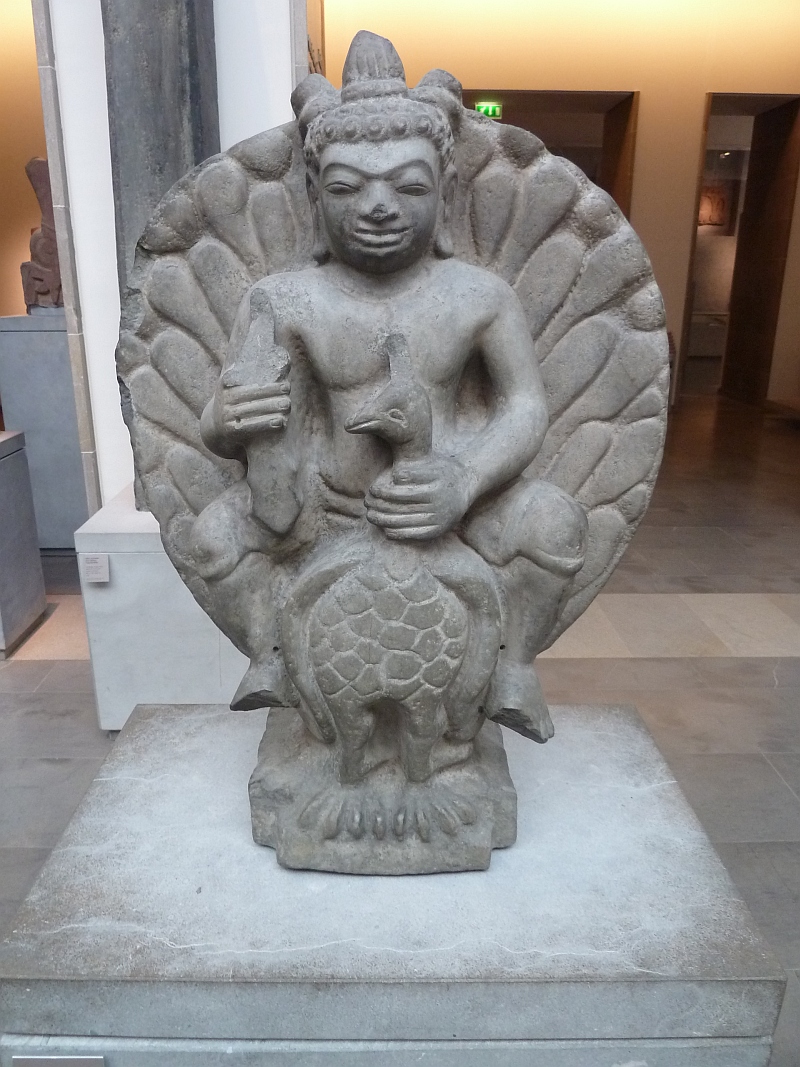
Krsna


As a manifestation of Visnu, Krsna is the creator of his creatures, while also the loving god to his devotees (Sheth 77). Krsna has been called Brahman, the most supreme, the highest self, and the highest bliss, among others (Sheth 80). He has been referred to as a manifestation, or avatara also of Narayana, “Lord of the Universe”. Narayana is another name for Visnu or the original man, purusa. Krsna is one of the two more famous avatars of Visnu, Rama being the other. Krsna is probably more popular than Rama, however, as he fulfills almost every human need. As the divine child, he satisfies the maternal instincts of womanhood. As the divine lover, he gives romantic fulfillment and freedom of sexual expression. He can even save the sinner from evil rebirths (Schweig 16). Although considered by some to be an incarnation of Visnu, Krsna stands alone due to his unusual adoration (Bhandarkar 59).

Krsna’s life spanned from around 3228 BCE to 3102 BCE, according to scriptural documentation (Rosen 124). The earliest mention of Krsna is found in the Chandogya-upanisad (Majumdar 2). He appeared in Mathura, India and spent his youth as a cowherd or gopa in the nearby Northern village of Gokula. He lived with his ‘father’, Nanda, the ruler of the village, along with his ‘mother’ Yasoda and his brother Balarama (Hudson 5). This is where Krsna’s first mischievous yet endearing thieveries took place (Rosen 130). Krsna is also portrayed in texts such as the Mahabharata, the Harivamsa, the Visnu-purana and the Bhagavata-purana. The Harivamsa portrays Krsna as a hero while the Visnu-purana and the Bhagavata-purana portray him as divine (Sheth 43). Some view Krsna as a deity while others view him as a prince who was deified. Some believe he is a real historical person (Majumdar 279) and others as an Indian form of Christ (Couture 38).

Vaisnavism is said to be the most strictly theistic among traditions within the Hindu complex as it claims devotion, or bhakti as both a means and an end. Vaisnavism is the term used for all the devotional traditions dedicated to the worship of Visnu and his avatars (Schweig 15). Vaisnavism was first called Ekantika Dharma, the religion of a single-minded love and devotion to one. It appeared as a religious reform based on theistic principles (Bhandarkar 142). More and more elements have been added to Vaisnavism over time such as the worship of the cowherd boy, Krsna, because of his marvelous deeds and amorous frolicking with the cowherdesses, or gopis. He then came to be regarded as a god and another element was added: the worship of Krsna along with his mistress Radha (Bhandarkar 143). Some Vaisnava groups view Krsna as the source of Visnu and not as a manifestation (Rosen 124).

Someone in full Krsna consciousness uses everything for Krsna’s service and is always liberated from false egoism (Prabhupada 93). The devotee desires nothing for himself but can seek prosperity for others as this is what the Lord wants. (Hudson 25). Schweig calls the devotion to Krsna “theistic intimacy” as Krsna is a god that presents his closest or innermost relationships of love (14). It is significant that what Krsna devotees desire is not moksa (liberation), not freedom from entanglement in samsara, the cycle of repeated births, but continuous “entanglement” in Krsna. They want nothing more than to serve him intimately forever, even if such intimate service may depend upon their own continuous rebirth with him rather than upon release (Hudson 9). Even when the gopis do not purify themselves through ritual bathing or proper actions before rushing to offer themselves to him, Krsna still receives them because it is their intense longing for him that causes their behavior. Receiving the gopis turns all their past and future faults to cotton that will burn up and leave no trace behind (Hudson 26). All devotees seek to emulate the gopis’ pure and consummate devotion to Krsna (Rosen 122).

Krsna is frequently depicted with his female counterpart, Goddess Radha (Schweig 15). Radha has been called the supreme goddess. She embodies all the gopis and all other goddesses. Although Krsna has intimate relationships with all the gopis, Radha is a special gopi; she is Krsna’s supreme gopi (Schweig 19). Many devotees of Krsna worship Radha with him. Their relationship is said to be light, playful, and amusing, leaving out work, worry and anger (Kinsley 84).

If there is one god that is more playful than the others, it is Krsna. Krsna is often called a ‘playful lover’ and he is often engaged in playful actions. Krsna’s actions are called play, or lila, because he is completely fulfilled. His actions are not purposeful; they come from an overflowing abundance (Kinsley 1). Sheth attempts to give evidence to Krsna’s divinity by stating that because his actions are pure, purposeless play, Krsna is unlike a finite being (82). He is commonly worshipped in the form of a baby or child, whose very nature is to play (Kinsley 61). As a child, he is known for his mischief, but his misbehavior is unique in that it purifies and heals all who take part in them rather than evoking concern (Rosen 132). Even when wrestling with enemies, Krsna appears as if he is playing (Sheth 84).

Krsna’s maya, which can be defined as the power to change form or an illusion, is used as a veil when in human form so that during encounters with people, they will not treat him like a god but as another human. For example, when Krsna’s parents realized his divinity, he spread maya on them so that they would continue their parental affection for him (Sheth 89). Another power of Krsna’s is that he can destroy, or heal simply with his touch. He can kill enemies or turn someone beautiful just by touching them (Sheth 91). In his Visnu form, Krsna carries four weapons. In two hands, he carries a lotus flower and a conch shell. These are to assure his devotees that they cannot be vanquished. In the other two hands, he carries a club and a disc. These weapons are meant for the non-devotees to bring them to their senses and remind them that there is the Supreme Lord above them (Prabhupada 21). More distinguishing of Krsna, is a bamboo flute held up to his mouth with both arms. He also carries a herding stick and a buffalo horn. Schweig shows the importance of Krsna’s flute by quoting from a Sanskrit poetic verse, the Krishna Karnamrita, that people would wait to hear Krsna play his flute so that om might sound (24).

Krsna is noted to be strikingly beautiful and youthful, and that he is beauty himself. His speech and his odor are equally as beautiful and it is said that one may find Krsna by his irresistible smell (Kinsley 75). In almost every Vaisnave-Krsna work, Krsna’s physical appearance is revered (Kinsley 77). He usually wears a silk, yellow garment, an ornament with a peacock feather on his head, and a garland made of fresh flowers and leaves. He is a deep blue color, frequently compared to a dark raincloud (Schweig 23). Krsna is so beautiful that even though he wears ornaments, it is his body that enhances the ornaments he wears (Rosen 122). Krsna’s charm and beauty are not purposeless however; they are to allure humanity back to the transcendental realm (Rosen 157).

No other figure in the history of Indian culture has given rise to as much controversy as Krsna (Majumdar 1). He is an extremely powerful, playful, and loving god. Krsna is the true friend of all souls because, when he kills, he not only protects his devotees but, he liberates those that he kills (Schweig 23). Krsna gives salvation not only to his devotees, but also to those who hate him (Sheth 77). Krsna is also multi-faceted as seen in texts such as the Mahabharata, where he exhibits qualities of a philosopher, warrior, friend, lord, husband, charioteer, and guru (Rosen 122). In essence, loving Krsna is synonymous with loving God. In Hinduism, even though there is a hierarchy of sorts, the absolute nature of a god and his name are one (Rosen 220). Krsna eventually returned to the spiritual realm after ridding the world of its worst demons and establishing dharma, or righteousness (Rosen 136). His appearance in this world is claimed to be for the benefit of humankind, to remind us of our real life in the spiritual realm (Rosen 125).

REFERENCES AND FURTHER RECOMMENDED READING

Bhandarkar, Ramkrishna Gopal (1995) Vaisnavism, Saivism and Minor Religious Systems. New Delhi: Asian Educational Services.

Couture, Andre (2002) Krsna’s initiation at Sāndīpani’s hermitage. Numen, 49(1), 37-60. Retrieved March 3, 2009, from ATLA Religion Database with ATLASerials database.

Hudson, Dennis (1980) Bathing in Krishna : a study in Vaisnava Hindu theology. Harvard Theological Review, 73(3-4), 539-566. Retrieved February 28, 2009, from ATLA Religion Database with ATLASerials database.

Kinsley, David R. (1979) The Divine Player: A Study of Krsna Lila. Delhi: Motilal Banarsidass.

Majumdar, Bimanbehari (1969) Krsna in History and Legend. Calcutta: Calcutta University Press.

Prabhupada, A.C. Bhaktivedanta Swami (1970) Krsna: The Supreme Personality of Godhead. New York: Bhaktivedanta Book Trust.

Rodrigues, Hillary (2006) Hinduism – The Ebook. Journal of Buddhist Ethics Online

Books, Ltd.

Rosen, Steven J. (2006) Essential Hinduism. Westport, CT: Praeger Publishers.

Schweig, Graham M. (2004) “Krishna, the Intimate Deity.” The Hare Krishna Movement: The Postcharismatic Fate of a Religious Transplant. Ed. Edwin F. Bryant & Maria L. Ekstrand. New York: Columbia University Press, 13-30.

Sheth, Noel S.J. (1984) The Divinity of Krishna. Delhi: Munshiram Manoharlal Publishers.

RELATED TOPICS FOR FURTHER INVESTIGATION

Avatara

Bhagavata Purana

Chandogya Upanisad

Gopa

Gopis

Govinda

Hare Krnsa Movement

Harivamsa

Lila

Mahabharata

Maya

Narayana

Purusa

Radha

Rama

Vaisnavism

Visnu

Visnu Purana

NOTEWORTHY WEBSITED RELATED TO THE TOPIC

www.krishna.com

http://www.pantheon.org/articles/k/krishna.html

http://www.sanatansociety.org/hindu_gods_and_goddesses/krishna.htm

http://en.wikipedia.org/wiki/Krishna

http://krishna.org/

Article written by: Annie Siegrist (March 2009) who is solely responsible for its content.