The Ananga Ranga

The book The Ananga Ranga was written by Kalyana Malla in 1885 in the Sanskrit language; this book was translated by Richard Francis Burton into English and includes nine chapters and two appendixes. The Ananga Ranga is heavily condensed with specific categorizations. As a result, I will provide a brief summary of the translated version for each chapter or appendix; this paper will also discuss additional information that is pertinent to the inquiry.

Chapter one contains two sections that explain the four orders of women. They are known as Padmini, Chatrini, Shankhini, and Hastini. A Padmini is also known as the Lotus-woman, and is described as having a yoni [a yoni is a woman’s vagina] that resembles the open-lotus bud; she only sleeps a small amount, is respectable, and religious. She possesses the walk of a swan. A Chitrini is also known as the Art-woman, and is described as having a medium sized body, her yoni has hair that is thin, and her walk is described as being like that of an elephant. A Chitrini also loves to sing and loves pets. A Shankhini is also known as the Conch-woman, and is described as having a bilious temperament that sometimes makes her hot headed and confused; a Shankhini is also described as having a body that is large with small breasts and a yoni that is moist. A Hastini is short, has dead white skin, large hips and a harsh voice. A Hastini can only be truly satisfied by prolonged sex.

In chapter one, and also in section three, there is a table which classifies the greatest days of enjoyment for the four classes of women. In section four there are the hours prescribed which gives one the highest enjoyment.

In chapter two, Malla describes “The Various Seats of Passion in Women”. This means the four classes of women have different ways to enjoy their sexual desires and achieve satisfaction. Malla advises the husband to continue his action until he sees the body-hair bristle and hears the Sitkara, and then he will know that his wife is truly satisfied.

There are four different tables of manipulation [a manipulation is a way of pleasuring one’s wife] in chapter two, each one relating to one of the four different classes of women. Manipulation is directed towards a woman’s body and certain body part. A Padmini can be manipulated by her throat, cheek, hair, waist, breast, back, bosom, side, thigh, belly, arm, lip, nipple, space between her eyes, and her foot. A Chitrini can be manipulated through her yoni, lower lip, throat, waist, navel, lip, breast, ear, thigh, back, butt, forehead, chest, hair, eye, and the middle of her body. A Shankhini can be manipulated by her body in general, lower lip, arm, breasts, belly, chest, throat, ear, foot, mouth/face, yoni, lip, inch below her head, and the lower edge of her yoni. A Hastini can be manipulated through her yoni, navel, lip, side, breast, chest, nipple, body generally, eye, and armpit.

In chapter three, section one, Malla describes three types of men. A Shastra (Hare-man) is described as having a linga [a linga is a man’s penis] that does not exceed three inches while erect. He has features that are clear, well proportioned, and large eyes. He is humble, moderate in carnal desires, and nothing is offensive about his semen. A Vrishabha (Bull-man) is portrayed as having a linga that is four and a half inches, and a body that is robust and tough. He is cruel, violent, restless, and his semen is ever ready. An Ashwa (Horse-man) has a linga that is six inches long; he is tall, muscular, and has coarse and thick hair. An Ashwa is passionate, reckless and lazy, full of sleep, and his semen is copious, salty and goat-like.

In chapter three, section two, the women are further subdivided into three categories; this is dependent upon the depth and extent of their yoni. They can be categorized into: Mrigi (Harini) (Deer-woman) who has a yoni that is six fingers deep, Vadava (Ashvini) (Mare-woman) who has a yoni that is nine fingers deep, and Karini (Elephant-woman) who has a yoni that is twelve fingers in depth.

In Chapter two, section three, there are prescriptions to how men from section one, and how the women from section two, should be placed together in a relationship. This is done by tables which go on to describe a person’s best, middle, and worst match.

In Chapter two, section four, Malla describes four minor distinctions in sex. He describes the various degrees in sexual lust among the women. Malla reports that there are twenty-seven different kinds of congress [congress meaning sex], and when multiplied by nine species and three periods, the total is two hundred and forty-three.

In Chapter four, Malla explains the “Description of the General Qualities,” characteristics, and temperaments among women. There are four periods of life for women. The first, Bala (11-16 years old), is in darkness towards congress. Second, Taruni (16-30 years old), is in light towards congress. The third, Praudha (30-55 years old), is both in light and darkness towards congress. Lastly, the fourth, Viddha (beyond 55 years old), becomes sick and infirm towards congress. Malla describes the principle causes that cause women to deviate from engaging in proper behavior; those being the twelve periods when women have the greatest desire for congress, four kinds of love-tie connections, and the four different kinds of yonis.

In chapter five, Malla explains the characteristics of the women from different lands. I will explain only a selected few, with brief examples. A woman from the middle region has red nails and is an excellent housekeeper. Mathra from Krishna’s Country (Cow-herds’ Land) is satisfied by various forms of kissing. A woman from Lata-desha exhibits pleasure that is frequent and violent, with pleasure being gained by gentle insertion, striking with the hand, and soft biting of her lips. Andhra-desha (Telangana) does not feel shame and is considered wicked when compared to others of her sex.

In chapter six, “Treating of Vashikarana,” Malla describes Vashikmuna who uses specific drugs and charms to have various effects; there are three prescriptions, four magical prescriptions for winning love and friendship, three prescriptions that reduce people to submission, a philter-pill (Vatika), four charms, and two different incenses.

In chapter seven, Malla illustrates different signs in men and women; for example, a woman should marry of equal rank, be free from vices, and have brothers. She should have hair that is as black as Bhramara’s, teeth that are clean, ears that are small and well-rounded, a stomach that is flat, and a walk like that of an elephant. She should not come from a bad family and have inappropriate features (e.g. eyes that are yellow) and characteristics (e.g. violent temper).

In chapter seven, Malla explains the following: four ways a man should be tried, different considerations that need to be taken into account when picking a man (learning, disposition, qualities, and action), twenty-one qualities of a excellent man, seven kinds of troubles that result as a consequence when a man has intercourse with a married woman, ten changes in the natural state of men, a list of women who should never be enjoyed, a list of women who serve as go-betweens, a list of women who cannot be easily subdued, signs and symptoms that women become charmed by, places where a woman should not be enjoyed, times when a woman should not be enjoyed, and a description for the best woman fitted for sexual intercourse.

Chapter eight references the “Treating of External Enjoyments” [this precedes sexual intercourse]. Malla explains eight Alinganas, which are ways in which a woman can be embraced such as Vrikshadhirudha, Tila- Tandula, Lalatika, Jaghan-alingana, Viddhaka, Urupagudha, Dughdanir-alingana (Kshiranira), and Valleri-vreshtita.

Malla describes seven places to kiss a woman, which are the lower lip, both the eyes, both the cheeks, the head, the mouth, both breasts, and the shoulders. There are ten types of kisses which are Mlita-kissing (mixing or reconciling), Sphurita-kissing [ this kiss is associated with twitching], Ghatika (neck-nape kissing), Tiyak (oblique kissing), Uttaroshtha (upper-lip kissing), Pindita (lump-kissing), Samputa (casket-kissing), Hanuvatra-kissing [this kiss is done in an irritating way such as a prank], Pratibodha (awakening kiss), and Samaushtha-kissing [this kiss is accomplished by the initiation of the wife].

Malla explains Nakhadana, which is titillating [titillating means sexually exciting another] and scratching with the nails. Nakhadana can be exerted to the neck, hands, thighs, breasts, back, sides, axillaes, the whole chest or bosom, hips, the mons veneris and all parts of the yoni, and the cheeks. There are certain times and seasons when a style of manipulation is suitable and Malla discusses seven ways of applying the nails.

Malla describes seven Dashanas, which are ways of applying the teeth to the human body. He explains the four Keshagrahana’s, which are the manipulations of the woman’s hair. He describes four Karatadana’s, which are known as soft tappings and pattings with the hand by the husband or wife. Sitriti is a sound that is produced through inhaling the breath between closed teeth; this sound is produced from women and can be divided into five categories. Also, Malla describes men inhabiting characteristics of the Ashtamahanayika (eight great forms of Nayika).

In chapter nine, Malla discusses the “Treating of Internal Enjoyment in its Various Forms,” this means different sex positions. The Uttana-bandha is a position where the woman lies on her back, and this can be divided into eleven different subdivision positions. Tiryak-bandha is a sex position where the woman lies on her side, and this can be further divided into three positions. Upavishta is known as a sitting sex position, and this can be further subdivided into ten different positions. Utthita is the standing posture, and can be divided into three different sex positions. Vyanta-banda is a sex position where there woman has her breast and stomach to the bed or carpet, and this is divided into two different subdivisions. Purushayitabandha is where the man lies on his back with the woman on top, and this can be divided into three different positions. Malla does note that there are women that need to be excluded from the Purushayita; an example would be a woman who is pregnant.

Appendix one explains how astrology can be connected with marriage. Malla shows where consonance or dissonance emerges due to the stars of a bride and groom to be. A table was made by Malla to predict this; there is the zodiacal sign, presiding planet, genus, and the caste of a person. Malla discusses eight Gunas that are dispersed under eight heads and these are the caste, vashya, the nakshatras, class, planets, groups, kuta, and the nadi or point of time.

Appendix two is brief and comprised of six recipes, which are related to Rasayana, which is the preparation of metals for medicinal reasons.

The Ananga Ranga has been slow to become appreciated and learned because of its controversial discussions on sex. Malla wrote this book primarily to have the husband and wife live happily together as one, and to prevent the separation of a married couple.

REFERENCES AND FURTHER RECOMMENDED READING

Burton, R (1885) The Ananga Ranga (Translation). Internet Sacred Text Archive. Retrieved February 10, 2009, from http://www.sacred-texts.com/sex/ar/ar01.htm.

Related Topics for Further Investigation

Alinganas

Ashwa

Bala

Chatrini

Dashanas

Hastini

Karatadana

Karini

Mrigi

Padmini

Praudha

Shankhini

Shastra

Sitkara

Sitriti

Taruni

Vadava

Vashikarana

Viddha

Vrishabha

Noteworthy Websites Related to the Topic

http://en.wikipedia.org/wiki/Ananga_Ranga

http://burtoniana.org/books/1885-Ananga%20Ranga/1885-Ananga%20Ranga.htm

http://www.caitlainscorner.com/content/view/488/55/

http://www.notelay.com/articles/books/ananga_ranga/

http://tantramag.com/e-library/ananga-ranga/

http://tfj.sagepub.com/cgi/content/abstract/14/1/81

http://www.tantra-sex.com/anangaranga.html

Article written by: Lindsay Kleiner (March 2009) who is solely responsible for its content.

The Baul Religion

The Bauls of Bengal are people who practice the Baul religion. The Baul people are mostly known for singing because singing is one way in which they project their beliefs (Thielemann 1). This religion is a combination of Hindu and Islamic beliefs and is based on the Upanisads and the Vedas (Capwell 255). To be Baul requires not only studying, but an emersion in the knowledge acquired (Thielemann 20). In order for the Bauls to be consumed with this knowledge, they must learn by experience. The most important aspect is self-realization, sadhana (1). The Baul does need guidance from a spiritual master, sadguru; the only way for a person to fully achieve sadhana is by attempting it themselves, not just learning about it.

The main component of the Baul religion is that the true divinity, maner manusa (the man of the heart), dwells within the human heart (17). The Bauls believe that the human body is the temple of the gods, so they must take care of and properly cultivate their bodies. Before one can unite with the Supreme Divinity, his soul must be completely purified. A person must be purified through body and heart; means of attaining this includes having good thoughts, company, conversation, and environment. One must also completely give up his ego. The main goal for a Baul adherent is to surrender himself to the divinity within himself. Once the human and Supreme Soul has united, he or she is able to attain infinite reality; this is Baul sadhana (21).

The path to attaining sadhana is not easy; it takes much control and selflessness. One of the most important aspects of Baul sadhana is aropa sadhana (the fundamental process of implementation). This is achieved by mastering breath- control (38). Within this process there are three stages to perform: “drawing the breath upwards, suspending it for some time, and finally releasing it again” (39). There is a whole process on how one performs these steps which takes a great deal of strength and control. The first step is called Puraka and it consists of using one’s finger to close the right nostril and breathing through the left, then switching and breathing through the right. The next step, Kumbhaka, is when the Baul holds the breath within him by holding his nose and mouth closed with his right hand. The final step is Recaka, where the breath is released through one nostril. This is a very specific procedure but it helps the Baul gain strength to attain sadhana. The amount of time one is supposed to hold their breath is not specified but being able to train and hold it for long periods of time shows that person has full control over the vital air and their inner strength (40). Another aspect that goes along with the vital air is ajapa (the soundless incantation). After one is fully conscious of the supreme divinity within them, this incantation is automatically pronounced while that person breaths in (41). When the Bauls have achieved the highest level of control, which is done through their breathing, they are able to pursue more in their sadhana (43).

Once the Baul has found his true self, a brilliant light shines before him. This light allows him to see everything within himself by illuminating the inner self. Man’s own self is this light, it is atma (the self – illuminating human soul) (81). To attain the spiritual goal of atma the Baul must have total knowledge of their body and have achieved proper sadhana (Capwell 260). Also, for one to see their inner self they have to tune – out everything outside of their own body.

Baul philosophy is mostly known for the songs that the Baul people sing; in the Samsad Bengali – English Dictionary the definition of Baul is “one of a class of Hindu stoical devotees singing songs in a special mode illustrating their doctrine (Thielemann 1).” Although the Bail religion may be synonymous with singing, it is not the totality of the Baul religion. The reason the Bauls are known for their singing is because it is one way they are able to share and attain sadhana, which people hear and therefore relate to them. The Baul’s song comes completely from his heart. Through his song he can express his feelings and sing them to everything around him. The Baul becomes engrossed in the song he is singing and nothing else around him matters. This is because while singing he has become one with the Supreme Being within him (36). Becoming one with the maner manusa is the ultimate goal for the Bauls, which explains the prevelance of singing within the Baul religion.

While singing the Baul plays a one – stringed plucked drum called the ekatara. This instrument symbolizes union of the body (deha) and the mind (mana). The clothes worn by the Baul also symbolizes unity. Their guduri is a dress that is made of many different pieces and colors of fabric that are sewn together. Each of the pieces is supposed to represent every caste and every religion and they are being brought together in unity and equality in the dress (35 – 36).

The Baul is always trying to achieve sadhana and by singing, dancing and playing his instrument he is able to perform his sadhana. The Bauls believe that worshipping alone is a form of selfishness because it is not universally shared. Therefore, an act of devotional selflessness can be found in the Baul interaction with the surroundings and audience (102). Being unified with all is very important to the Bauls and singing is claimed to unify all individual aspects into a whole. When sound (svara brahma), rhythm (tala brahma) and speech (vakya brahma), combine to make music, it becomes the highest point of emotion and at this point it has gained full strength and that is when everything is united (112).

Although it seems that plain singing is all that is needed to reach this great height of oneness, this is not the case. It is very important that the singer be in tune and be completely focused on praising the divinity within him. If the singer fails to do either of these then negative forces are able to enter his heart (114). Done correctly though, the Baul is able to show his worship to the Supreme Divinity within himself. Samkirtana is the congregational rendition of musical worship. This brings together many like – minded people to worship, which intensify the devotion to the Supreme Divinity.

Music is a way in which the Baul people are able to worship their inner deity and move closer to their ultimate goal of sadhana. Because the Supreme Divinity dwells within the hearts of men, sadhana (self-realization) as the greatest aspiration of the Bauls, is to become completely one with The One inside of them.

Bibliography

Capwell, Charles H. (1974) “The Esoteric Belief of the Bauls of Bengal.” The Journal of Asian Studies, Vol. 33, No. 2 (February): 255-264.

Thielemann, Selina (2003) Baul Philosophy. New Delhi: A.P.H. Publishing Corporation.

Related Reading

Capwell, Charles (1988) “The Popular Expression of Religious Syncretism: The Bauls of Bengal as Apostles of Brotherhood.” Popular Music, Vol. 7, No. 2, The South Asia/West Crossover (May): 123 – 132.

Related Topics

Sadhu

Sadhana

Baul Music

Sexual Rituals

Related Wedsites

http://en.wikipedia.org/wiki/Baul

http://hinduism.about.com/od/artculture/a/bauls.htm

Written by Emily Kaun (Spring 2009), who is solely responsible for its content.

Creation in the Markandeya Purana

The Brahmanical tradition encompasses a vast body of literature commonly referred to as the Puranas (Pintchman 261). The Puranas are categorized as smrti (i.e., literature that has been passed on by human beings to the next generation through oral tradition), but often claimed as sruti-like or “divinely heard” (Coburn 343-344). For instance, the Markandeya Purana states that “as soon as Brahma, whose origin is inscrutable, came into being, this Purana and the Vedas issued from his mouths” (Mark. P. 219). The Puranas are classified according to sectarian perspectives; a majority of the eighteen Mahapuranas, or major Puranas, are Vaisnava or Saiva in orientation as the gods Visnu and Siva are deemed to be Brahman, the Absolute reality (Pintchman 261).  Four of the eighteen Upapuranas, or minor Puranas, celebrate the goddess Sakti, and are thus Sakta in orientation (Pintchman 261).  Other Puranas, however, such as the Kurma Purana and the Markandeya Purana do not appear to have any clear sectarian orientations (Rodrigues 290).

The Puranas mainly comprise several myths on “creation, renewal, genealogies, manvantara periods of time, and tales of genealogical figures” (Rodrigues 290). According to Pintchman (262), the Puranas distinguish between the two significant phases of universal creation. The sarga, or primary, creation phase occurs after a major dissolution, while the pratisarga, or secondary, creation phase refers to the renewal of the universe after a minor dissolution. These two stages illustrate the Hindu notion of eternal repeating cycles whereby the universe is constantly being created, dissolved, and renewed (Miller 63-66). In the Markandeya Purana, both the sarga and pratisarga creation phases are explained through a dialogue between three rsis (sages): Jaimini (the first inquirer), Kraushtuki (the second inquirer), and Markandeya (the informer).

Markandeya begins the creation myth by claiming that Brahma is the cause and effect of everything in the universe (Mark. P. 220). Within Brahma, the three gunas, or qualities, exist in equilibrium: Brahma is one-third sattva (pure/luminous), one-third rajas (active/passionate), and one-third tamas (passive/dark). In accordance with Sankhya philosophy, Markandeya states that the disruption of Brahma’s gunas lead to the creation of the Mahatattvas, or great categories (Pintchman 263; Mark. P. 220). First the Pradhana, or the Imperceptible, came into existence; from this, came the Mahat, or Intellectual principle, which can be identified by goodness, passion, and ignorance. Mahat in turn led to the creation of the Ahankara, or principle of Individuality. Ahankara, much like Mahat, has three characters: the Modifying, the Energizing, and the Evolving.   The Evolving Ahankara then creates the subtle elements; from each element, a complementary element was created:  From sound came ether, from touch came air, from form came light, from taste came water, and from smell came earth (Mark. P. 220-221). Following these creations, the Modifying Ahankara generated the eleven human organs. Of the eleven, five were organs of the buddhi, or intellect, and five were organs of the taijasa, or action (Mark. P. 221). These ten organs constitute the ten Vaikarika deities, while the manas, or mind, is the eleventh organ. Markandeya then continues by stating that Mahat, along with the other tattvas, give rise to a hiranya-garbha, or cosmic egg, which floats on a cosmic ocean (Mark. P. 222). [The notion of a cosmic egg that holds the universe in its incipient form is consistent with Rg Vedic accounts on creation, for an example, see Bhattacharyya 2-5]. This hiranya-garbha contains the Absolute and the universe in its embryonic form.

At this point, Markandeya is interrupted by Kraushtuki, a third rsi, who wishes to know what happens “when things are not created, and nothing exists, everything has been destroyed by time at the end of the dissolution of the universe” (Mark. P. 224). In response to this question, Markandeya commences by declaring that Brahma possesses three qualities that are manifested as Brahma the creator, Visnu the maintainer, or nurturer, and Rudra the destroyer. He continues by stating that Brahma, who is the first of all gods, lives for a hundred years. These years, however, are different from the years of human beings and deities (Mark. P. 226).  Markandeya explains that the fundamental unit of time is an age, or yuga.  There are four yugas that make up a mahayuga: the krta yuga, the treta yuga, the dvapara yuga, and the kali yuga. A thousand mahayugas constitute one kalpa, while seventy-one cycles of a mahayuga form a single manvantara. Thus, one kalpa can be divided into 14 manuvantaras; manvantaras are presided by divine beings known as Manus (Mark. P. 226-227). A single day of Brahma comprises two kalpas (For a thorough explanation of the computation of Brahma’s life, see Appendix A).

After computing Brahma’s lifespan, Markandeya continues with the creation myth. Markandeya explains that at the end of each kalpa, Brahma sleeps and a minor dissolution, which is referred to as a causal dissolution or naimittik pralay, takes place (Mark. P. 227). During the naimittik pralay, residents of the triple-world, which includes the bhurloka (earth), bhuvarloka (atmosphere or mid-region), and svarloka (heaven), temporarily relocate to the maharloka, while the residents of the maharloka travel to the janaloka (Mark. P. 227-228). [For a more detailed explanation of the triple-world system, see Prakash 55-61 and Miller 83-86]. The entire universe is also submerged in the cosmic ocean at the time of the naimittik pralay. When Brahma awakens, he starts to create the universe.

First, Brahma creates Narayana, or ‘the one who dwells in water’, who assumes the body of a boar, to dive into the cosmic waters to bring up the previously submerged world (Mark. P. 229). Markandeya continues by claiming that “the earth floated like an immense boat on that ocean, but [did] not sink by reason of the amplitude of its size” (Mark. P. 229). Narayana then began creating the triple-worlds, as well as the maharloka. Brahma is extremely satisfied with Narayana’s creations, but desires to create other superior beings to inhabit the worlds. He begins to meditate, and through this process, he creates nine classes of creations. As Brahma had already created mahat (intellect) and the subtle elements, he began meditating to create the vikaras. The vikaras comprised of sense capabilities (i.e., seeing, hearing, tasting, touching, and smelling) as well as action capabilities, such as grasping, speaking, walking, procreating, and excreting (Pintchman 270). These three creations (i.e, the mahat, subtle elements, and vikaras) are thought to evolve from Prakrti, and are thus deemed to be prakrta, or primary, creations (Mark. P. 232).

The fourth class comprised the vegetables, which are described as the “creation incapable of causation” (Mark. P. 230). The fifth class comprised the four-legged animals, such as cattle, that can be characterized by ignorance. Brahma realized that even these creations were incapable of causation, and thus, he continued to meditate and created the sixth class of beings known as the urdhva-srotas, or the gods. According to Markandeya, Brahma was exceptionally pleased with this creation because the gods are primarily characterized by goodness, pleasure, and affection. Brahma prolonged his meditation to create the seventh class that was capable of causation, and characterized by ignorance and passion; these were the human beings. Since “the streams of life in them moved downwards”, human beings were deemed the arvak-srotas. The eighth class of beings was the anugraha, characterized by goodness and ignorance. These latter five creations are thought to derive from the Vikaras, and are thus known as the vaikrta creations. The ninth and final creation was the kaumara creation; kaumara consisted of both prakrta and vaikrta (Mark. P. 232).

Markandeya continues reciting the creation myth to Kraushtuki by explaining the details of Brahma’s four created beings: the asuras, or demons, the suras, or gods, the pitrs, or ancestors, and the humans. Brahma created each being from a different and separate body (Mark. P. 233-234). After using each body to create a specific being, Brahma discards the body to form different periods of the day. Night came from the body that created the asuras, while day emerged from the body that created the suras. Twilight, or dawn, derived from the body that created the pitrs, and moonlight came from the body that created the humans. According to Pintchman (270), Brahma “then creates all other existing entities from his own bodily form.” One such notable category of entities include Brahma’s manasa, or mind-born, sons (Mark. P. 247-248).

Brahma created nine sages from his mind alone (Mark. P. 247). These sages were named Bhrigu, Pulastya, Pulaha, Kratu, Angiras, Marici, Daksha, Atri, and Vasishtha. These mind-born sons were supposed to continue Brahma’s work of creation. However, the sages disregarded Brahma’s work and, instead, pursued a renouncer-like life typified by contemplation, meditation, and asceticism (Pintchman 271).  Realizing that his creations were at great risk of meeting an abrupt end, Brahma grew angry (Mark. P. 248). Amidst his anger, Markandeya explains, Brahma creates a divine being that is half male and half female (Mark. P. 248). In order to sustain his creations, Brahma orders the being to “divide thyself” to create several other females and males (Mark. P. 248).  With several other beings created from the half male and half female divine being, Brahma generates Manu Svayambhuva to guard these numerous beings.

Markandeya’s account of how the world came to be is one of several in the Hindu tradition. Although many Hindu texts bear close resemblance to the account in the Markandeya Purana (e.g., Brahmada Purana, Garuda Purana, and Padma Purana), several other texts describe differential versions of creationism. For instance, the Purusa Sukta hymn, in the Rg Veda, depicts the universe as an enormous cosmic being, known as Purusa, that is three quarters transcendent and one quarter manifest (Rg Veda 10.90). From Purusa, a feminine principle named Viraj, or the widespread, is generated. Together, Viraj and Purusa beget a son, also named Purusa; this son is sacrificed by the gods, and from this sacrifice Purusa creates the cosmos (Rodrigues 89). As this account of creationism is vastly different from Markandeya’s account, it is worth noting that many creationist accounts in the Hindu literature may be contradictory. Although most Puranic creationist accounts are valued by Hindus worldwide, the Puranas have not been granted a sruti status, and thus, Vedic accounts of creationism, such as the Purusa Sukta hymn, may be deemed more significant.


REFERENCES AND FURTHER RECOMMENDED READING

Bhattacharyya, Narendra Nath (1983) History of Indian Cosmogonical Ideas. New Delhi: Munishiram Manoharlal.

Chatterji, Suniti Kumar (1936) “Purana Legends and the Prakrit Tradition in New Indo-Aryan.” Bulletin of the School of Oriental Studies, University of London 8, no. 2/3: 457-466.

Coburn, Thomas B. (1980) “The Study of the Puranas and the Study of Religion.” Religious Studies 16, no. 3: 341-352.

Knipe, David M (1991) Hinduism: Experiments in the Sacred. New York: Harper Collins Publishers.

Miller, Jeanine (1985) The Vision of Cosmic Order in the Veda. London: Routledge & Kegan.

Pargiter, F Eden (1981) The Markandeya Purana: Translated with Notes. New Delhi: Indological Book House.

Pintchman, Tracy (1998) “Gender Complementarity and Gender Hierarchy in Puranic Accounts of Creation.” Journal of the American Academy of Religion 66, no. 2: 257-282.

Prakash, Satya (1985) Hindu Religion and Morality. New Delhi: Asian Publication Services.

Rodrigues, Hillary (2006) Hinduism – The Ebook. Journal of Buddhist Ethics Online Books.

Shourie, Arun (1979) Hinduism: Essence and Consequence. New Delhi: Vikas Publishing House.

Singh, Jai Pal, & Khan, Mumtaz (1999) “Hindu Cosmology and the Orientation and Segregation of Social Groups in Villages in Northwestern India.” Geografiska Annaler, Series B, Human Geography 81, no. 1: 19-39.

Related Topics for Further Investigation

Absolute

Ahankara

Angiras

Anugraha

Arvak-srotas

Asura

Atri

Bhrigu

Bhurloka

Bhuvaloka

Brahmada Purana

Brahman

Brahma

Buddhi

Creation/Creator/ Creationism/Hindu Creationism

Daksha

Dvapara Yuga

Garuda Purana

Genealogical figures

Guna

Hindu cosmology

Hiranyagarbha/World egg/Golden Embryo

Jaimini

Janaloka

Kali Yuga

Kalpa

Kaumara

Kraushtuki

Kratu

Krta Yuga

Kurma Purana

Mahapurana

Maharloka

Mahat

Mahatattva

Mahayuga

Major dissolution

Manas

Manasa

Manus

Manu Svayambhuva

Manvantara

Marici

Markandeya

Markandeya Purana

Minor dissolution

Narayana

Naimittik pralay

Padma Purana

Pitr

Pradhana

Prakrti

Prakrta

Pratisarga

Pulaha

Pulastya

Purana

Purusa

Purusa-Sukta

Prthivi

Rajas

Renewal

Rg Veda

Rg Vedic Cosmology

Rsi

Rta

Rudra

Saiva

Sakta

Sakti

Sankhya philosophy

Sarga

Satva

Siva

Smrti

Sruti

Supreme Being

Sura

Svarloka

Taijasa

Tamas

Tapas

Tattva

Treta Yuga

Triple-world system

Universe

Upapurana

Urdhva-srotas

Vaikarika

Vaikrta

Vaisnava

Vashistha

Vikaras

Viraj

Visnu

Yuga

Noteworthy Websites Related to the Topic

http://www.astrojyoti.com/puranasindex.htm

http://www.veda.harekrsna.cz/encyclopedia/puranas.htm

http://www.sacred-texts.com/journals/jras/ns13-13.htm

http://www.veda.harekrsna.cz/planetarium/index.htm

http://en.wikipedia.org/wiki/Purana

http://en.wikipedia.org/wiki/Hindu_cosmology

http://en.wikipedia.org/wiki/Markandeya

http://en.wikipedia.org/wiki/Markandeya_Purana

http://ancienthistory.about.com/gi/dynamic/offsite.htm?zi=1/XJ&sdn=ancienthistory&zu=http%3A%2F%2Fwww.webonautics.com%2Fmythology%2Fbrahma.html

http://www.urday.com/mark_chp8.htm

Article written by: Sara Kafashan (April 2009) who is solely responsible for its content.

Maharishi Mahesh Yogi

Maharishi Mahesh Yogi can be considered one of the most well-known practitioners of yoga not only in the eastern world, but in the west as well. Having studied under a Hindu guru in the 1950s, he has now come to represent an industry that is estimated to be worth over $3 billion (Economist 95). Some have come to know him as a “modern Vedic scholar and educator” (Riedesel 332). [The Vedas are the prominent set of texts found within the Hindu tradition, and are said to be divinely revealed; for more information about these scriptures see Rodrigues(2006)]. In 1959 his influence in the west became apparent when he immigrated to the United States and founded an “impressive” number of associations dealing with meditation (Aravamudan 33). Maharishi Mahesh Yogi’s status rose when he received a two-month visit from the famous band, the Beatles, in 1968 at one of his sites in Rishikesh, India (Platoff 242). Perhaps one of the reasons why he has gained recognition in the west is a result of his fusion between eastern philosophy and western science. In 1972 the yogi aimed to take his views worldwide through the establishment of the World Plan Executive Council (Aravamudan 35). Here, the issues of politics, the economy, and existing social situations would be addressed on a global scale (Aravamudan 35).

Yoga is considered by Hindu philosophy as a darsana or an “event of ‘seeing’”(Burley 1). Basically, it is understood as a method for discovering the true reality of the universe. The term yoga is derived from the Sanskrit word yuj, which can be translated as “to yoke or harness” (Whicher 7). Some say that this unification is between the self (Atman) and the universe (Brahman) (Wilson 304). Nevertheless, there have been numerous philosophers and publications attempting to provide insight within this broad philosophy, one of which is known as the Yogasutra. Written between the third and fourth century, it is classified as a set of teachings aiming to provide followers a release from “sin, pain, and ignorance” (Burley 4). Complier of the text, Patanjali, uses the term yogas cittavrttinirodhah to say that in order to achieve this union with Brahman, we must first end the misidentification of our thoughts with our mind (Whicher 1).[For more information on the philosophic literature of yoga, see Burley(2007) and Whicher(2000)]. Many people, including Maharishi Mahesh Yogi, have applied the practice of mediation to cease this confusion. Nevertheless, just as extensive as the concept of yoga is the phrase yogi. This word is the nominative term for the term yogin, which is used to describe a student of yoga (Whicher 31). Therefore, Maharishi Mahesh Yogi has come to represent a practitioner under the vast Indian philosophy of yoga.

One of Maharishi’s main innovations is the Transcendental Meditation technique. This form of meditation is intended to be practiced twice a day for fifteen to twenty minutes while in a comfortable, closed-eyed position (Riedesel 333). The yogi describes this activity as “turning the attention inwards towards the subtler levels of a thought until the mind transcends the experience of the subtlest state of the thought and arrives at the source of the thought” (Wallace 1752). What the yogi means by this is the ability to concentrate on a single feature that will eventually lead a higher realization or state of consciousness, and thus connect back to who we are as a person. This process is explored further through the concept of the four states of consciousness (which are expressed within the Maharishi Vedic Science): Transcendental Consciousness or Turiya Chetana, Cosmic Consciousness or Turiyatit Chetana, God Consciousness or Bhagavad Chetana, and Unity Consciousness or Brahmi Chetana (Nidich, Nidich and Alexander 143). From a cosmic standpoint, it is said that the purpose of these higher states of awareness are to merge the person with the universe. In the first state, Transcendental Consciousness, the awareness of the “unbound self” appears (Nidich, Nidich and Alexander 143). It is here where the body’s stress is “naturally dissolved” and the instability of emotion is stabilized (Riedesel 333). This first state is the main level that is achieved in Transcendental Meditation, and has been noted by Mahesh that through regular experience of this awareness, the conflicts that arise in life do not inflict on the “eternal freedom” of the self, or in other words, “Life is not lost to itself” (Nidich, Nidich and Alexander 143). [For more information on the states of consciousness see Maharishi Mahesh Yogi (1969)].

Along with the spiritual components of Transcendental Meditation, there is said to be physiological effects that accompany the practice. Studies have indicated it has the ability to decrease tension both mentally and physically (Wallace 1754). Furthermore, biomedical researchers assert that the ability to relieve certain nervous and cardiovascular conditions such as hypertension, asthma, epilepsy, and hypertension looks promising (Holden 1176). The type of relaxation produced by this technique is different from what is found while sleeping, being awake, or under hypnosis (Wallace 1754). [For information on specific EEG readings see Wallace (1970)]. In fact, Maharishi points out that it is a pulsation between deep rest and activity within the entire nervous system; one he says that mimics the natural “expansion and contraction in the physical universe” (Holden 1177). Due to its ease of use and the ability for beginners to achieve this relaxation quickly, there are currently over half a million Americans practicing Transcendental Meditation, and over three million worldwide (Holden 1176 and Aravamudan 34). With the physiological research in place, it has even been implemented in prisons and rehabilitation centres since the 1970s, with the aim of helping at-risk people realize the possibility of voluntary control over the automatic nervous system (Holden 1176). Although there are traces of Hinduism behind the philosophy of Transcendental Meditation, the yogi is compelled to make it compatible with all faiths, and even takes this notion one step further by attempting to establish an alliance between religion and science (Aravamudan 33).

Transcendental Meditation is housed under Maharishi Mahesh Yogi’s objectively philosophic framework of the Science of Creative Intelligence (SCI). With the purpose of attaining world peace, the yogi has fused together the conceptual ideas of religion including “ancient Indian Vedic wisdom,” with pragmatic elements of science such as psychology, in order to create this system (Holden 1176). The basis behind SCI is the ability to demonstrate how a set of fundamental principles- creativity and intelligence- permeate the biological world, which in turn, are reflected within the mind (Holden 1177). He describes creativity as the reason why change occurs, and it is constantly being reflected within the universe (Riedesel 332). Intelligence on the other hand, is the essential quality of our existence. It is a part of creativity since it is here that intelligence becomes illustrated. Both of these are what Maharishi Mahesh Yogi combines to form a science in the sense that they have ability to be verified through experimentation (Riedesel 332).

Within the Science of Creative Intelligence lie a few basic hypotheses. First, is the belief that every individual contains an “unlimited reservoir” of creative intelligence which is expressed through the human nervous system (Riedesel 332). However, Maharishi Mahesh feels that this expression is inhibited when a person is under stress. In other words, the physiological effects we feel when we are under pressure obstruct our ability to connect with the true and beneficial qualities of the universe. However, he proposes a solution to this obstruction through the practice of Transcendental Meditation. SCI purports that creative intelligence is experienced in this technique because it takes a person to the higher levels of consciousness, eliminating the stress, and as a result, allowing his or her “biomachinery” to function properly again (Riedesel 333). The yogi goes on to state that the aim is to maintain this increased level of awareness in order to establish “greater achievement and fulfillment in life;” to him, it is here where an individual has attained enlightenment. In the final hypotheses, we see that the influence of science in his philosophy has been fully integrated in his claim that these enlightened qualities are not only definable, but able to be scientifically investigated (Riedesel 333).

The contributions Maharishi Mahesh Yogi has made towards spirituality positions him as one of the most globally recognized yogic practitioners. Through the development of Transcendental Meditation and the Science of Creative Intelligence, he has been able to bridge subjective philosophy with objective science. Although Transcendental Meditation explores the deeper levels of consciousness and connection with the universe, it is also seen as a practical aid in decreasing stress and creating positive physiological responses (Wallace 1754). As result, he has attracted both the spiritual seekers and the worldly dwellers alike. The Science of Creative Intelligence fuses this bridge stronger by making breaking down what can be considered a highly metaphysical process, enlightenment, into scientifically observable traits (Riedesel 333). With his appeal to both eastern philosophy and western science, there is no question as to why Maharishi Mahesh Yogi’s insights have become so successful.

REFERENCES AND FURTHER RECOMMENDED READING

Aravamudan, Srinivas (2001) “Guru English.” Social Text 66 19 no.1. 19-44.

Burley, Mikel (2007) Classical Samkhya and Yoga. New York, N.Y.: Routledge.

Holden, Constance (1975) “Maharishi University International: ‘Science of Creative Intelligence’.” Science, New Series 187 no. 4182. 1176-1180.

Maharishi Mahesh Yogi (1969) Maharishi Mahesh Yogi on the Bhagavad Gita: A New Translation and Commentary. Baltimore, Maryland: Penguin.

______ (2008) “Maharishi Mahesh Yogi.” Economist 386. 8567. 95.

Nidich, Randi J., Nidich, Sandford I., & Alexander, Charles N (2005) “Moral Development and Natural Law.” Journal of Social Behaviour and Personality.17. 137-149.

Platoff, John (2005) “John Lennon, ‘Revolution,’ and the Politics of Muscial Reception.” The Journal of Musicology 22 no.2. 19-44.

Riedesel, Brian C. (1979) “Toward Full Development of the Person.” Personnel & Guidance Journal, 57. 7. 332-338.

Rodrigues, Hillary (2006) Hinduism–The Ebook. Journal of Buddhist Ethics Online Books, Ltd.

Snider, Robert H. (2005) “New HealthRelated Applications of Maharishi Vedic Science.” Journal of Social Behaviour and Personality. 17. 547-551.

Wallace, Robert K. (1970) “Physiological Effects of Transcendental Meditation.” Science, New Series 167 no. 3926. 1751-1754.

Whicher, Ian (2000) The Integrity of the Yoga Darsana: A Reconsideration of Classical Yoga. Bali Nagar, New Delhi: D.K. Printworld (P) Ltd.

Wilson, Stephen R. (1984) “Becoming a Yogi: Resocialization and Deconditioning as Conversion Processes.” Sociological Analysis 45 no. 4. 301-314.

Related Topics for Further Investigation

Darsana

The Eight Limbs of Yoga

Patanjali

Raja Yoga

Sankhya

Vedic Science

Yoga

Yogasutra

Yogi

Noteworthy Websites Related to the Topic

http://www.maharishi.org/

http://maharishi-programmes.globalgoodnews.com/publications/books.html

http://www.mou.org/

http://www.mum.edu/

http://www.tm.org/maharishi/

Article written by: Mandi Jones (March 2008) who is solely responsible for its content.
Sankhya

Sankhya Philosophy

Sankhya Philosophy is best described as a form of substance dualism. This form of substance dualism has a division between consciousness and matter, which is seen as independent from one another and relying on one another at the same time (Schweizer 846). This division is described in several ways, such as: thoughts and feelings versus intellect, nature versus soul, non-eternal versus eternal, non-spiritual versus spiritual, and impure versus pure to name a few (Majumdar 1926a: 255) (Everett 311). The most significant division related to Sankhya Philosophy is between the entity Purusa and the entity Prakriti. The other listed divisions are used to describe or explain Purusa and Prakriti (Majumdar 1926a: 255).

In order to understand Sankhya Philosophy it is necessary to understand that Purusa and Prakriti are two separate elements of consciousness (Everett 314). However, Purusa and Prakriti are not and cannot be independent from one another. “… Purusa has the power of perceiving, but no power of acting, whereas Prakriti has the power of acting, but no power of perceiving” (Majumdar 1925: 52). This quote describes the guidance versus activity relationship that Purusa and Prakriti share. Moreover, this quote demonstrates the point that Purusa needs Prakriti just as Prakriti needs Purusa. The union between Purusa and Prakriti is required to move through one’s life (Majumdar 1925: 53).

Although Purusa and Prakriti are united, each has distinct features of their own. Prakriti is in reference to objects, matter, all material that includes the mind and body. Antahkarana means inner instrument and refers to the three components of the mind, which is associated with Prakriti. The first component is manas, which means mind. Manas is described as cognition, perception, and low intellect. The second component is buddhi, which means intellect or reason. Buddhi is described as a high level of intellect function that uses intuition, insight, and reflection. The final component is ahamkara, which means ego. Ahamkara is described as what claims ownership and what makes something personal (Schweizer 848). Prakriti alone is subconscious, but is capable of consciousness through the influence of Purusa. This is clarified through an example; “… fire burns only when in contact with a combustible thing…” Prakriti is the fire and Purusa being what makes fire burn (Majumdar 1926b: 56).

Since Prakriti is mostly in reference to the subconscious it is understandable that Purusa is mostly in reference to consciousness. Each individual is thought to have their own Purusa and each Purusa is unique from the next, but all Purusas have similar characteristics (Majumdar 1925: 61). Purusa is described as awareness, intelligence, the subject, the self, and the soul (Schweizer 849) (Everett 311). A look at the features of both Prakriti and Purusa gives further knowledge in interpreting the Sankhya philosophical view of Prakriti and Purusa’s union with each other.

The union between Purusa and Prakriti is additionally explained through the concept of bandha, which means bondage. There are three kinds of pain associated with bondage. These pains are intrinsic, extrinsic, and supernatural. The pains arise from Purusa’s experience with Prakriti (Majumdar 1926a: 253). Purusa is eternally bound and never separate from Prakriti. Prakriti is emotions, possessions, wants, desires, etc. Purusa is consumed with Prakriti. Purusa is a forgotten self and only identifies itself combined with what Prakriti is. Misery is what results from the delusion of what Purusa identifies itself as (Majumdar 1926a: 254).

According to the Sankhya Philosophy there are different kinds of knowledge. The delusion that Purusa has of what it identifies itself as is due to avidya, which means false knowledge (Majumdar 1926a: 255). The false knowledge that Purusa holds is that it needs to separate itself from Prakriti and identify itself as an individual entity. However, separation of Prakriti and Purusa is not possible. What must happen is a modification of one’s view or perspective. This can be achieved through vidya, which is discriminative knowledge or the knowledge of distinction. Vidya can be found through extensive religious training and practices. When vidya is attained it is then possible to see that Prakriti and Purusa are both the same and separate. Furthermore, the relationship between Prakriti and Purusa is relative not absolute (Majumdar 1926a: 266).

The union of Prakriti and Purusa is not perfect. The Sankhya Philosophy comments on the imperfect union by reflecting that things do not begin as perfect, but have the possibility to become perfect (Majumdar 1926b: 63). The goal is to achieve liberation or release. However, liberation or release cannot be achieved through just one life. Liberation and release may be achieved through many lives of true knowledge (Majumdar 1926a: 259).

The union of Prakriti and Purusa in Sankhya Philosophy view is equal to creation (Majumdar 1925: 57). The creation of this union allows one to move through one’s life. This is done by means of actions and guidance interacting with one another. Prakriti produces deliberate actions because it has the desire to release Purusa, but this is only made possible because Purusa guides Prakriti to do so. However, this is only workable after Purusa has had complete satisfaction of knowledge and enjoyment by Prakriti. Only then can liberation or release come (Majumdar 1925: 55).

Since Sankhya Philosophy considers the union of Prakriti and Purusa as creation and a beginning that consists of imperfection, Sankhya Philosophy also considers the union of Prakriti and Purusa as evolution. The perspective of Prakriti and Purusa being referred to as evolution comes from the many experiences Purusa goes through with Prakriti (Majumdar 1926a: 253). As with any other belief system, this philosophy is not different in acknowledging that every experience brings change and growth. The difference, however, is that this philosophy views that change and growth is done through many lives full of many experiences and acquirement of knowledge, not just one life’s worth of experiences and knowledge (Majumdar 1926a: 259). Therefore, according to Sankhya Philosophy, the union of Prakriti and Purusa from creation to liberation or release is a system that evolves through time.

References

Everett, C. C. (1899) “The Psychology of the Vedanta and Sankhya Philosophies”. Journal of the American Oriental Society, 20, 309-316.

Majumdar, A.K. (1925) “The Doctrine of Evolution in the Sankhya Philosophy”. The Philosophical Review, 34 (1), 51-69.

Majumdar, A.K. (1926a) “The Doctrine of Bondage and Release in the Sankhya Philosophy”. The Philosophical Review, 35 (3), 253-266.

Majumdar, A.K. (1926b) “The Personalistic Conception of Nature as Expounded in the Sankhya Philosophy”. The Philosophical Review, 35 (1), 53-63.

Schweizer, P. (1993) “Mind/Consciousness Dualism in Sankhya-Yoga Philosophy”. Philosophy and Phenomenological Research, 53 (4), 845-859.

Related Topics for Further Investigation

Antahkarana

Kaivalya

Vachaspati

Purusartha

The Sankhya Pravachana Sutram

Yoga Sutram

The Sankhya Karika

Bhagabatgita

Manas

Gunas

Ahamkara

The Ekadasa Indriya

Pan-psychism

Noteworthy Websites Relate to the Topic

http://en.wikipedia.org/wiki/Samkhya

http://www.hinduwebsite.com/hinduism/philo/samkhyavrg.asp

http://www.hinduwebsite.com/24principles.asp

http://www.swamij.com/six-schools-indian-philosophy.htm

http://www.experiencefestival.com/a/Sankhya/id/23117

http://www.archive.org/details/thesamkhyaphilos00sinhuoft

http://www.indianetzone.com/9/samkhya_philosophy.htm

http://www.indopedia.org/Samkhya.html

http://www.harekrsna.com/philosophy/gss/sadhu/vedanta/kapila.htm

http://www.jstor.org/pss/2179479

Written by Lynnette Johnson (Spring 2009), who is solely responsible for its content.

Bengal Vaisnavism

The Vaisnava-Sahajiya cult is found in Bengal, and is part of the larger tantric bhakti, or devotional movements. The cult’s roots can be traced back to the eleventh or twelfth century C.E., although the Vaisnava-Sahajiya cult rose as a separate entity in the sixteenth century. Because information about the cult is very difficult to find, this article will mainly discuss the Vaisnavas in Bengal as a whole and specify, where possible, the differences between the Vaisnavas and Vaisnava-Sahajiyas.

Caitanya (1486-1533), was a major figure in the development of the Vaisnavas. He was very instrumental in asserting the doctrine that the god Krsna is a supreme deity and not simply an incarnation of Visnu (Dimock 107-108). In his lifetime, Caitanya travelled through the South of India, and with him brought back many religious texts, including the Brahma-samhita and the Krsna-karnamrta. Although he did popularize the Krsna-centric bhakti movements, Caitanya was not the originator of the tradition in Bengal. Caitanya is believed by some to be either an incarnation of Krsna, or the god Krsna himself (Dimock 108). Some in the cult even see him as the ultimate divine figure in human form. Later biographers, such as Murari, even used events from Krsna’s life to fill gaps in Caitanya’s life (Stewart 1997 225). It is interesting, then, that Caitanya is only known to have written a total of eight devotional, not philosophical, verses (Dimock 109). Caitanya died in 1533, and there are very many mythical accounts of how this occurred. To those who believe he was a god, he did not die but ascended to heaven. While others claim he died of a foot infection (Stewart 1991 231). It was then left to other theologians and philosophers to write and outline the doctrine of the cult.

The six Gosvamins were theologians who were sent by Caitanya to Vrndavana, which was a holy place for worshipers of Krsna. There, they were supposed to establish a pocket of Vaisnavas, and also outline the basic doctrine of the movement (Dimock 110). These six men, most of whom knew Caitanya personally before his death, were extremely influential in establishing the doctrine and rituals of the Vaisnavas in Bengal (Dimock 110). However, according to Dimock, they rarely made mention of Caitanya and his divinity.

The main sacred texts of the Vaisnava-Sahajiya cult are the puranas and the Vedic texts. Of the puranas, the Bhagavata is considered the greatest by the Vaisnavas, as it tells the story of the life of Krsna (Dimock 108).

As mentioned above, the Vaisnavas and Vaisnava-Sahajiyas of Bengal believe that the one supreme god is Krsna. Krsna to them is not just an avatara, or incarnation of Visnu, but a powerful god himself. The overall doctrine of the Vaisnavas is explained extremely well by Edward C. Dimock in his article “Doctrine and Practice among the Vaisnavas of Bengal.” The following three paragraph explanation of doctrine is paraphrased from information on pages 113-115 of this article.

In Vaisnava belief, divinity bears three aspects of reality: Brahman, Paramatman, and Bhagavat. The true essence of the highest of these, Bhagavat, is Krsna. In the Bhagavat are “infinite energizing powers,” or saktis. These saktis are also divided into three groups: svarupa-sakti, jiva-sakti, and maya-sakti. The most divine of these three is svarupa-sakti. The jiva-sakti, evident by its name, has connections to the Creature, or the jiva. The jiva is found in all humans and is not fully in the divine, but also not completely without the divine. In contrast, the maya-sakti is the cause of both pain and pleasure in the material world. It is felt only in the lower areas of life. Within the Bhagavat, the jiva shares the divine quality of pure bliss, or ananda. In order for the jiva to gain absolute bliss and complete independence from the maya (worldly existence), a person must be involved in bhakti, or devotion. Once this release takes place, the jiva is only affected by svarupa-sakti.

As Dimock explains, bhakti is “selfless dedication to the Bhagavat.” In bhakti, there must only be the desire to please the god Krsna, as opposed to the desire of the jiva to release itself from earthly pain, or to experience the complete bliss of the divine. To the Vaisnavas, knowledge, works, and ritual are not enough to secure absolute release, unless they are practiced in conjunction with bhakti.

The greatest quality expressed within the Bhagavat is “belovedness.” Earthly love is not as perfect as this “belovedness.” Therefore, only the pursuit of the love within Bhagavat can be truly satisfying, both to the devotee and the god. This mutual pleasure and love attracts the devotee to the god, and also the god to the devotee. Just as the bhakta (devotee) needs the god as the object of devotion, Krsna needs the devotee. By demonstrating Krsna’s beauty and sweetness towards the god through bhakti, the devotee allows Krsna to taste his own goodness. And through his love for the bhakta, Krsna understands his personal beauty. The bhakta assumes a worshipful attitude towards the god, which is known as bhava. The experience of the pure ecstasy that is the love relationship between Krsna and the bhakta is called rasa. The doctrine of the Vaisnavas goes much deeper than this; however, there is no place in this article for a full explanation.

The sexual imagery, doctrine, and practices of the Vaisnavas of Bengal relate directly to the stories of the Bhagavata. The Gopis in the Bhagavata are women who are the wives of others, but who still completely devote themselves to Krsna. In this devotional love, Krsna participates in “love play” with them (Dimock 123). Radha is the main Gopi in this story, and is often seen as the consort of Krsna. Also in the Bhagavata and poetic theory, women seem to be divided into two distinct categories: svakiya and parakiya. Svakiya refers to “she who is one’s own,” while parakiya refers to “she who is another’s” (Dimock 123). The Gopi in the story are parakiya. Because of this, their love for Krsna is considered pure and intense, as the desire to satisfy the beloved above one’s own pleasure can only result from a parakiya relationship.

To the Vaisnavas, the highest state and experience in earthly life is the act of sexual union (Dimock 125). One of the major separating factors between the orthodox Vaisnavas and the Vaisnava-Sahajiya sects is that the former use the imagery of sex only as symbolism, while the latter have ritualized the human erotic experience in tantric practices as an experience of the divine (Dimock 127). Through human coupling, devotees are able to experience first-hand the ecstasy and beauty of the god.

References and Further Recommended Readings

Dimock, Edward C. (1989) The Place of the Hidden Moon: Erotic Mysticism in the Vaisnava-Sahajiya Cult of Bengal. University of Chicago Press. (Recommended reading; not referenced in article.)

Dimock, Edward C. (1963) “Doctrine and Practice among the Vaisnavas of Bengal.” History of Religions (summer): 106-127.

Stewart, Tony K. (1997) “When Rahu Devours the Moon: The Myth of the Birth of Krsna Caitanya.” International Journal of Hindu Studies (August): 221-264.

Stewart, Tony K. “When Biographical Narratives Disagree: The Death of Krsna Caitanya.” Numen (December): 231-260.

Related Topics for Further Investigation

Bengal

Bhakti movements

The Bhagavata

Krsna

Radha

Tantric practices (Hindu)

Visnu

Noteworthy Websites Related to the Topic

http://en.wikipedia.org/wiki/Vaisnava-sahajiya

http://en.wikipedia.org/wiki/Tantra

Written by Caitlin Jackson (Spring 2009), who is solely responsible for its content.
Vijayanagara

The four aspects of Vijayanagara that this paper will discuss are: its geographic context, its historical significance, its religious history, and its archaeological history. The city of Vijayanagara, more commonly known as Hampi, was the capital city of the Vijayanagara kingdom. It became the capital because it was built in a strategic area and it was powerful because of its positioning (Verghese 2004:421). It was constructed on a rocky area that opened up into wide valleys that further opened into fertile flat lands (see Verghese 2000:8-9). There is evidence that rulers were concerned with agriculture, and improving it. The available fertile lands of the region suggest why agriculture would have been such an important part of the ruler’s concerns (Sinopoli and Morrison 92). Another major physical feature was the Tungabhadra River because it provided water for the people and for agriculture. The placement of the city near the waterway and the fertile land allowed it to grow into an important and powerful.

Temple Courtyard with Hanuman relief, Vijayanagar

Historically the kingdom of Vijayanagara along with the capital city had been greatly influential. In 1328 CE South India was controlled by one common force but eventually independent states started to appear as a result of the successful revolts that were taking place (Verghese 2000:1). These independent states included the Vijayanagara kingdom and the Bahmani Sultanate (Verghese 2000:1). With the Vijayanagara kingdom emerging as a powerful kingdom the dominant and strategically placed city Vijayanagara, was named as the capital. Three dynasties ruled the Vijayanagara kingdom. They were the Sangama, Saluva, and Tuluva dynasties (Verghese 2000:1). The Sangama dynasty expanded the kingdom southward through a number of conquests and it was the first king, Harihara I, who built and expanded the kingdom from coast to coast (Verghese 2000:1). At the same time the Bahmani kingdom was emerging on the other side of the Krishna River. The emergence of this kingdom created an epoch of constant warfare between the two (Verghese 2000:1). When Harihara II took the throne he continued with the success of Harihara I and expanded the Vijayanagara kingdom over all of Southern India (Verghese2000:1-2). Throughout the kingdom’s existence it was ruled by many different kings, but of them all Krsnadevaraya was the greatest. He was a very good monarch and his armies were successful in every feat they took on (Verghese 2000:2). He and his brother Achuytadeveraya expanded and strengthened the kingdom (Sinopoli and Morrison 85). The great kings that headed the Vijayanagara kingdom were the reason the kingdom was so successful. One of the last kings to rule, King Ramaraya made alliances with the Deccan Sultanate which allowed the kingdom to expand even further. The kingdom’s increasing power made the Deccan Sultanate uneasy and a battle soon broke out (Verghese 2000:3). The Vijayanagara army was defeated in January 1565 at the battle of Talikota, which resulted in the sacking of the capital city (Verghese 2004:417). This defeat led to the desertion of Vijayanagara along with the loss of the northern territories eventually causing the collapse of the kingdom because it was not able to recover (Verghese 2000:3).

The capital city was established in the fourteenth century and was similar to the kingdom because it became a very large and wealthy city relatively quickly. It is known as the “city of victory” which was named after the fabulous city that was built by Bukkha I (Sharma 1255 and Verghese 2000:42). The city eventually reached an area of three hundred and fifty square kilometers, which included everything from city houses to farm land. The city served as a major population center, a marketplace, a sacred place, and a military center (Sinopoli and Morrison 92). There were many temples found within the city; in fact most monuments were religious, civil, or military. There was also evidence of some Islamic influences found on these buildings and monuments (see Sharma 1255). The temples, upper class houses, and fortifications were subsidized by the king or other upper class individuals (Sinopoli and Morrison 86). After the defeat at Talikota, Vijayanagara was looted and occupied by the enemies. The city was then sifted through by vandals and finally natural forces took over, leaving the city in a state of ruin, as it is today (Sharma 1255).

Temple Ruins at Vijayanagar

Religiously the city has numerous connections. The city contains numerous Hindu temples but also contains three Jaina temples (Sharma 1255). The most important Hindu temples are the Vaishnava Ramachandra and the Shaiva Virupkaksha (Sharma 1255). The towers, pavilions, and stables contain the evidence of Islamic influence. Evidence also shows that for over one thousand years there was a lot of religious activity (Verghese 2004:416). [For more on religion within the kingdom see Verghese (2000)]. It is evident that public rituals were practiced in the city because processional routes and platforms were found (Sinopoli and Morrison 87). Concerning the history of the city, local beliefs tend to deviate from scholars’ beliefs. This is seen in the belief that Vijayanagara is Kishkindha, kingdom of the monkey kings, from the great Hindu epic the Ramayana (see Verghese 2004:421).Locals believe this story and although there is a strong tie to Rama within the city there is no actual evidence that proves Vijayanagara is tied to the epic in any way.Along with a strong tie to Rama, Vijayanagara also has closely related sacred ties to Siva (Sinopoli and Morrison 85).There are a great number of opinions on the religious aspect of Vijayanagara but not all of them are proven.

Archaeologically the site is magnificent because it is rare for archaeologists to be able to study an entire city; usually they only get to study bits and pieces. The earliest archaeological documentation is from 1800 and by the 1970s there were some systematic research and documentation projects initiated (Sinopoli and Morrison 87). It was not until the 1980s that major excavations started to occur. These excavations included surface mapping and documentation by the Karnataka Directorate of Archaeology and Museums and the Archaeology Survey of India (Sinopoli and Morrison 87). Archaeologists used two techniques: excavation and surface archaeology (Sharma 1255). In 1987 the Vijayanagara Metropolitan Survey studied unrecorded items and tried to look at the broader environment by looking at roads, irrigation networks, shrines, and temples (Sinopoli and Morrison 87). They provided a wealth of new information that could not be found in texts. Archaeological evidence proves that the city dates back to Neolithic times, based on the neoliths and handmade pottery found (Verghese 2000:9). Archaeologists also found that a number of the remains were burnt or heat cracked proving that the city or at least parts of it were burnt (Verghese 2004:417). Processional paths along with platforms were also discovered proving that there were ritual procedures occurring within Vijayanagara (Sinopoli and Morrison 87). Although the site was not really excavated until around 1975, it is fairly well preserved. The good preservation is a result of the capital’s abandonment because there were no people left to change, modify or destroy buildings. Therefore, it is mostly natural forces that have affected the site. The city was robbed of all its treasures but the buildings are still in good shape and an archaeologist can find a lot of information from the remaining structures, soil, and debris. The city was important in antiquity and that importance carried on to the present as it is currently seen as a World Heritage Site.

References and Further Recommended Reading

Anila, Verghese. (2000) Archaeology, art, and religion : new perspectives on Vijayanagara. New Delhi; New York: Oxford University Press.

Anila, Verghese. (2004) Deities, Cults and Kings at Vijayanagara. Oxfordshire: Taylor and Francis, Ltd.

Michell, George. (2008) Vijayanagara: splendor in ruins. New Delhi: Alkazi Collection of Photography.

Morrison, Kathleen D. (1995) Fields of victory: Vijayanagara and the course of intensification. University of California, Berkley. Archaeological Research Facility.

Sharma, Jagdish P. (1986) Where Kings and Gods Meet : The Royal Centre at Vijayanagara, India. Tucson: University of Arizona Pr.

Sinopoli, C. M., and K. D. Morrison. (1995) Dimensions of Imperial Control the Vijayanagara Capital. Malden, MA: Blackwell Publishing.

Stein, Burton. (1989) Vijayanagara. New York: Cambridge University Press.

Venkata, Ramanayya N. (1990) Vijayanagara: origin of the city and the empire. New Delhi: Asian Educational Services.

Related Topics for Further Investigation

Ramayana

Rama

Siva

Ayodhya

Noteworthy Websites Related to the Topic

www.vijayanagara.org

www.archaeos.org/html/vsite.htm

http://hampionline.com/

Written by Lindy Holthe (Spring 2009), who is solely responsible for its content.

Emperor Asoka

Emperor Asoka is regarded as one of the greatest rulers in India’s history. His grandfather, Chandragupta Maurya, ruled India for twenty-four years. It is reported that Chandragupta ascended the throne in 322 B.C. at the capital of Pataliputra by murdering the Nanda king and proclaiming the beginning of the Maurya dynasty (Smith 13). The entirety of his reign was defined by opulence and totalitarianism. Bindusara Amitraghata, Chandragupta’s son, took over the empire after Chandragupta died or abdicated and presumably began his reign in either 301 or 298 B.C, and ruled for twenty-five or twenty-eight years according to different authorities (Smith 18). He conquered much of southern India during his reign and then passed on the empire to his son Asoka-vardhana, also called Asoka, who became the third ruler of the Maurya dynasty.

Legends claim that Bindusara initially disliked Asoka as a young man due to his unattractive physical appearance. Soon after though, Asoka’s other qualities impressed Bindusara, who then appointed Asoka as a prince (Thapar 21). Asoka ascended the throne at Pataliputra in 273 B.C. It is acknowledged that his coronation was delayed for four years until 269 B.C.; the cause of the delay is still debated between scholars as some believe it to be due to an unclear succession that involved much violence, while others believe that such a struggle was not likely required to solidify the succession to such a well established throne in such a resolutely united empire (Smith 20). The events surrounding Asoka’s death are still unknown as there are no monuments to mark the location of his remains. Both the Hindu Puranas and the chronicles of Ceylon assign Asoka’s reign to be forty to forty-one years long beginning with his accession in 273 B.C. to his death at around 232 B.C (Smith 68).

Tradition states that in Asoka’s early years he followed the Brahman religion, with special adherence to Siva, and it is assumed that he led the life of a Hindu raja (king) (Smith 23). The Buddhist monks who attempted to chronicle Asoka’s reign tried to assert the emperor as a cruel monster before he converted to Buddhism. These claims, however, have no historical value and are treated as stories designed to lead the reader to think Asoka’s transformation was much greater than it actually was (Smith 23). There are no records of Asoka waging war on anyone during his early years as ruler. The first major documented event in Asoka’s reign was his bloody victory over the Kingdom of the Three Kalingas in 261 B.C. (Smith 24). Due to the horrific nature of the battle with the Kalingas, Asoka was given the name Asoka the Wicked or Asoka the Fierce. Later on he is called Asoka the Pious or Asoka the Righteous after he renounces his violent war-like conduct for a more dharmic approach to kingship. Despite his victory in the war with the Kalingas, Asoka felt great remorse for the death and suffering his actions had caused (Smith 24). As a result, there has been no reason to believe that Asoka instigated an aggressive war ever again. Asoka began to devote his life to dharma and never permitted himself to be tempted to wage unprovoked war again (Smith 26). To live a life devoted to dharma is to live righteously and moral­ly, with particular regard to religious teachings and law.

It has been determined that Asoka’s conversion to Buddhism occurred around 261-260 B.C., and that he did not always rule exactly the way a theoretical Buddhist king should. According to the Sanskrit text Asokavadana, Asoka was still very interested in maintaining his rule in the empire and had no scruples about punishing or disposing of those who opposed him in any way (Strong 43). Consequently, he is rarely referred to as a cakravartin, an ideal Buddhist king, but rather is called a balacakravartin, an armed Buddhist king who must “use or threaten physical force to become ruler of his cosmos” (Strong 50). It is widely accepted that Asoka protected, propagated and loved the teaching of dharma, which he often called the Law of Piety. The Hindu interpretation of dharma differs from Asoka’s Buddhist interpretation in the way that Hindus upheld the caste system and believed that each caste had its own dharma, whereas Asoka dropped the caste system and also placed respect for the sanctity of animal life and reverence towards elders in much higher regard than Hindu tradition (Smith 29-30). About four years after Asoka became an upasaka (a lay Buddhist), he progressed so much in his spiritual journey that he became a bhiksu (a Buddhist monk). Scholars believe “that Asoka was both monk and monarch at the same time” based on the clear testimony of the rock edicts he issued in 257 B.C. (Smith 35). It is possible, according to scripture on Buddhist ordination (upasampada), that he lived as a monk temporarily because ordination does not require lifelong vows, and therefore Asoka could have resumed a civil life after any period of time (Smith 38). Asoka’s devotion to the teachings of dharma prompted him to use his enormous imperial power to organize “the most comprehensive scheme of religious missionary enterprise recorded in the history of the world” (Smith 46). Asoka’s efforts resulted in spreading Buddhism as a dominant religion throughout India and other countries in Asia. It is important to realize that when one applies Asoka’s policy of religious tolerance and acceptance to the modern connotation of the word tolerance that in his time there were no truly diverse religions in India. In other words, the only organized religions were Buddhism, Jainism and Hinduism while Jesus and Zarathustra were figures still unknown to the emperor (Smith 61).

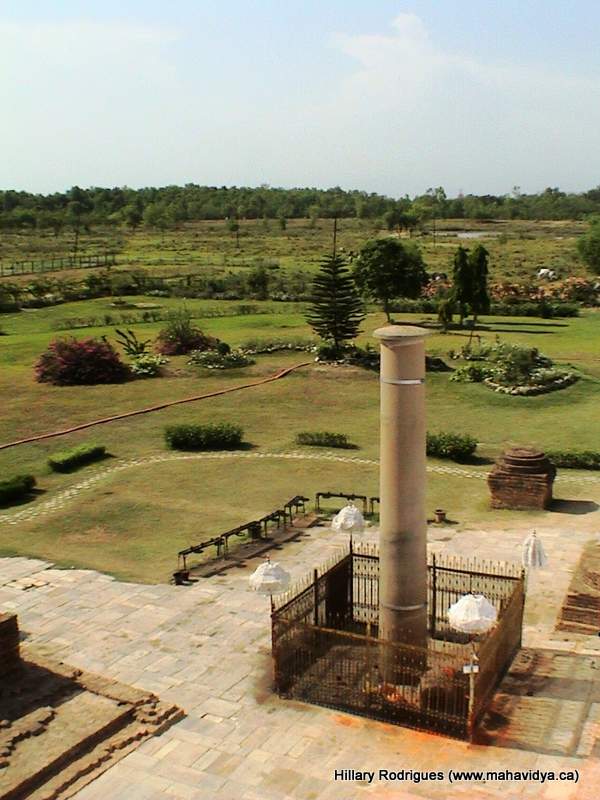
Asoka Pillar
Asoka Pillar (Lumbini, Buddha’s Birthplace)

Asoka is most well-known for is the creation of his vast number of stupas, monuments, pillars and rock edicts. The numerous inscriptions found on these various objects were mostly recorded by Asoka and provide the leading authentic history of events during his reign (Smith 20). There exists an exaggerated legend that Asoka erected eighty-four thousand stupas, a memorial mound containing relics of important persons, within the span of three years (Smith 107). The actual number of stupas is much smaller. The most important inscriptions made during Asoka’s reign were those found on the Major and Minor Rock Edicts and the Pillar Edicts; these inscriptions defined Asoka’s policy of Dharma (Thapar 2). The dharma ethics in these edicts are Buddhist rather than Brahmanical (Smith 30). There are fourteen major rock edicts located at Kalsi, Mansehra, Shahbazgarhi, Girnar, Sopara, Yerragudi, Dhauli and Jaugada; and various other minor rock edicts located throughout the country (Thapar 5). Asoka particularly enjoyed erecting large numbers of monolithic pillars, both inscribed and uninscribed, throughout his empire (Smith 116-117). Seven major pillars exist at Allahabad, Delhi-Topra, Delhi-Meerut, Lauriya-Araraja, Lauriya-Nandangarh and Rampurva (Thapar 5). It is because of the tales inscribed on the rock edicts that scholars have been able to authentically document the earliest events in Asoka’s reign, the conquest of the Kalingas, for example, and many more of the major events that occurred during his rule (Smith 24). The third and fourth major rock edicts describe the years 257 and 256 B.C.E. as the period of Asoka’s great advance in his spiritual development and religious policy (Smith 52). The final depictions that scholars have of the historical Asoka are found on the Minor Pillar Edicts, which describe “him as the watchful guardian of the unity and discipline of the Church which he loved” (Smith 67).

There is a great deal of evidence of various types available on the history of the Mauryan dynasty, particularly on Asoka’s life and reign during that period (Thapar 11). To consider all of the legends of Asoka would be an overwhelming task for this article, as there are stories about him in many different languages from many different sources (Strong 16). Some of these sources include texts such as the Asokavadana, the Divyavadana, the Mahavamsa and the Dipavamsa, the Asokasutra, the Kunalasutra, and the Puranas. The Asokavadana is a Sanskrit text which starts with details of the life of the elder Upagupta, a Buddhist monk who later plays a major role in Asoka’s career as ruler (Strong 16). The text then goes on to tell the entire Buddhist legend of Asoka’s life and his path to becoming a dharmic king. The legend includes several variations of how Asoka was introduced to Buddhism and how he spent his last years (Thapar 35 & 192). The efforts of many scholars to establish an accurate chronology of Asoka’s reign has resulted in the conclusion that the Asokavadana itself does not explicitly date events during Asoka’s life (Strong 12). The Asokavadana is said to be part of the Divyavadana, a voluminous Sanskrit anthology of Buddhist legends: some Chinese translations of the Asokavadana claim it is a separate, independent work of the Divyavadana (Strong 16). The Kunalasutra is another text that contains the same legends found in the Asokavadana but sheds a different light on these legends (Thapar 192). Kunalasutra’s authors did not compose the text to shape Asoka’s character in a particular way, but to document the legends as they were in local tradition (Thapar 193). The Dipavamsa and the Mahavamsa are Ceylon chronicles that describe in great detail the part Asoka played in expanding Buddhism in India, particularly to Ceylon (Thapar 8). It is important to note that many of the legends of Asoka written in Buddhist texts were written by Buddhist monks and therefore depict Asoka from an orthodox Buddhist standpoint.

REFERENCES AND FURTHER RECOMMENDED READING

Barua, B.M. (1968) Asoka and His Inscriptions. 2 vols. Calcutta: New Age Publishers.

Dasgupta, Surendranath (1975) A History of Indian Philosophy. 5 vols. Delhi: The University Press.

Davids, T.W. Rhys (1907) “Asoka and the Buddha Relics.” Journal of the Royal Asiatic Society,pp. 397-410.

Drekmeier, Charles (1962) Kingship and Community in Early India. Stanford: Stanford University Press.

Eggermont, P.H.L. (1956) The Chronology of the Reign of Asoka Moriya. Leiden: E. J. Brill.

Gokhale, B. G. (1966) Asoka Maurya. New York: Twayne Publishers.

­________ (1949) Buddhism and Asoka. Baroda: Padmaja Publications.

MacPhail, James M. (n.d.) Asoka. London: Oxford University Press.

Monier-Williams, Monier (1964) Buddhism in its Connexion with Brahmanism and Hinduism. Delhi: The Chowkhamba Sanskrit Series Office.

Mookerji, Radhakumud (1972) Asoka. Delhi: Motilal Banarsidass.

Nikam, N. A., McKeon, Richard, ed and tr (1959) The Edicts of Asoka. Chicago: University of Chicago Press.

Smith, Vincent A. (1997) Asoka: the Buddhist Emperor of India. New Delhi: Asian Educational Services.

Strong, John S. (1983) The Legend of King Asoka. Princeton: Princeton University Press.

Thapar, Romila (1997) Asoka and the decline of the Mauryas. Oxford: Oxford University Press.

Related Topics for Further Investigation

Dharma

Cakravartin

Chandragupta Maurya

Bindusara Amitraghata

Maurya Dynasty

The Buddha

Guatama (Historical) Buddha

The Rock Edicts

The Puranas

Mahavamsa

Dipavamsa

Asokasutra

Mahinda

Sanghamitta

Noteworthy Websites Related to the Topic

http://en.wikipedia.org/wiki/Ashoka_the_Great

http://www.humanistictexts.org/asoka.htm

http://www.imdb.com/title/tt0249371/

http://www.cs.colostate.edu/~malaiya/ashoka.html

http://www.infoplease.com/ce6/people/A0805027.html

http://www.bartleby.com/86/29.html

http://www.accesstoinsight.org/lib/authors/dhammika/wheel386.html

http://www.urbandharma.org/udharma/asoka.html

Article written by: Megan Hilton (March 2008) who is solely responsible for its content.

Ekadanta: The Single Tusked One

Ganesa, the son of Lord Siva and the Goddess Parvati, is known to Hindus as the Remover of Obstacles. He is the much loved, elephant headed, pot bellied deity with a penchant for sweets. He is one of the gods propitiated by students seeking assistance with their studies. Ganesa is known by many other names: Ganapati (Lord of the Multitudes), Vinayaka (Remover of Obstacles), Ekadanta (Single-Tusked One) and Gajanana (Elephant-Headed One) (Grimes, 41) just to name a few. He was Vyasa’s scribe when Vyasa dictated the epic The Mahabharata. He is best known as the guardian of Parvati’s private chamber, where his duties resulted in his receiving his elephant head. It was in a similar situation that his tusk was broken too, while he was guarding the door to his parents’ private chamber.

While there are a few stories of how Ganesa’s tusk came to be broken or severed, the most common one says that Ganesa received his broken tusk during a fight with Parasurama (one of Visnu’s avataras), while he was guarding the door for both of his parents, who were inside making love (Courtright 74). Parasurama was a great warrior of Siva’s, and had just returned victorious from war, having fought successfully against the demons, using an axe bestowed upon him by Siva. Siva had given Parasurama the axe with the caveat that it not be used in vain. When his attempt to enter the palace and the bedroom of Siva and Parvati was rebuked by Ganesa, Parasurama grew angry and the two exchanged words. Parasurama’s words were angry, while the words of Ganesa, as set out in the Brahmanda Purana and the Brahmavairvarta Purana, were even toned and matter of fact. Ganesa simply informed Parasurama that his parents Siva and Parvati were inside engaging in intercourse and that the entry by anyone would be most improper. Parasurama, offended at being reminded of the applicable dharmic obligations of the situation, grew more and more angry, and attempted to push past Ganesa, dismissing him. Ganesa jumped in front of him, blocking his way.

Further argument ensued at this point, and Parasurama raised the axe as if to throw it at Ganesa. Ganesa, seeing this, seized Parasurama with his trunk, “lowering him down through the seven regions of the world and finally down to the ocean at the innermost part of the earth until Parasurama became so frightened he wanted to die” (Courtright 75). Ganesa then raised Parasurama back up and set him back down on the ground. Due to his very frightening experience, Parasurama mistakenly thought Ganesa had defeated him. When he realized that he was standing once again before Ganesa in front of Siva’s palace, he flew into a rage and threw Siva’s axe at Ganesa. Ganesa, not wanting the axe to be thrown in vain, took the blow of the axe blade in his left tusk, severing it and causing it to fall to the ground. When the severed tusk struck the ground “all the worlds shattered and trembled with fear” (Courtright 25). The God Skanda (Ganesa’s brother), who had been sitting guard along with Ganesa when Parasurama had approached, as well as others present during this altercation, had created such a commotion that their noise in addition to that of the falling of the tusk drew Siva and Parvati from their chamber. Parvati, protective of her son whom she noticed had been injured, provided Siva with an angry redress for not immediately jumping to Ganesa’s defence, accusing him of having a preference for Parasurama over that of his own son. She seethed at Siva that “virtuous people take better care of their slaves than you do of me” (Courtright 76). At this, Siva said nothing. Parvati then took her children and left, still angry that Siva has once again rejected his own child.

Ekadanta (Giant Ganesha image displaying his broken tusk, near Kolhapur, India)

Parvati’s anger at Siva, and Siva’s quiet acceptance of that anger may provide some insight into the ideal that women are posses their own power in Hinduism. This would fall in line with other power-possessing Goddesses such as Kali, Tara or Sakti.

Another story of how Ganesa lost his tusk begins with Ganesa receiving many modakas (sweet, steamed coconut-poppy seed dumplings) from his devotees one evening. He ate so many of them that his belly grew very large and bloated. As Ganesa set off home, riding his mouse mount (musika), a snake slithered across his path. At the sight of the snake, Ganesa’s mount drew back in fear, causing Ganesa to fall to the ground where his sweet-filled belly broke open and all the sweets rolled out onto the ground. Ganesa got up, picked up his scattered sweets, and placed them back in his belly. He then killed the snake and used it to tie his belly closed.

While all this was going on, the moon was watching, amused. When Ganesa’s belly split open and the sweets rolled out all over the place, the moon laughed out loud at Ganesa’s predicament. Ganesa, one must remember, is often viewed as a child deity. Therefore, given his childlike status, it should come as no surprise that Ganesa grew angry, throwing a temper-tantrum at being the subject of the moon’s laughter, so angry in fact, that he plucked out his tusk and speared the moon through, causing darkness across all the land. It was not until the gods pleaded with Ganesa to restore the light of the moon that he did so, however, “only on the condition that the moon gain and lose its light by waxing and waning each month” (Courtright 81).

Ganesa’s removal of his own tusk is not restricted to just the story of his anger with the moon, he also removed it in his occupation as scribe to Vyasa. While he was transcribing the Mahabharata for Vyasa, his writing instrument broke, and without hesitation, he broke off one of his tusks and continued writing in accordance with the deal between the two that Ganesa would be Vyasa’s scribe so long as he would write without ceasing, and that Vyasa would dictate continuously (Grimes 76).

There has been some speculation by anthropologists and others, which suggests that Ganesa’s tusk is possibly representative of a lingam, especially so due to Ganesa’s paternity from Siva, who’s virility is embodied in his phallic emblem (Courtright 111). Further, it has also been suggested that it was an agent of Siva (or even Siva himself), who removed Ganesa’s tusk for the purposes of quasi-castration in order to jealously prevent Ganesa from approaching Parvati in an incestuous fashion, the quasi-castration having left Ganesa sexually ambiguous (Courtright 117). This would not be entirely unreasonable given the theme of Ganesa and Parvati’s close relationship throughout the myths. If it were the case then, that Siva was attempting to prevent Ganesa getting too close to Parvati by making him asexual, it would serve to further support the apparent continual denial of Ganesa by Siva which is evident throughout a great deal of the Ganesa myths. Siva is seen to act in either indifference or violence toward Ganesa, for example, by cutting off his head at the entrance to Parvati’s chamber, demanding, “don’t you know who I am?” or seemingly taking Parasurama’s side when he cuts off Ganesa’s tusk with the axe Siva had bestowed upon him.

One cannot help but feel sorry for Ganesa while reading his stories as he always seems to be on the receiving end of one misfortune or another, such as being beheaded by his father, having his belly split open and all his sweets falling out, or losing his tusk to a great warrior who is favoured by his father over him. However, given the necessity of balance in Hinduism, Ganesa likely must experience his obstacles before he can remove them.

Scholar and author John Grimes eloquently summed up Ganesa when he said: “Ganapati is a child, a god, an elephant, a siddha, four armed, and an enigma. He does exactly as he pleases. He is free. He is seen, but he is the seer. He sees what cannot be seen. He can be known, but he is the knower. He knows, but he knows nothing. His secret is that he is himself. His secret is that he is you. His secret is tat tvam asi” (Grimes 63).

References and Recommended Readings:

Brown, Robert L (1991) Ganesh: Studies of an Asian God. Albany: State University of New York

Courtright, Paul B. (1985) Ganesa: Lord of Obstacles, Lord of Beginnings. New York: Oxford University Press

Grimes, John A. (1995) Ganapati: Song of the Self. Albany: State University of New York Press

Krishan, Yuvraj (1999) Ganesa: Unravelling an Enigma. New Delhi: Motilal Banarsidass Publishers Private Limited

Michael, S.M. (1983) The Origin of the Ganapati Cult. Asian Folklore Studies, 42 no 1 1983, p 91-116

Seth, Kailash Nath. (19–) God & Goddess of India. New Delhi: Diamond Pocket Books Pvt. Ltd.

List of Related Terms:

Brahmanda Purana

Brahmavairvarta Purana

Ekadanta

Ganesa Gita

The Mahabharata

Musika

Parvati

Parasurama

Siva

Siva Purana

Skanda

Vyasa

Noteworthy websites related to the topic:

http://en.wikipedia.org/wiki/Ganesha

http://hinduism.about.com/od/lordganesha/a/ganesha.htm

http://www.himalayanacademy.com/resources/books/lg/lg_ch-10.html

http://en.wikipedia.org/wiki/Parvati

http://www.lotussculpture.com/parvati1.htm

http://en.wikipedia.org/wiki/Shiva

Written by Stacy Hill (Spring 2009), who is solely responsible for its content.

The Ellora Caves

The historically and archaeologically significant Ellora Caves are located near the city of Aurangabad, in the Maharashtra state. The Ellora Caves site is comprised of thirty-four temples and monasteries cut directly from the vast cliffs that surround the caves. The site exemplifies the Dravidian tradition of rock-cut architecture and art. The Ellora Caves were given UNESCO World Heritage site accreditation in 1983 (UNESCO). There is also evidence that the various caves have been used throughout history for Buddhist, Jain, and Hindu worship (Heston 219). The site culminates at the centre, where the vast Kailasanatha Temple sits in the middle of the courtyard area. Although the other thirty three caves are similarly intricate and interesting, the most is known about the Kailasanatha, or Kailasa Temple.

The caves are an excellent example of the Dravidian architectural tradition. The gopura, or gateway, at the Kailasa Temple [as well as at several of the other caves] is monumental to the study of Hindu religious architecture (Heston 219). In particular, the Kailasa gopura features numerous figural images that are extremely important to the Hindu tradition. The gopura is often seen as an indication to the worshipper as to what kinds of themes they may wish to consider upon entering the temple. Gopura sculptures typically depict guardian gods and goddesses, whereas depictions of other more important deities are reserved for the inside of the temple (Heston 220). This is an example a hierarchy within the Hindu tradition, where images such as one of a river guardian may be present at the gopura, but important imagery such as the linga, representing Siva, are present inside the temple. At Ellora, several lingas adorn the inner niches of the Kailasa Temple, along with other depictions of Siva, Visnu, and Brahma.

The use of several Hindu [as well as Buddhist and Jain] deities throughout Ellora, and particularly Kailasa, represents a certain unity present in many elements within the Hindu tradition. For example, one image in the niches of Kailasa depicts Harihara, a composite of Siva and Visnu together (Heston 223). Another example is a male and female fusion of Siva and his divine consort. This image is called the Ardhanarisvara, and represents the union of powers, or sakti, and could be based on the purusa-prakrti doctrine (Heston 225).

The Ellora Caves offer great insight into the development of Indian architectural traditions throughout the county, but particularly on the Indian subcontinent. There are other rock-cut cave sites that exist in India. Sites such as Elephanta and Kanheri offer additional insight into the realm of ancient architecture, but Ellora remains one of the more important sites (Chakrabati 327). Despite its designation as a UNESCO World Heritage site, the knowledge surrounding Ellora is still somewhat patchy. It is an immense challenge to try to piece together the historical context within which the Ellora Caves were constructed. From 1830 to 1861, excavating megaliths in southern India became very popular (Chakrabati 328). Many images and relics at Ellora [and other sites] were supposedly damaged during this time due to over-enthusiastic excavation (Chakrabati 328). After 1939, Indian universities became more interested in archaeology, the preservation of historical information, as well as pre-historic research endeavours. This contributed to existing theories about the history and context of the Ellora Caves.

The Ellora Caves are renowned for their exemplary rock-cut architecture. The caves and the images within were carved directly from the rock face of the staggering cliffs that surround the site. The time it must have taken the ancient architects to design and execute such a massive feat can only be imagined, especially when the dimensions of the site are taken into consideration. The Kailasa Temple alone, stands at the centre of the Ellora site, and measures 200 feet long, and 100 feet wide and high (Goetz 85). The entire site stretches even further towards the faces of the cliffs, making the feat of creating such a masterpiece very impressive. The Kailasa Temple, although it is not technically a cave, is one of the most important examples of ancient Indian art. Also carved directly from the rock face, Kailasa is a freestanding structure that sits in the middle of the enormous court surrounded by the wall of cliffs (Goetz 89). The Kailasa has been generally accepted to date back to the middle of the eight century of the Common Era (Goetz 89). This assertion is based on inscriptions present in Kailasa that indicate the temple was erected in honour of Krishnaraja (757-772 CE) of the Rashtrakuta Dynasty (Goetz 90). The courtyard walls surrounding the Kailasa Temple are generally accepted as being carved out later. These ties to the Rashtrakuta Dynasty are what help make Kailasa so important to Indian art history.

Although Kailasa is mainly credited to the Rashtrakuta Dynasty, scholars have accepted that it would have been impossible for the entire temple to have been finished under one ruler (Goetz 92). Not only would the construction of such a marvel be extremely time-consuming, but there is also the issue of the non-uniform nature of much of the imagery throughout Ellora. Due to India’s rich history of rock-cut architecture and other art, it is also near impossible to cross-reference the Ellora Caves with other sites such as Elephanta. The fact that few monuments survive from the time of the Rashtrakuta Dynasty suggests that it was a violent period in which temples were constantly changing hands, and therefore were re-appropriated over time. [By the tenth century of the Common Era, the Ellora site seems to have been occupied by the Jains (Goetz 92)]. It is currently accepted that Kailasa could not have been completed during the reign of Krishnaraja, even though he is the ruler who is thought to have commissioned the temple, and maybe even the entire site (Goetz 92).

Another important factor in determining the historical context within which the Ellora Caves were constructed is that rock-cut structures were built backwards. Normal temple construction began with the gateway, or gopura, and progressed into the rest of the temple afterwards. Rock-cut temples began with the construction of the inner rooms and builders would have worked towards the mouth of the cave, finishing with the gopura (Goetz 94). This concept is very useful in analyzing another of the major structures at Ellora, the Dasavatara cave. This cave houses fifteen inscriptions about Dantidurga (735-757 CE), who is thought to have been the founder of the Rashtrakuta Dynasty (Goetz 97). This would mean that Krishnaraja, although he had previously been credited with Ellora, could not be the mastermind. The chronology of the Dasavatara cave, along with the inscriptions and general styles of the images contained within, may prove that Dantidurga, not Krishnaraja, was the planner behind the Ellora Caves. Despite this evidence, Krishnaraja I is still credited with completing the Kailasa Temple, although his contribution to Ellora as a whole is still somewhat questionable. There are implications that Krishnaraja killed Dantidurga’s two sons, who would have been the rightful heirs to the Rashtrakuta Dynasty, and took power by force. This may be why Dantidurga’s contribution to the Ellora Caves seems somewhat covered-up, and Krishnaraja’s contributions glorified (Goetz 99)

BIBLIOGRAPHY AND FURTHER RECOMMENDED READING

Chakrabati, Dilip K (1982). “The Development of Archaeology in the Indian Subcontinent”. World Archaeology. Vol. 13, No. 3 – Regional Traditions of Archeological Research II. 326-344.

Goetz, H (1952). “The Kailasa of Ellora and the Chronology of Rashtrakuta Art”. Artibus Asiae. Vol. 15, No. 1/2. 84-107

Heston, Mary Beth (1981-1982). “Iconographic Themes of the Gopura of the Kailasanatha Temple at Ellora”. Artibus Asiae. Vol. 43, No. 3. 219-235

Markel, Stephen (2000). “The ‘Ramayana’ Cycle on the Kailasanatha Temple at Ellora”. Ars Orientalis. Vol. 30, Supplement 1: Chachaji – Prof. Walter M. Spink Felicitation Volume. 59-71

UNESCO (2002). “Ellora Caves: Description”. 2 February 2009.

Related Topics for Further Investigation

Purusa-Prakrti Doctrine

Linga

Siva

Visnu

Guardian Deities

History of Indian Philosophy

Rashtrakuta Dynasty

Elephanta

Kanheri

Megaliths

Dravidian Architecture

Noteworthy Websites Related to the Topic

whc.unesco.org

www.majavidya.ca

www.sacred-destinations.com/india/ellora-caves.htm

www.mtdcindia.com/Ellora/Ellora_Caves.htm

www.ajantaelloracaves.in

www.kamat.com/kalranga/deccan/rashtrakutas/7528.htm

www.britannica.com/EBchecked/topic/309775/Kailasa

Article written by: Evelyn Hickey (April 2009) who is solely responsible for its content.